



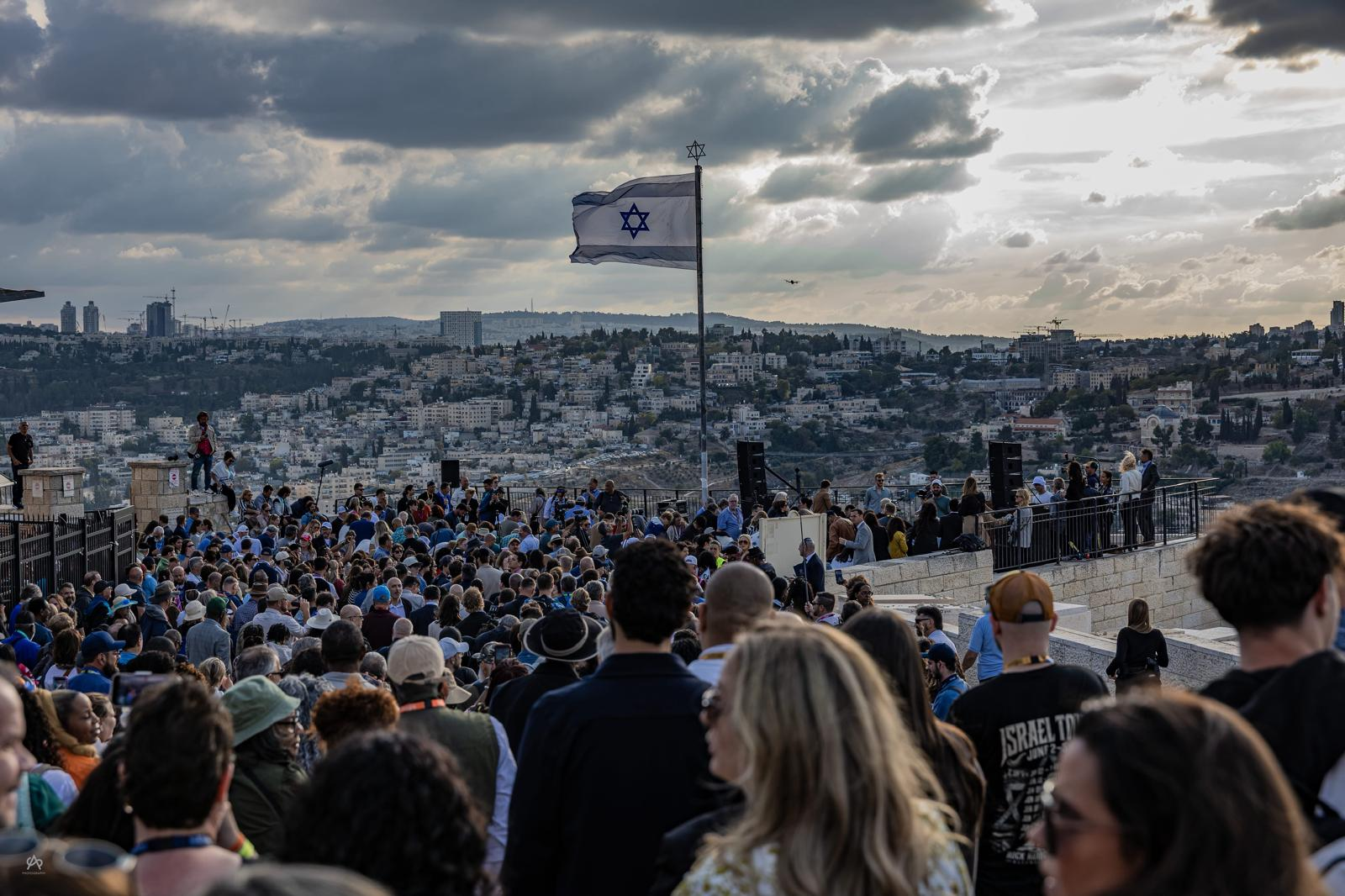
The Friends of Zion (FOZ) Ambassador Summit concluded on Tuesday after a week of memorials, testimonies, and diplomatic meetings across Israel. The summit, held for the second consecutive year in cooperation with Israel’s Ministry of Foreign Affairs, centered on an international October 7 memorial at Jerusalem’s Southern Wall and a 24-hour live broadcast from Jerusalem, the first of its kind.
According to FOZ, the broadcast reached more than 250 million people in 176 countries, and FOZ content generated more than 90 million views on social media over the past week. The broadcast reached audiences in countries with no diplomatic ties to Israel, recording 1.3 million views in Syria and 98,000 in Saudi Arabia. In Brazil, more than 8.5 million people tuned in after Senator Flávio Bolsonaro, a presidential candidate, publicly urged Brazilians to watch. Bolsonaro has pledged to move Brazil’s embassy to Jerusalem if elected.
The summit brought together over 1,000 participants from 122 countries and opened with an event on Jerusalem’s Mount of Olives. Dr. Mike Evans, founder of Friends of Zion, framed the gathering as a response to Israeli isolation. He told Fox News Digital that Israelis are suffering from the trauma of October 7 and also from the sense that they are alone and that the world has turned against them. Evans was blunt about where Israel’s support lies. “The vast majority of Zionists in the world are not Jewish,” he told Fox News, describing them as Bible-believing Christians.
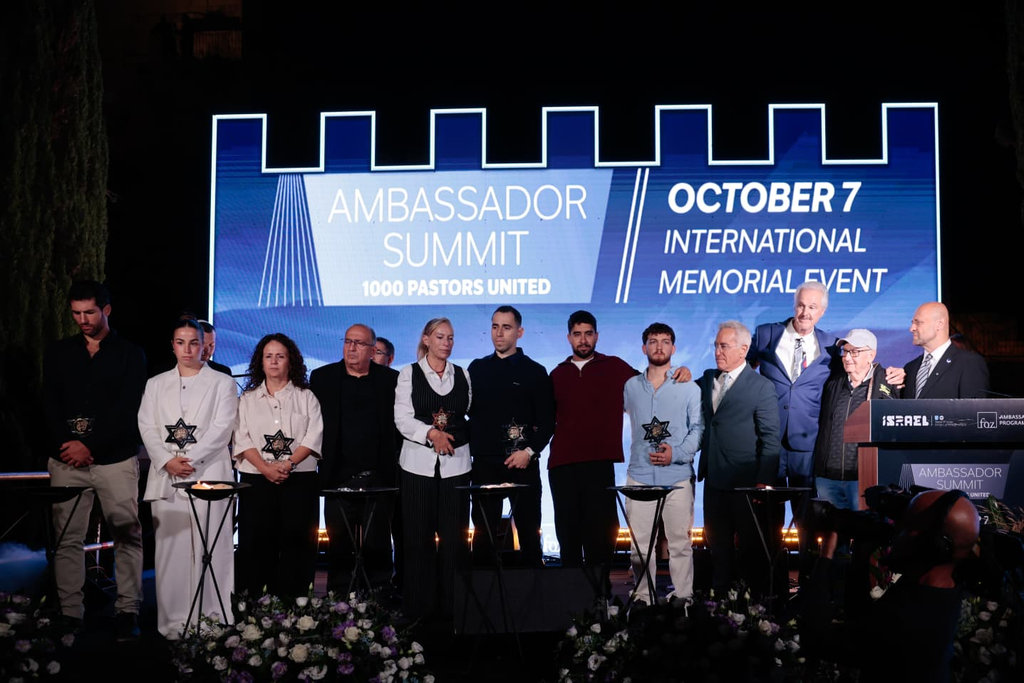
More than 2,000 people attended the memorial at the Southern Wall, including ambassadors, bereaved families, former hostages and wounded survivors. Evans led the event in partnership with Sylvan Adams, president of the World Jewish Congress Israel. Former hostages Evyatar David, Agam Berger, Sagui Dekel-Chen and Bar Kupershtein attended the ceremony. During the ceremony, Evans presented FOZ’s “Here Am I” Award to Yaniv Hayun, whom FOZ credits with helping thwart an attempted hijacking aboard a Flydubai aircraft and subdue the attacker.
Noa Argamani returned this week to the field near Re’im where Hamas terrorists seized her on October 7, 2023, in footage that the entire world watched in horror. It was her first visit to the Nova festival site since her abduction. She came to meet more than 1,000 Christian leaders and influencers who traveled to Israel to tell the Jewish people they do not stand alone.
At the Nova site, the delegation met former hostages Romi Gonen, Elkana Bohbot and Argamani, along with dozens of festival survivors and soldiers who fought there on October 7. Gonen, on her second visit since her release, described returning to the place where her life was irrevocably changed. Bohbot recounted his ordeal and his journey from captivity back to his family. FOZ presented the “Here Am I” Award to Gonen, Bohbot, Argamani, and Hila Abir, whose brother Lotan Abir was murdered at the festival.
Evans told Ynet that Friends of Zion has worked with hostage families since October 8, 2023, amplifying their stories internationally and supporting the families financially. “Our commitment is to be friends of Zion, all of Zion,” he said.
Over the week, participants visited Yad Vashem, the Old City, the City of David, Masada, ancient Shiloh, the Gaza border communities and the Galilee, and met with President Isaac Herzog, government officials, and diplomats.
Why would an award honoring freed hostages and a passenger who confronted an attacker in midair carry the name of a one-word Hebrew reply that Abraham spoke on the morning he was told to climb Mount Moriah?
The word is hineni, “here I am.” The phrase appears at the decisive moments of the Bible, when God calls, and a person answers with total readiness. Abraham says it when God calls him before the binding of Isaac (Genesis 22:1). Moses says it at the burning bush (Exodus 3:4). Rashi, the foremost medieval Bible commentator, explains that hineni “is the answer of the pious; it is an expression of humility and of readiness.” The word carries no conditions. The one who says hineni has already agreed before hearing the assignment.
The prophet Isaiah gives the word its most famous form:
“Then I heard the voice of the Lord, saying: ‘Whom shall I send, and who will go for us?’ Then I said: ‘Here am I; send me.'” (Isaiah 6:8)
Isaiah volunteered before he knew the mission, and the mission he received was to deliver a hard message to a people that would refuse to hear it. That is the hineni of the hostages who returned to the Nova site to speak, and of the bereaved sister who stood where her brother was murdered.
The location of the memorial adds another layer. The Southern Wall of the Temple Mount holds the remains of the Hulda Gates and the broad stone steps where Jewish pilgrims ascended to the Temple during the shalosh regalim, the three pilgrimage festivals of Passover, Shavuot, and Sukkot. The Mishnah records that “the two Hulda gates on the south served for entrance and exit” (Middot 1:3). For a thousand years those steps carried Jews up to the House of God. Isaiah foresaw a day when the nations would climb them too:
“And many peoples shall go and say: ‘Come ye, and let us go up to the mountain of the Lord, to the house of the God of Jacob; and He will teach us of His ways, and we will walk in His paths.’ For out of Zion shall go forth the law, and the word of the Lord from Jerusalem.” (Isaiah 2:3)
Three years after Hamas tried to erase the Jewish presence from the southern border, thousands of Christians from more than a hundred nations gathered at the foot of those pilgrim steps, during the week of Sukkot, the festival the prophet Zechariah declared the nations would one day come to Jerusalem to celebrate (Zechariah 14:16). They returned home carrying the testimony of Noa Argamani, Romi Gonen, and Elkana Bohbot to their congregations and followers.
Isaiah asked who would go. On October 7, 2026, the answer came in dozens of languages from the Southern Wall: hineni.

