



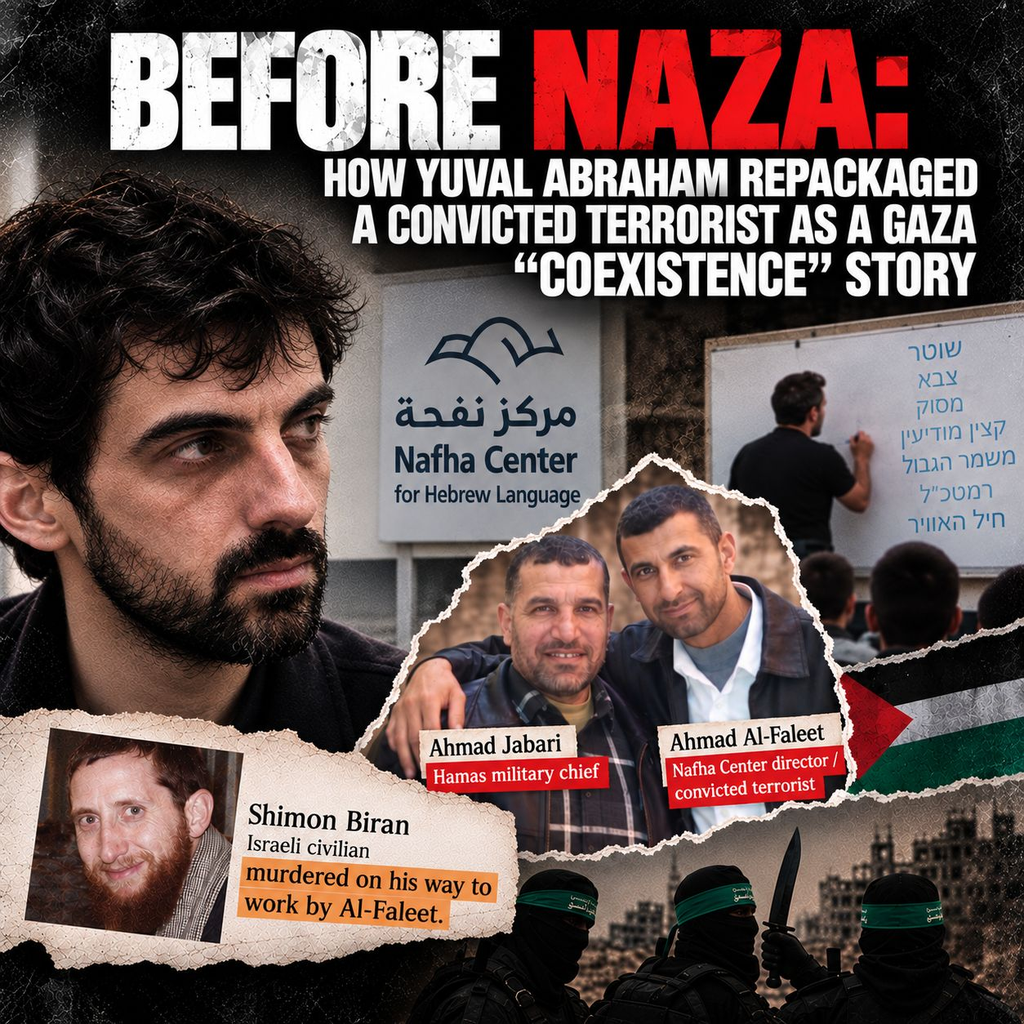
The Regavim Movement has released a previously unpublished investigation alleging that Yuval Abraham, the Oscar-winning Israeli filmmaker behind the Venice prize-winning documentary NAZA, presented a convicted terrorist as the face of Gaza coexistence in a 2020 web series and misidentified the man’s victim, a Gush Katif rabbi, as a soldier. The investigation documents how Ahmad al-Falit, the Gaza Hebrew teacher featured in Abraham’s report, reenacted the 1992 stabbing murder of Rabbi Shimon Biran on camera, praised senior Hamas commanders, and celebrated the October 7 massacre online.
The release comes as NAZA, which accuses the IDF of knowingly killing large numbers of civilians in Gaza, faces a detailed rebuttal from the military, a counter-documentary by IDF reservists, and criticism from legal experts who say the film misrepresents the laws of war.
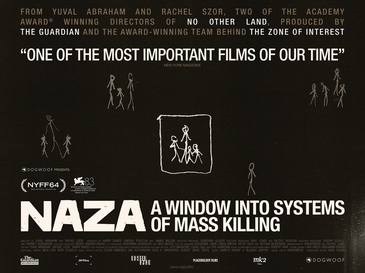
NAZA, directed by Abraham and Rachel Szor and produced by The Guardian, won the Special Jury Prize at the Venice Film Festival in September. The title is the Hebrew acronym for nezek agavi, “collateral damage.” Built on anonymous testimony from Israeli intelligence personnel, the 80-minute documentary alleges that the IDF knowingly killed large numbers of civilians in Gaza. The film has drawn a detailed rebuttal from the IDF, a counter-documentary from IDF reservists, and criticism from legal experts and Israeli journalists.
“Come Learn Hebrew in Gaza!”
In 2020, Abraham created Shasheh (“Screen”), a 13-episode web series produced under the Van Leer Jerusalem Institute’s Ofek project and the Forum for Regional Thinking. The fifth episode, first posted on July 20, 2020, profiled the Nafha Center, which it called the first Hebrew-language school in Gaza. The school is run by Ahmad al-Falit and named after Nafha Prison, where he served his sentence.
“Come learn Hebrew in Gaza! Welcome to the Nafha Center, the first Hebrew-language school in the Strip,” the show’s page told followers. The comments were glowing. “Only cultural and positive initiatives like this can bring peace between Israelis and Palestinians,” one viewer wrote. “The cultural impact of such gestures far outweighs any military action!”
The episode described al-Falit as a “former prisoner who spent 20 years in Israeli prison for killing a soldier his own age.” After public criticism, the Forum for Regional Thinking added a correction to its post: “Contrary to what was said in the video, in the version without subtitles, al-Falit murdered a 32-year-old Israeli civilian and not a soldier.” According to Regavim, the Van Leer Institute never made the correction.
Rabbi Biran was the rabbi of Kfar Darom and a father of four. After the 2005 expulsion of the Jews of Gush Katif, his body was moved and reburied on the Mount of Olives in Jerusalem.
“A Stone, a Knife or a Gun”
Moran Tal, Regavim’s Arabic-language open-source intelligence researcher, found the material the episode left out. Much of it had been published by al-Falit himself or by those celebrating him.
In a 2015 video report, al-Falit returns to the site of the murder. The video introduces him as a “Qassami,” a member of Hamas’s Izz al-Din al-Qassam Brigades, who “crossed the border of the former settlement of Kfar Darom” and killed “the settler rabbi” with knife stabs. al-Falit says he planned the attack for two months. He reenacts how he sat at the bus stop and stabbed Rabbi Biran three times. He says it took about 20 seconds before residents noticed, that one of them ran him over, and that a soldier shot him as he fled. He recalls that a helicopter was sent to try to save the rabbi, who was already dead.
According to the report, al-Falit said he deliberately chose a knife because stabbing attacks strike more fear into Israelis than shootings. At minute 4:47 of the video, he delivers a message:
“Everyone should know — and this is my message to the whole world — we are a people under occupation, and every people under occupation has the right to resist that occupation by any means: whether it’s a stone, a knife, or a gun. All means are legitimate.”
“The Day We Were Reborn”
Al-Falit was freed in October 2011 in the Gilad Shalit exchange, which Hamas calls Wafaa al-Ahrar, “Loyalty to the Free.” In that deal Israel released 1,027 prisoners in return for one kidnapped soldier. In a TEDx talk in Gaza’s Shujaiya neighborhood, al-Falit told the audience, “When people ask me how old I am, I say I am four years old. I was born the day I left my prison cell.”
He marks the anniversary every year. “On this day, seven years ago, we were reborn — after spending so long in the graves of the living,” he wrote in 2018, dedicating the post to “the martyred leader, the mastermind of the ‘Loyalty to the Free’ deal, Ahmad Saeed Jaabari,” the commander of Hamas’s military wing, and to “all those who took part” in the 2006 operation in which Shalit was abducted. In November 2017, he posted a photo of himself with his arm around Jaabari to mark the fifth anniversary of the Hamas commander’s death.
He also posts the date of the murder itself. On May 27, 2019, he uploaded a photo of himself wounded on the day of the attack. The caption read “27 years have passed — O Lord, praise be to You,” followed by a prayer for the release of all prisoners.
His feeds praise Nael Barghouti, who murdered bus driver Mordechai Yekuel in 1978, and Hassan Salameh, the Hamas commander serving 47 life sentences for the suicide bombings on Jerusalem’s Line 18 bus and at a hitchhiking post near Ashkelon that killed 46 people. When six terrorists tunneled out of Gilboa Prison in September 2021, al-Falit wrote, “The sun of their freedom has risen. May Allah protect the heroes who carved through rock — literally — to secure their release.”
“The Only Language You Understand Is Resistance”
The Nafha Center’s own pages carried the same message in Hebrew. In one video, a student named Dina Ahmad addresses Israelis while masked men brandish knives on screen.
“You are just a group of people expelled from all over the world. It’s time to put a stop to you,” she says. “Sadly, the only language you understand is resistance — because you don’t understand any other language, including the language of peace… So get out of our land.”
The center’s Facebook page also published a message from Salameh.
Abraham’s own episode showed what the students were learning. The classroom board listed “intelligence officer,” “Border Police,” “Chief of Staff,” and “IDF.” Al-Falit was filmed asking his students what “attack helicopter” means, and one student said she uses Hebrew to follow Israeli news during wartime. The class studied a Hebrew news article about the terrorist sentenced for killing IDF officer Eliav Gelman at the Gush Etzion Junction.
In 2021, after the IDF struck the Gaza building that housed the Nafha Center, Dr. Assaf David, director of the Forum for Regional Thinking, reshared the episode. He described the school as a place where “a Hebrew school was teaching kids like Omar, age eight, to say ‘thank you very much’ in Hebrew” and wrote, “Language doesn’t exist in a vacuum. It has speakers, and they have lives. If you want to teach language, instill some empathy. Just a little.” His post did not mention the school director’s conviction for murder.
October 7
A week before the massacre, al-Falit’s center was taking registrations for a 100-hour “Diploma in Israeli Studies,” run with Palestine University in Gaza. The course covered Israel’s military, military intelligence, and ‘Israeli’ security agencies and their branches,’ and it opened on September 30, 2023. Details of the course were published by Hassan Eslaiah, the Gaza photographer who entered Israel with the Hamas terrorists on October 7. Al-Falit called Eslaiah his “brother and loyal journalist friend.”
On October 7, al-Falit’s Telegram channel, which has about 11,800 subscribers, followed the massacre in real time. He posted footage of young people running from the Nova music festival: “Dozens of settlers fleeing from the fighters who opened fire on them during a party in the south — with many wounded.” He celebrated Hamas leader Muhammad Deif’s announcement of “Operation Al-Aqsa Flood.” He shared a map taken from one of the terrorists and wrote, “Everything was planned.” He tracked the dead: “Official statistic from the occupation: the number of those killed in Operation ‘Al-Aqsa Flood’ has risen today to 1,200 — and the number keeps climbing.” He circulated images of the bodies of murdered IDF soldiers and tracked rocket alerts against “the settlers in the Golan.”
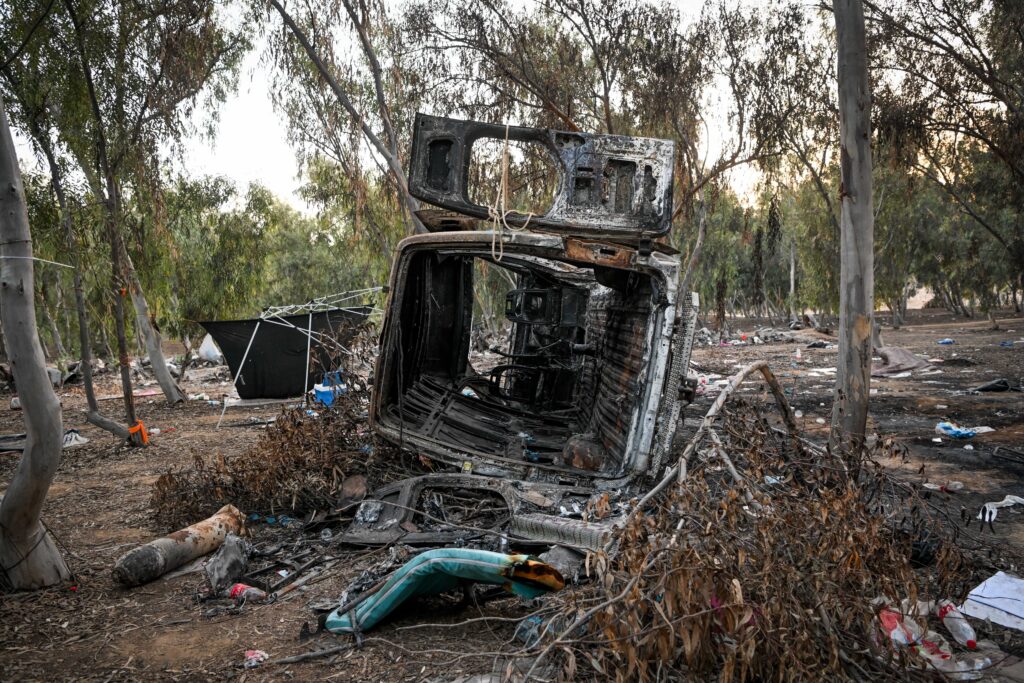
On October 11, 2023, he posted a prayer for Gaza in which a voice can be heard pleading, “Allahumma ‘alayka bil-Yahud,” “Oh Allah, bring destruction upon the Jews.”
“Distorted, Misleading and Disingenuous”
Abraham’s new film faces many of the same questions about sourcing and context. On October 1, the IDF released a 10-page response in English and a 17-page version in Hebrew. The army said NAZA “presents a distorted, misleading and disingenuous picture of the IDF’s target planning and striking process.” IDF Chief of Staff Lt. Gen. Eyal Zamir called its allegations “blood libels.”
The IDF said it “has never planned, approved or carried out any strike in Gaza in which 500 civilians” were expected to be killed. It also said “artificial intelligence has never independently selected targets to strike in the IDF.” It said the system called Lavender “is not a database of targets approved to strike, but a database that assists intelligence analysts.” According to the army, the film’s interviewees describe only the early intelligence stages of target selection, so their claims about the full approval process amount to speculation. The IDF also accused the filmmakers of manipulative editing and of ignoring October 7 and Hamas’s practice of embedding itself among civilians. It said they never gave the army the allegations to respond to before publication, and refused its request for a screening copy.
The Guardian said its 24 participants worked across intelligence, operations and final authorization, and that it interviewed more than 100 sources.
The Lawyer’s Verdict
International lawyer Natasha Hausdorff, legal director of the UK Lawyers for Israel Charitable Trust, said the film gets the law exactly backwards. She spoke in a UKLFI interview based on published reports and promotional material, before she had seen the film.
“The central premise of the whole documentary is an inversion of the law of armed conflict,” Hausdorff said. “The laws of war require law-abiding armies to calculate and approve estimated civilian casualties.”
She explained that the rule of proportionality prohibits an attack only when the expected civilian harm would be “excessive in relation to the concrete and direct military advantage anticipated.” She added, “An expectation of no incidental harm whatsoever isn’t a legal standard at all. It’s a fantasy.”
“Anticipating and calculating potential civilian harm is the very mechanism by which a military complies with the rule of proportionality,” she said. “A commander who launched a strike without making that assessment would be in breach of international law, not in compliance with it.”
Hausdorff pointed to what the film leaves out: “the warnings given to civilians ahead of strikes on a scale that no military has previously attempted. Leaflets, broadcasts, messages, individual telephone calls made to the occupants of particular buildings… strikes refused authorization, modified, aborted because of civilian presence. And if the object of the exercise really were to kill as many civilians as possible, why on earth would any of that be happening?”
The film’s title makes her point for her. “It isn’t an Israeli invention. It’s the law, and it’s precisely intended to minimize excessive harm to civilians,” she said. “Pre-strike collateral damage estimation is a standard practice in every law-abiding Western military that includes American and NATO forces.”
She called the film’s central allegation, a strike approved with up to 500 expected civilian deaths, “a serious failure of journalistic practice.” She said the claim was made “with no date, no location, no target, no operational record and no means by which anybody anywhere can establish whether the person making it was in any position to know.” She noted that in January 2025, some 20 months before the film premiered, the IDF had already published that no strike aimed only at a single Hamas commander was authorized where more than 100 people were expected to be endangered.
On the film’s claims about artificial intelligence, Hausdorff offered a simple test: “A machine doesn’t call off its own strike. So if a mission can be halted or postponed or changed on the strength of a harm assessment, then somebody is still exercising judgment at the point of decision, and that somebody is a human being.”
She said the film’s 24 anonymous witnesses deserve “very little” evidential weight. “These accounts are unverified in every respect that actually matters. We don’t know who these individuals are. We don’t know what roles they held. And we don’t know whether they are who the filmmakers say they are.”
She also said the film removes Hamas from the picture. “When you’re shown the aftermath of a strike with the military objective that was inside the building removed from the frame, you’re being shown half a photograph,” Hausdorff said. “And the incentive that this creates is frankly grotesque because it tells every terrorist organization watching that embedding yourself among civilians works.”
Lt. Col. (res.) Sarit Zehavi, who says she helped build the IDF’s civilian-casualty estimation system, made the same point. “Noting the collateral damage on the target sheet does not signify an intention to kill civilians,” she wrote. “They could have simply interviewed me.”
Raviv Drucker, an investigative journalist at Channel 13 and a frequent critic of the Netanyahu government, said he would not have aired the film himself, citing “no supporting evidence” publicly available to confirm the testimonies.
Edited Quotes and Unmatched Footage
The media watchdog HonestReporting found that the film cuts President Isaac Herzog’s October 12, 2023 press conference to show him saying, “It’s an entire nation out there that is responsible.” The film leaves out his answer moments later, when a reporter asked whether civilians were legitimate targets: “No, I didn’t say that. I did not say that, and I want to make it clear.”
HonestReporting also found that one witness’s description of watching a family before a strike is shown alongside rescue footage that the film never connects to that incident. It found that an estimate of 80 residents in a building becomes “80 dead” with no casualty records, and that in at least one interview it was Abraham who raised the word “genocide,” with the witness then agreeing.
The Soldiers Answer: NAZA: The Real Story
Three Israelis answered the film with one of their own. Lt. Col. (res.) Roi Danino, who served more than 600 days of reserve duty with the Nahal Brigade during the war, made the film with Maj. (res.) Ariel Averbuch, an attorney and co-founder of Sword of Gideon, and director Hagay Gutman. NAZA: The Real Story runs 49 minutes and was filmed at night on Tel Aviv rooftops, the same setting NAZA used.
The NAZA interviewees are anonymous. The Real Story’s commanders and intelligence officers appear on camera under their own names. They describe Hamas terrorists in civilian clothes, hostages held inside family homes, the diversion of aid trucks and the IDF’s rules for opening fire. The film is free to watch online, and its website reports more than 33 million views.
For Omer Shem Tov, who spent 505 days as a Hamas hostage in Gaza, the film’s title carries a different meaning. Describing what it was like to be held in Gaza during Israeli airstrikes, he wrote, “As a former hostage, those minutes felt like a shower of knives… perhaps I am NAZA too. Collateral damage.”
From No Other Land to NAZA
This is not Regavim’s first challenge to Abraham’s work. After No Other Land, which Abraham co-directed, won the 2025 Academy Award for Best Documentary Feature, Regavim released footage from Masafer Yatta in the south Hebron Hills. The footage showed provocations that were left out of scenes the film presented as Israeli aggression. Regavim also published research challenging the film’s portrayal of the area and took part in No Other Lie, a Daily Wire documentary that returned to Masafer Yatta to fact-check the Oscar winner.
“Yuval Abraham is once again asking international audiences to place enormous trust in his reporting, his sources and the context he chooses to present,” Regavim said in a statement. “Years ago, our researchers examined another story he told from Gaza. We found that the civilian victim had been described as a soldier, while publicly available material showed the man at the center of the story reenacting the murder, defending knife and gun violence and praising terrorists.”
“Abraham wants to be treated as an investigative journalist, but this record gives the public every reason to see an ideological activist whose reporting repeatedly serves a deeply political narrative,” the statement continued. “Turning a convicted terrorist into the sympathetic face of a ‘coexistence’ story while his victim becomes a ‘soldier’ is whitewashing, plain and simple. Before the world accepts Abraham’s latest claims about Israel at face value, it should take a much harder look at the journalist making them.”
Regavim compiled the research several years ago and never published it in full. The full investigation, “Before NAZA: How Yuval Abraham Repackaged a Convicted Terrorist as a Gaza ‘Coexistence’ Story,” is available on Regavim’s website.


