



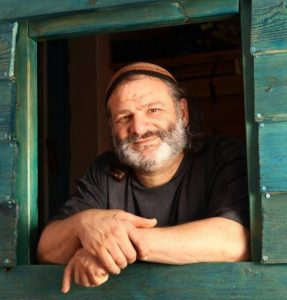
Jewish tradition teaches of two Messiahs. Mashiach ben Yosef (Messiah son of Joseph) fights the wars that open the redemption, and Mashiach ben David (Messiah son of David) reigns as king. In a recent lecture, Rabbi Mendel Kessin, a leading teacher of Jewish eschatology, revealed a third: Mashiach ben Dan, the Messiah from the tribe of Dan, a figure he described as God’s special forces, sent to live inside Satan’s fortress and drag back what the Jewish people lost there.
“Probably 98% of the Jews are not aware of this topic,” Rabbi Kessin said. “It appears prominently at the end of time, and it demonstrates the infinite love that God has for the Jews. The Zohar refers to him, the Arizal and other kabbalists, as the Messiah son of Dan.”
Rabbi Kessin framed the lecture, the sixth in his series on God’s conduct at the ketz (the End), around a single question. “Why do you need a third messiah? In fact, why do we even need two messiahs? I would imagine one redeemer should be sufficient.”
The Sparks in Satan’s Hands
The answer begins in the Garden of Eden. Rabbi Kessin explained that every mitzvah (commandment) grants the Jew control over nitzotzot kedusha (sparks of holiness), the Divine energy that will transform Olam Hazeh (this world) into Olam Haba (the World to Come). After Adam accepted the serpent’s argument, God tied Satan’s very existence to those sparks.
“The only way the Satan can survive is if he gets those sparks,” Rabbi Kessin said. “If the Jew does the mitzvah, the sparks go to him. If the Jew sins, the sparks go straight to the Sitra Achra (the Other Side). So the Satan lives by the sins of the Jews. We and the Satan are in eternal combat.”
The two familiar Messiahs divide the work. Mashiach ben David brings down the sparks still in Heaven. Mashiach ben Yosef fights to retrieve the sparks trapped in the kelipah, the “shell” of evil.
“When Adam sinned, he created the need for Mashiach ben Yosef,” Rabbi Kessin said. “You need a Messiah that can fight with the Satan and not sin.”
The Iron Yoke
The burden, Rabbi Kessin explained, proved too heavy for one man. A midrash in Pesikta Rabbati, cited in Yalkut Shimoni (Isaiah 499), describes God offering Mashiach ben Yosef a choice at the dawn of creation. Many Jews would sin without repenting, and their sparks would remain with Satan, barring them from the World to Come. The Messiah accepted suffering on their behalf, for his own generation, for every Jew who lived before him, and even for infants who died. God placed an iron yoke on his neck, and the Messiah cried out, “Am I not flesh and blood?”
The mechanism rests on the unity of the Jewish people as a single body. “If the arm suffers, then the whole body suffers,” Rabbi Kessin said. “God has created a mechanism where it’s possible for one Jew to suffer for others.” The condition is that the sufferer be righteous, with no sins of his own to atone for, so that his pain counts entirely for others.
According to the same source, the Patriarchs later approach this Messiah and tell him he is greater than they are.
Rabbi Kessin explained what that suffering entails. Extracting sparks from Satan’s domain requires a soul of the highest righteousness to live inside the kelipah itself, under constant, overwhelming temptation.
“They have to battle the Satan in the kelipah, in his hotel. They move in with him,” he said. “They literally are put in his embrace. Their temptation to sin is abnormal, whether it be promiscuity, idolatry, or food. It requires a Superman of middot (character) and righteousness to survive.”
He quoted the Hasidic master known as the Yehudi HaKadosh of Peshischa, who taught that Mashiach ben Yosef learns Torah each day and forgets it by the next. “Imagine taking someone with the potential of the Vilna Gaon and keeping him an ignoramus,” Rabbi Kessin said.
Enter the Navy SEAL
That mission explains Mashiach ben Dan.
“Many of the Mashiach ben Yosef figures failed,” Rabbi Kessin said. “So it was decided: I need special forces. I can’t just send Yosef in. Not if it’s inside the kelipah. If you’re outside and every once in a while you’re battling the Satan, okay. But if I put you inside next to him, are you going to survive?”
“You ever hear of the Green Berets? When the army can’t do it, they send in special forces,” he continued. “Mashiach ben Dan is a Navy SEAL. He’s a person equipped for extraordinary sacrifice and suffering because he has tremendous gevurah (strength). He works for Mashiach ben Yosef. They’re really a team.”
Rabbi Kessin said the Zohar gives this Messiah his name: Sari-yah, meaning “Prince of God.” “That’s the only one you can send down,” he said, “because he can’t be responsible for his own sins. It’s got to be for the sins of the Jewish people.”
He named Esau as the first candidate for the role. Rashi (Genesis 25:22) records that whenever Rebecca passed a house of idolatry, the unborn Esau struggled to emerge. “How can an embryo have a desire to worship idols?” Rabbi Kessin asked. “That means you’re in the kelipah.” Esau possessed enormous spiritual power. Rabbi Kessin cited the Talmudic sage Rabban Shimon ben Gamliel, who said that he was the greatest in his generation at kibbud av v’em (honoring father and mother), yet Esau surpassed him, because Esau dressed in his finest garments whenever he served his father Isaac. “The hardest thing for an arrogant man is to submit to his parents,” Rabbi Kessin said. “That shows you the gevurah, the incredible strength.” He also cited the Paneach Raza (Revealer of Secrets), a 13th-century Torah commentary, which teaches that had Esau been righteous, he would have been twice as great as Jacob, fathering six of the tribes of Israel while Jacob fathered the other six. “Esau was no pushover,” Rabbi Kessin said. “And he failed utterly.”
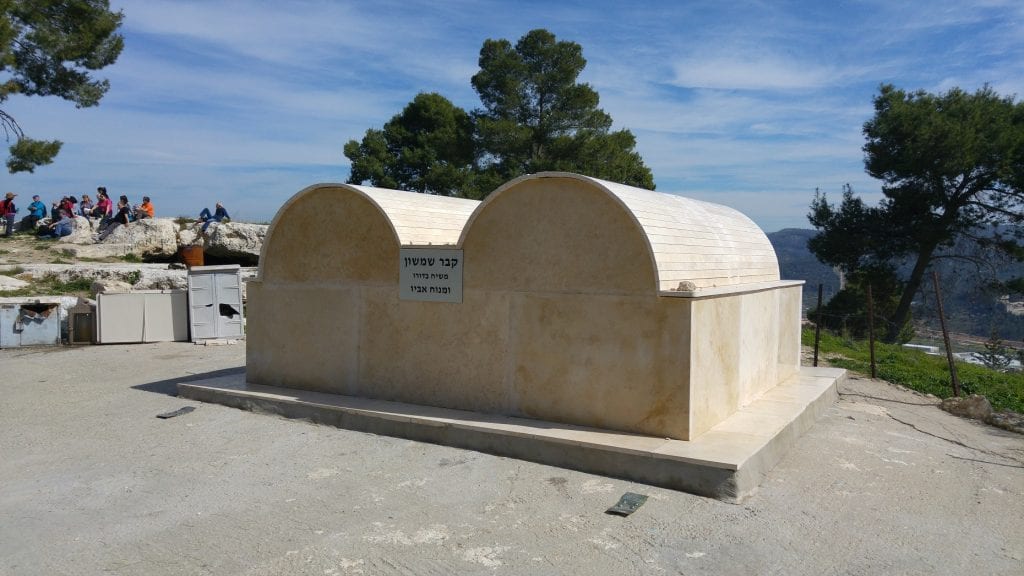
Samson came closer. “Samson was Mashiach ben Dan,” Rabbi Kessin said. “He wasn’t strong because he worked out in the gym. His strength represented the enormous psychological strength he needed to fight the Philistines and the Satan. He almost succeeded in stopping the Satan.”
The Suffering Messiah
Christian readers know the idea of a Messiah who suffers for the sins of others through Jesus. The Jewish sources Rabbi Kessin cites place that suffering on Mashiach ben Yosef and his partner from Dan, and the Bible gives that figure a face in Samson.
Samson’s life matches the pattern. Before his birth, an angel told his mother that her son “shall begin to save Israel out of the hand of the Philistines” (Judges 13:5), a mission to begin the deliverance, with its completion left to others. Samson lived his life entangled with the enemy, drawn again and again to Philistine women, the very people he was sent to fight. Delilah betrayed him, and the Philistines gouged out his eyes and set him grinding grain in the prison of Gaza. Blind, chained, and mocked in the temple of their god Dagon, Samson called out:
“And Samson called unto the LORD, and said: ‘O Lord GOD, remember me, I pray Thee, and strengthen me, I pray Thee, only this once, O God, that I may be this once avenged of the Philistines for my two eyes.'” (Judges 16:28)
Samson brought down the pillars and died together with the enemy, and the Bible records that the dead he slew at his death outnumbered those he slew in his life (Judges 16:30). The warrior who lived in the house of the enemy delivered his greatest blow at the moment of his death.
Rabbi Kessin promised that the next lecture will name the men who carried this role through history and explain how they fell. “It’s a fascinating story that 99% of the Jewish people never heard of,” he said. “But I think we’re very close to the exposure of Mashiach ben Dan.”
Why would God draw this warrior from Dan, the tribe Jewish history associates with idolatry, the tribe that housed the idol of Micah and one of Jeroboam’s golden calves?
The Serpent on the Road
The answer lies in Jacob’s deathbed blessing to Dan, the source Rabbi Kessin cites for Samson:
“Dan shall be a serpent in the way, a horned snake in the path, that biteth the horse’s heels, so that his rider falleth backward. I wait for Thy salvation, O LORD.” (Genesis 49:17-18)
Rashi explains that Jacob saw Samson in this vision, and that Jacob cried out for God’s salvation because he foresaw Samson’s death at the hands of the Philistines. The tribe destined to fight the original serpent bears the image of a serpent itself. The Midrash (Numbers Rabbah 2:7) records that Dan’s tribal banner in the desert displayed a snake. The fighter who enters Satan’s domain carries the nature of the enemy he must defeat.
The Bible also assigns Dan the exact role Rabbi Kessin describes. When the Israelites traveled through the wilderness, the camp of Dan marched last as me’asef (the gatherer) of all the camps (Numbers 10:25). Rashi explains that Dan, the most numerous tribe, traveled at the rear and returned anything the other tribes lost along the way. The tribe of Dan was the Bible’s lost-and-found, appointed to recover what others dropped.
The Sages also note that God paired Dan with Judah in building the Mishkan (Tabernacle). Betzalel came from Judah, the royal tribe, and his partner Oholiav came from Dan. Rashi observes that God placed the lowest of the tribes beside the highest. The tribe of Judah produces Mashiach ben David, and the tribe of Dan produces the warrior who descends into the depths so the king can build.
Jacob’s blessing ends with a cry for salvation. The tribe of Dan, marching at the very back of the camp, gathers the last of the lost. When the final spark returns from Satan’s hands, every Jew enters the World to Come, and the gatherer at the rear of the camp becomes the reason the redemption arrives in full.