
One of the most repeated statements in Israel today is that the IDF desperately needs more soldiers. After years of war, reserve duty, casualties and exhaustion, the argument seems self-evident: Israel has a manpower shortage, and therefore tens of thousands of Haredim who currently do not serve must be drafted. Perhaps. But before tearing Israeli society apart over the conclusion, perhaps we should question the premise.
This is hardly academic. The Haredi draft has become one of the central political issues in Israel and a defining issue of the coming election. Soldiers and reservists who have carried an extraordinary burden understandably ask why they and their children should repeatedly be sent into battle while tens of thousands of other young Jewish men remain in the beit midrash. Haredim respond that Torah study is itself essential to Jewish survival and that military service can threaten the religious character of their communities.
But what if we are beginning the discussion one question too late? Before asking how many more Haredim the IDF should draft, perhaps we should first ask: Does the Jewish army actually need more soldiers—or does it need the right soldiers?
The Torah’s description of an army preparing for battle is remarkable. Someone who built a new house and has not dedicated it returns home. Someone who planted a vineyard and has not enjoyed its fruit may leave. A man who betrothed a woman and has not yet married her may also return. Finally comes perhaps the most astonishing exemption: “Who is the man who is fearful and fainthearted? Let him go and return to his house” (Devarim 20:8). Imagine running the IDF that way today. From the perspective of modern manpower planning, it sounds absurd. Yet that is precisely how the Torah describes preparing the Jewish army for battle.
Chazal make the point even more striking. Rabbi Yosi HaGelili explains in Mishnah Sotah that the “fearful and fainthearted” soldier is afraid because of the sins in his hands. The Torah is concerned not merely with the soldier’s physical ability but with his spiritual condition. The objective is therefore not simply to assemble the maximum number of bodies carrying weapons. The Torah demands something more: a machaneh kadosh—a holy camp.
This point was brought home to me recently by a Haredi yeshiva student. After discussing this Mishnah, he challenged me: “How can you serve in the IDF? Do you think you’re without sin?” My answer was simple: “No. I’m far from perfect. Indeed, I am waiting for the day when all the holy yeshiva students volunteer for military service. But until then, someone has to fill the ranks.”
There is more than humor in that exchange. If we take Rabbi Yosi HaGelili seriously, the Torah’s ideal is hardly that the holiest Jews remain safely behind while the less religious do the fighting. One could reach precisely the opposite conclusion: the greater the spiritual demands placed upon the Jewish military camp, the greater the argument for filling it with people deeply committed to Torah and mitzvot.
“For Hashem your God walks in the midst of your camp, to save you and to deliver your enemies before you; therefore your camp shall be holy” (Devarim 23:15). Holiness and military victory appear in the same verse. If Hashem’s presence within the camp is part of the Torah’s conception of victory, perhaps the question is not how religious Jews can possibly enter the army, but how a Jewish army can fulfill its Torah ideal without them.
And here lies an irony difficult to ignore. Tens of thousands of Haredim—Jews who define themselves as trembling before the word of Hashem—represented by political parties defining themselves specifically as religious, seek exemptions in order to preserve their Torah way of life. Yet the army envisioned by the Torah is itself supposed to be profoundly religious. The Torah’s ideal is not an army from which religious Jews must flee to remain religious. It is an army whose camp itself is holy.
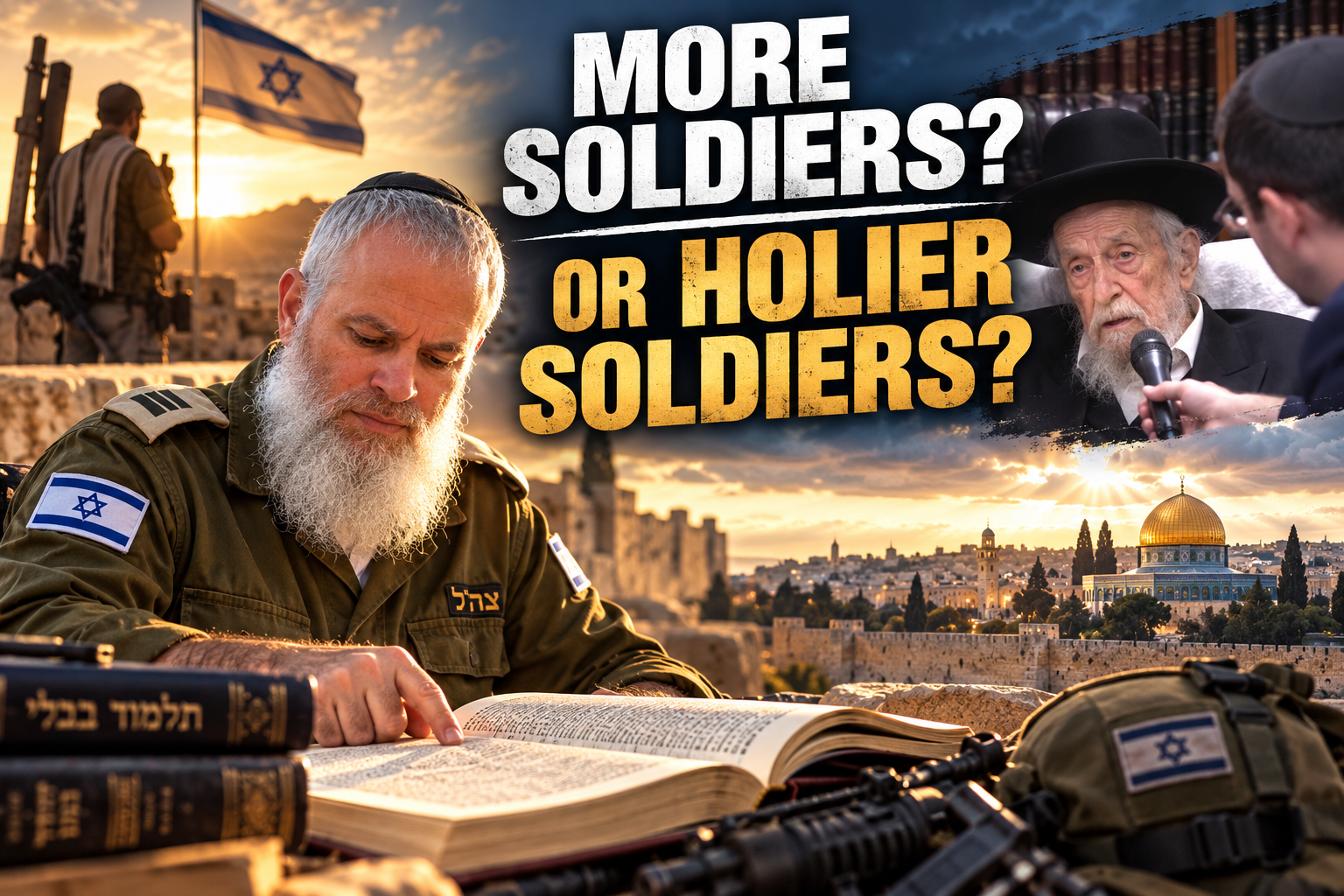
We do not have to imagine whether serious Torah commitment and serious military service can coexist. The National Religious community has been disproportionately represented among Israel’s combat soldiers, commanders and fallen during the recent war, particularly in combat units and the officer corps. Many came through Hesder yeshivot and other Religious Zionist Torah institutions. I know this model personally because I served in Hesder myself. Hesder is built upon a proposition that should be perfectly natural in a Jewish state: intensive Torah study and defending the Jewish people are not contradictory values. A young Jew can carry a Gemara into the beit midrash and a rifle into battle.
The tension was illustrated recently in a remarkable televised exchange with Rav Dov Landau, one of the most senior leaders of the Haredi world. He was challenged with a deceptively simple question: What about religious soldiers who both learn Torah and serve? His response maintained the traditional Haredi emphasis on Torah study as the essential protection of the Jewish people. But the question itself goes to the heart of the debate. Why must Torah learning and defending Am Yisrael be presented as mutually exclusive when thousands of religious Jews demonstrate that they are not?
Hesder soldiers may spend years immersed in Torah, put on a uniform to defend Am Yisrael, learn while serving and then return to the beit midrash. Perhaps putting on that uniform to protect Jewish lives is not leaving the world of Torah at all, but part of living it.
Something may even be beginning to shift within Haredi society. A new political party, HaTzibur HaHaredi—“The Haredi Public”, is contesting the election on a platform that defends genuine full-time Torah study while advocating structured service for others through frameworks designed to preserve Haredi religious life. Some of its voices, including Anglophone olim, are familiar with integrating work, civic life and uncompromising Torah commitment. Current polling gives the party little prospect of crossing the electoral threshold, but perhaps its significance is not measured in seats. Its existence suggests an emerging Haredi voice asking not simply whether a Haredi Jew should serve, but how he can serve while remaining uncompromisingly Haredi.
Perhaps part of the difficulty is that we are still viewing Jewish sovereignty through the mentality of exile. For nearly two thousand years, Jews developed an extraordinary religious civilization without a Jewish army or sovereign state. The beit midrash became our fortress, and survival often meant keeping our sons away from armies. In Galut, the Torah scholar and soldier naturally inhabited different worlds because the soldier generally served someone else’s king, government and national interests.
But Geula changes that reality. For the first time in nearly two thousand years, a young man can leave the beit midrash, put on a Jewish uniform, defend Jerusalem and his fellow Jews, and then return to his Gemara. Geula demands something more difficult than simply transferring the shtetl to Eretz Yisrael. It requires us to relearn how Torah governs a nation: how Jews farm the Land, administer justice, exercise political power and, when necessary, wage war.
It is relatively easy to imagine holiness inside a beit midrash. Geula demands that we create holiness in a government ministry, a farm, a courtroom and, yes, an army camp. The Torah commands, “והיה מחניך קדוש” — “Your camp shall be holy.” The challenge is not to choose between the camp and holiness. The challenge is to make the camp holy.
Of course, the prophetic destination is a world in which “לא ישא גוי אל גוי חרב ולא ילמדו עוד מלחמה” — “Nation shall not lift up sword against nation, neither shall they learn war anymore” (Yeshayahu 2:4). But we are plainly not at that final stage. Until the nations put down their swords, the Jewish people cannot put down ours. The ultimate aspiration is a world without warfare; it does not require Jews to remain defenseless while their enemies are still armed.
Nor is the combination of holiness and military prowess a modern Religious Zionist invention. King David, the sweet singer of Israel and ancestor of Mashiach, was also an extraordinary warrior. The same David who declared, “Hashem is my shepherd” could say, “Blessed is Hashem, my Rock, Who trains my hands for battle and my fingers for war” (Tehillim 144:1). There was no contradiction.
Shimshon teaches the same lesson differently. His extraordinary strength was not simply the product of muscle; Tanach repeatedly tells us that the Ruach Hashem came upon him. When his hair was cut and his strength departed, “he did not know that Hashem had departed from him” (Shoftim 16:20). His muscles were still there. What had departed was the Divine source of his strength.
Anyone familiar with Israeli soldiers should appreciate the point. Some extraordinarily capable combat soldiers hardly resemble the stereotypical image of massive commandos. Military effectiveness cannot be measured with a bathroom scale or tape measure. Training, courage, intelligence, cohesion and willingness to sacrifice matter more than appearance. Tanach takes the lesson further: even those qualities are not independent of their Divine source.
The Torah explicitly warns against forgetting this: “כֹּחִי וְעֹצֶם יָדִי” — “My strength and the might of my hand” (Devarim 8:17). The next verse reminds us that Hashem is the One Who gives us the strength to achieve. Likewise, Zechariah declares: “לֹא בְחַיִל וְלֹא בְכֹחַ כִּי אִם בְּרוּחִי” — “Not by might and not by power, but by My spirit” (Zechariah 4:6). Judaism does not command us to possess no strength. We train soldiers, acquire weapons, develop technology and fight with everything we have. The danger begins when we confuse the instrument with the Source.
Gideon demonstrates this principle dramatically. Preparing to fight Midian with thousands of soldiers, Hashem tells him: “The people who are with you are too many…lest Israel glorify itself against Me, saying, ‘My own hand saved me’” (Shoftim 7:2). Twenty-two thousand leave, then the force is reduced again until only 300 remain. Gideon’s 300 do not teach us that 300 is the ideal size of an army. They teach us that even an army can become spiritually dangerous when its strength convinces Israel, yadi hoshiah li—“my own hand saved me.”
None of this means Israel does not need soldiers, weapons, training or technology. Of course it does. Nor does it dismiss the enormous burden carried by Israel’s soldiers and reservists or the serious question of shared national responsibility. The Torah itself commands Israel to wage war and establishes laws governing soldiers and military camps. But the army is an instrument. It is not the ultimate source of Jewish salvation.
Perhaps this is where the Haredi draft debate needs to change direction. Instead of asking only how the state can fit more Haredim into the existing military structure, Israel should also ask how the military can create structures in which deeply committed Torah Jews can serve without surrendering their religious commitments. Hesder has demonstrated that serious Torah study and serious military service can coexist. The challenge is to develop models capable of meeting Haredi religious requirements as well.
If we took the Torah’s military model seriously, the paradox might almost be reversed. Those most committed to Torah should not appear alien to the Jewish army; they should seem like its most natural soldiers. The aspiration should not be an army that becomes less religious as more religious Jews enter it, nor religious communities that become less religious because their sons defend Am Yisrael. The more Torah Jews who serve, the more Torah should enter the Jewish army with them.
Perhaps Israel therefore does not simply need a bigger army. Perhaps it needs a holier army—one that understands why it fights, whose soldiers know whom they represent, and in which Torah study and military service are not treated as mortal enemies. As politicians make the Haredi draft one of the defining questions of the coming election, perhaps we should first ask a more fundamental question: What kind of army does the Torah actually want the Jewish people to have? Only then can we properly ask whether Israel needs more soldiers—or whether Hashem expects us to build better and holier ones.