



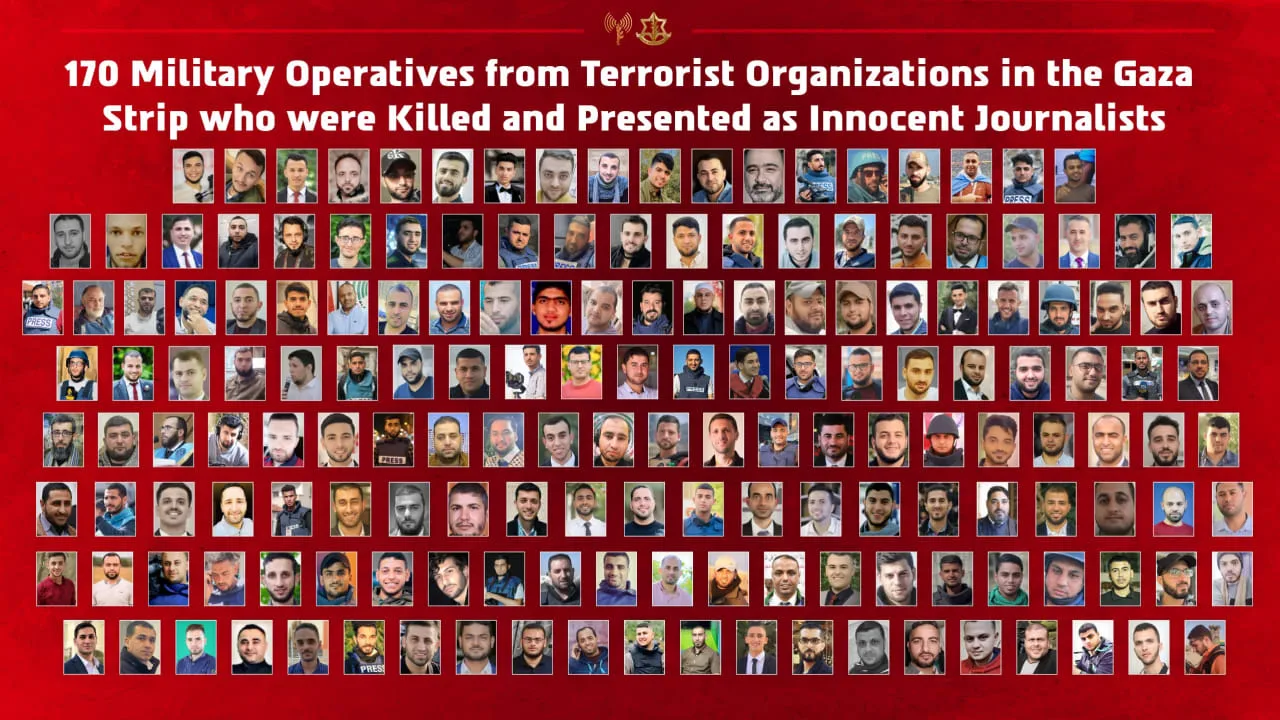
The IDF on October 1 published the names, military ID numbers, and captured personnel records of 170 Gazans killed in the war who were mourned worldwide as journalists while serving in Hamas, Palestinian Islamic Jihad, and other terrorist organizations. The list includes stringers for Reuters, the Associated Press, CNN and the BBC, four Al Jazeera correspondents, and 17 men who took part in the October 7 massacre. The release confirms warnings that Israeli researchers, media watchdogs and officials have issued since the first weeks of the war, while international news organizations, the UN and press freedom groups cited the same deaths as proof that Israel deliberately targets reporters.
Amro Abu Odeh took pictures for Reuters and Turkey’s Anadolu Agency. In one photograph released by the IDF last week, he holds a camera. In another, he holds a Kalashnikov. According to the IDF, he was a team commander in the photography unit of Hamas’s military wing, and both tools served the same employer.
Abu Odeh is one of 170 Gazans the world mourned as slain journalists whom the IDF has now identified, by name, military ID number and captured Hamas paperwork, as members of terrorist organizations. The list, published on October 1 under the title “The Press Files,” includes stringers for Reuters, the Associated Press, CNN and the BBC, four Al Jazeera correspondents, and 17 men who took part in the October 7 massacre.
The release is the most detailed exposure yet of a deception Israel and independent researchers have documented since the first weeks of the war, one that the international media brushed aside for three years.
The Press Files
Of the 170 names, 118 served in Hamas’s military wing and 49 in Palestinian Islamic Jihad (PIJ). The remaining three belonged to smaller terrorist factions, including the Popular Resistance Committees. Seventeen took part in the October 7 massacre, and the IDF said the deaths of more than 40 of them drew condemnations of Israel from the United Nations.
Each profile lists a Hamas or PIJ military ID number, a civilian ID number, the outlets the man reportedly worked for, and the post he held. The posts include snipers, intelligence operatives, engineers, trainers, squad commanders and members of propaganda and “combat information” units. Many entries carry scans of terrorist personnel rosters captured by IDF soldiers in Gaza, with English translations. The IDF said its evidence came from open-source material, documents seized in the field and interrogations of captured terrorists.
“Today, we are exposing the truth,” said IDF Spokesperson Brig. Gen. Effie Defrin. The 170, he said, “were presented as innocent journalists” but “were in fact terrorists.”
The site itself opens with a reminder that journalists “are expected to report the unbiased truth,” and states that these men hid their own roles in terrorist organizations. In its statement, the IDF said international media outlets had accused Israel of deliberately harming journalists “without presenting verified findings.” In some cases, the IDF added, the terrorist organizations themselves claimed the dead men “as their own.”
That last point carries the case. The IDF said it built the list after noticing a pattern in which Hamas and PIJ published martyrdom notices for slain “media workers” that acknowledged their service in the military wings. Much of the evidence in the Press Files was written by the terrorists themselves.
Stringers for the West
According to the IDF, men on the list had worked for Reuters, CNN, ABC News, the Associated Press, Agence France-Presse, the BBC, Le Monde and Australia’s ABC. Others worked for Hamas and PIJ outlets such as Al-Aqsa Media Network, Shams News Agency and Palestine Today, whose output fed the same global news stream.
Abu Odeh is the clearest example. Another is Hassan Majdi Abu Warda, who reported for the Barq Gaza news agency while serving as a sniper in PIJ’s Northern Gaza Brigade. Muhammad Abd al-Aziz Nagar, according to the IDF, crossed into Israel on October 7 and was later presented to the world as a journalist, with no mention of his membership in Hamas’s military wing.
The BBC was already in trouble before the IDF published a word. In late September, the British Telegraph reported that 53 of the more than 180 people listed by BBC Arabic as journalists killed in the war had ties to Hamas or other terrorist groups. Forty-three appeared only on BBC Arabic, and ten were also described as journalists by the BBC’s English-language service. Terrorist organizations published death notices for at least 20 of them.
One was Rizq Abu Shakian, whom the BBC described as a journalist for Palestine Now. He appeared in a video wearing Hamas military clothing and carrying an automatic rifle. Another was Yaqoub al-Barsh, whom the BBC identified as an executive at Gaza’s Namaa radio station and whom Hamas’s Qassam Brigades listed among their “martyrs.” Both men appear in the IDF’s Press Files.
The BBC said it was reviewing the list, which it said was last updated in August 2025 and covered journalists killed “regardless of their media outlet’s political affiliations.” Rebecca Paul, Britain’s shadow culture secretary, told the Telegraph the disclosures were part of “a long-running problem with impartiality and accountability” at BBC Arabic.
Al Jazeera’s Correspondents
The Press Files hit Qatar’s Al Jazeera hardest. Four of its Gaza correspondents appear on the list.
Anas al-Sharif was the network’s most familiar face in northern Gaza and shared in the 2024 Pulitzer Prize for wartime photography. The IDF lists him as a company-level officer in the Artillery Company of Hamas’s Northern Gaza Brigade, military ID 305342. Captured documents show he enlisted in Hamas at 17 and led a rocket-launching cell. He was killed on August 10, 2025, in a strike on a tent near Shifa Hospital, and his death set off a wave of international condemnation.
Ismail al-Ghoul appears as a Hamas military operative in the Gaza Brigade. According to Israel’s Meir Amit Intelligence and Terrorism Information Center (ITIC), he was a member of Hamas’s nukhba commando force who took part in the October 7 massacre and trained terrorists in how to film the fighting. Before joining Al Jazeera, he worked for the Hamas-affiliated papers Felesteen and al-Resalah.
Hamza al-Dahdouh, son of Al Jazeera’s Gaza bureau chief Wael Dahdouh, appears as a PIJ military operative in the Gaza Brigade. The evidence posted with his profile is a captured roster of PIJ’s electronic engineering unit. Hossam Shabat, the fourth, had posted photos of himself in the green-and-white scarf of Hamas’s student movement, as the New York Times reported in 2024.
None of this is new to Al Jazeera. In October 2024, the IDF published captured personnel tables, training-course lists and salary records naming six of the network’s Gaza reporters, including Sharif and Shabat, as Hamas and PIJ members. Al Jazeera called the material “fabricated evidence.” Ten months later, Sharif was dead, and today the same documents appear in the Press Files.
The IDF also released captured Hamas documents showing coordination between the terrorist group and the network’s management. In one 2022 document, Hamas instructed Al Jazeera on how to cover a failed PIJ rocket launch that killed Gazan civilians, telling it to avoid the word “massacre” because Israel was not responsible. According to the document, the network agreed. The ITIC called the material “incontrovertible proof” of systematic coordination between Hamas and Al Jazeera.
The network’s own Arabic website supplied more evidence on October 7 itself. It published an account by Ismail Abu Omar, a former photographer for Al-Aqsa TV, a Hamas station the U.S. Treasury sanctioned in 2010, describing his entry into an Israeli community during the massacre. According to the report, the first thing he did was shout the takbir, “Allahu Akbar.” He told the site he was experiencing the scenes he had always heard about, “live and directly.” That day he posted video on Telegram that appears to show him alongside the invading terrorists, along with signed photographs of slain IDF soldiers inside Israel.
The Photographer Who Crossed the Fence
The most damaging name on the list belongs to a man the world’s largest news organizations were warned about in November 2023.
On November 8, 2023, the media watchdog HonestReporting published a report asking what Gaza freelancers working for AP, Reuters, CNN and the New York Times were doing at the border fence at dawn on October 7. Four names appeared on AP’s photo credits from the border area that morning: Hassan Eslaiah, Yousef Masoud, Ali Mahmud and Hatem Ali. Reuters published pictures from two more, Mohammed Fayq Abu Mostafa and Yasser Qudih.
Eslaiah, who also freelanced for CNN, crossed into Israel, photographed a burning Israeli tank, and then photographed the terrorists entering Kibbutz Kfar Aza. HonestReporting then surfaced a 2020 photo of Eslaiah being kissed by Yahya Sinwar, the architect of the massacre. Hatem Ali filmed Hamas terrorists dragging an Israeli man into Gaza.
The Prime Minister’s Office called the photographers “accomplices in crimes against humanity.” The Government Press Office demanded explanations from the bureau chiefs of all four outlets. AP and CNN said they would stop working with Eslaiah.
The outlets denied everything else. “Reuters categorically denies that it had prior knowledge of the attack or that we embedded journalists with Hamas on Oct 7,” the agency said. The New York Times called the accusation that anyone at the paper had advance knowledge “untrue and outrageous.” Eslaiah denied any advance knowledge and any link to Hamas. Under pressure, HonestReporting said it had only raised questions.
The Press Files answer them. Hassan Eslaiah is Hassan Aslih, the English spelling of his name having varied from outlet to outlet. The IDF lists him as a Hamas military operative in the Southern Khan Yunis Battalion who infiltrated Israel on October 7, and it published the captured Khan Yunis Brigade roster bearing his name. The ITIC reports that he founded the Alam24 news agency in 2022, entered Israel during the massacre, documented the atrocities and posted them online. He was killed in a targeted strike at Nasser Hospital in Khan Yunis on May 13, 2025.
The freelancer AP and CNN dropped in 2023, while the press treated questions about him as a smear; he was a member of the brigade that invaded southern Israel.
Three Years of Warnings
The Press Files confirm what researchers have been publishing since the second month of the war.
In December 2023, the ITIC issued a report titled “Photojournalists in the service of Hamas in the Gaza Strip.” In February 2024, it found that more than half of the Gaza journalists killed to that point were affiliated with terrorist organizations. Its update on December 11, 2025, examined 266 people listed as slain media personnel and found that at least 157, about 60 percent, belonged to or were affiliated with terrorist groups: 104 with Hamas and 45 with PIJ.
The ITIC reported that during the October 7 massacre, “some Hamas-affiliated journalists received advance notice of the attack,” reached the border and entered Israeli communities to broadcast live. It noted that the dual role “is not new,” and that reporters in earlier Gaza wars also served as armed terrorists.
In July 2026, the Jamestown Foundation, a Washington research institute that tracks terrorism worldwide, went further. Its Terrorism Monitor reported that the number of terrorists using the journalist label as cover was documented “in the several dozens.” It concluded that Gaza journalists may have been “generally required to be Hamas or PIJ members in order to operate in the Strip.” Jamestown also noted that at least 30 percent of the roughly 200 journalists counted by the Committee to Protect Journalists (CPJ) worked for outlets CPJ itself describes as “Hamas-affiliated.”
Jamestown highlighted Ibrahim al-Sheikh Ali, killed on December 26, 2024, in a strike outside Al-Awda Hospital. At the time, Al-Quds Today reported that journalists had been killed in a marked press vehicle. Israel said the dead were PIJ terrorists posing as journalists. More than a year later, PIJ itself named Sheik Ali a commander. He appears in the Press Files.
Then came Motaz Azaiza. The Gaza photographer, named to TIME’s list of the 100 most influential people of 2024, gave a three-hour interview to the Arabic podcast Taqarob in September. Asked whether the media campaigns out of Gaza were spontaneous, he answered: “No. They were never spontaneous.” He described a WhatsApp group called “Smart,” run by a Hamas media official, and said every journalist in Gaza was in it.
“Photographers in Gaza have become accustomed to lowering their cameras the moment someone says something bad about Hamas,” Azaiza said. He also admitted withholding footage he shot on October 7 of a Gaza mob beating Israeli hostages. He later insisted the group was simply a channel for updates from the Hamas government, and that membership did not mean belonging to Hamas.
A Sniper on a Press Freedom Memorial
The deaths of these men became evidence in the international case against Israel.
In December 2023, Reporters Without Borders (RSF) filed a complaint with the International Criminal Court accusing Israel of deliberately targeting civilian journalists. The complaint named Asem al-Barsh, a reporter for Palestinian Al-Rai Radio, and made no mention of his membership in Hamas’s military wing, the Jerusalem Post reported. RSF later engraved the name of Mohammed Abu Sharia, reported as a journalist for Shams News Agency, on a memorial to journalists killed between June 2024 and June 2025. According to the IDF, Abu Sharia was a sniper in PIJ’s Gaza Brigade.
In 2024, UNESCO Director-General Audrey Azoulay condemned the killing of Mohammed Abu Armana, whom the IDF identifies as commander of the propaganda department in Hamas’s Rafah Brigade. The IDF counts more than 40 names on its list whose deaths drew UN condemnations.
Several of the 170 appeared in CPJ’s database of journalists killed in Gaza, the figure cited in nearly every accusation that Israel was hunting reporters. CPJ has since removed names after they were exposed as terrorists. In June 2026, CEO Jodie Ginsberg said CPJ “condemns in no uncertain terms the misrepresentation of combatants as journalists.” The Algemeiner reported that CPJ dropped another 22 names in late September.
CPJ still describes Israel’s conduct as the deadliest effort to kill and silence journalists it has ever documented.
Cameras Down
The journalists in Gaza who were not terrorists worked under terrorist rule, and CPJ documented the price of independence.
In May 2025, CPJ published testimonies from Gaza journalists who described intimidation, threats and assaults by Hamas. “There are major violations committed by the Hamas government and group against journalists,” Nasser Abu Bakr, head of the Palestinian Journalists’ Syndicate, told CPJ. The syndicate withholds most of the testimonies it collects for fear of reprisals.
Veteran journalist Tawfiq Abu Jarad said Hamas operatives beat and questioned him in Rafah in November 2023, accusing him of covering calls for a coup. Mohammed Abu Aoun, a correspondent for the Fatah-affiliated Awda TV, said Hamas’s Internal Security Force beat him in 2024 while he interviewed a woman in Deir al-Balah who insulted Hamas leaders on camera. Other reporters told CPJ that Hamas security agents blocked them from certain areas and followed them as they worked.
Foreign correspondents faced the same rules in the 2014 war, according to testimonies compiled by Israel’s Foreign Ministry. “We have received clear directions that if we see Hamas launching or shooting rockets, we cannot record them,” Norwegian TV 2 reporter Pål T. Jørgensen reported from Gaza. Doing so, he said, could mean expulsion, and their local fixers would be “in grave trouble.”
An Indian NDTV crew aired footage of Hamas assembling and firing a rocket beside its hotel only after leaving the Strip, explaining that Hamas had “not taken very kindly” to reports of its rocket fire. Italian journalist Gabriele Barbati waited until he was out of Gaza, “far from #Hamas retaliation,” to report that a misfired terrorist rocket had killed children in the Shati camp. Dutch reporter Monique van Hoogstraten wrote in Trouw that uniformed Hamas men sat at Shifa Hospital to monitor the foreign press, adding, “Local camera crews know this, but foreigners do not.”
Hamas said so itself. In 2014, Isra al-Mudallal, head of foreign relations in Hamas’s Information Ministry, complained on Lebanon’s al-Mayadeen TV that foreign reporters were filming rocket launch sites. “These journalists were deported from the Gaza Strip,” she said. The Foreign Press Association condemned Hamas that week, reporting that foreign journalists in Gaza had been “harassed, threatened or questioned” over their reporting.
“Quite the Journalist You Are”
The IDF launched the Press Files with a fight. On the eve of the release, it posted a video of commentators accusing Israel of targeting journalists, including British broadcaster Piers Morgan saying the IDF “has killed over 200 Palestinian journalists and tries to pretend they’re all Hamas.” The video also featured Mehdi Hasan, Owen Jones and Hasan Piker. The IDF tagged them and asked, “This you?”
Morgan replied that he did not trust the IDF “to be entirely truthful given your ongoing ban on international journalists reporting freely in Gaza.” The IDF answered: “Spread lies, get called out, and then try to change the topic. Quite the journalist you are.” It invited him to look at the evidence.
Morgan’s point about access is accurate as far as it goes. Israel has barred foreign journalists from entering Gaza independently since October 2023, permitting only escorted trips with the IDF. The Foreign Press Association has petitioned the Supreme Court twice, and at a January 2026 hearing the state argued that independent access would endanger soldiers operating in the Strip.
His conclusion collapses on contact with the evidence. Much of the Press Files rests on martyrdom notices published by Hamas and PIJ themselves, which Morgan can read from London. The Telegraph exposed the BBC’s list without setting foot in Gaza. And the last time foreign reporters worked freely in the Strip, Hamas told them what they were forbidden to film and expelled the ones who filmed it anyway.
With foreign correspondents absent, the world saw Gaza through local cameras. The Press Files show who was holding many of them.
The Report Stands Corrected
For three years, the claim that Israel hunts journalists filled op-ed pages, UN statements and complaints to the International Criminal Court. It rested on a casualty count that included snipers, rocket-cell commanders, propaganda chiefs and men who crossed the fence on October 7. The warnings came in November 2023, December 2023, February 2024, October 2024, December 2025 and July 2026. The newsrooms and press freedom groups dismissed each one until Hamas and PIJ began confirming the names in their own martyrdom notices.
In 2024, the Foundation for Defense of Democracies called on U.S. authorities to investigate Al Jazeera’s cooperation with Hamas and to determine whether the Qatari network should face terrorism sanctions. The Press Files make that demand harder to ignore. They also leave Reuters, AP, CNN and the BBC with a question their readers deserve answered: how many of the images that shaped the world’s view of this war came from members of the organization that started it.
In Gaza, the witnesses joined hands with Hamas, and the world’s most powerful newsrooms accepted their testimony for three years. The Press Files have now delivered the other side.

