




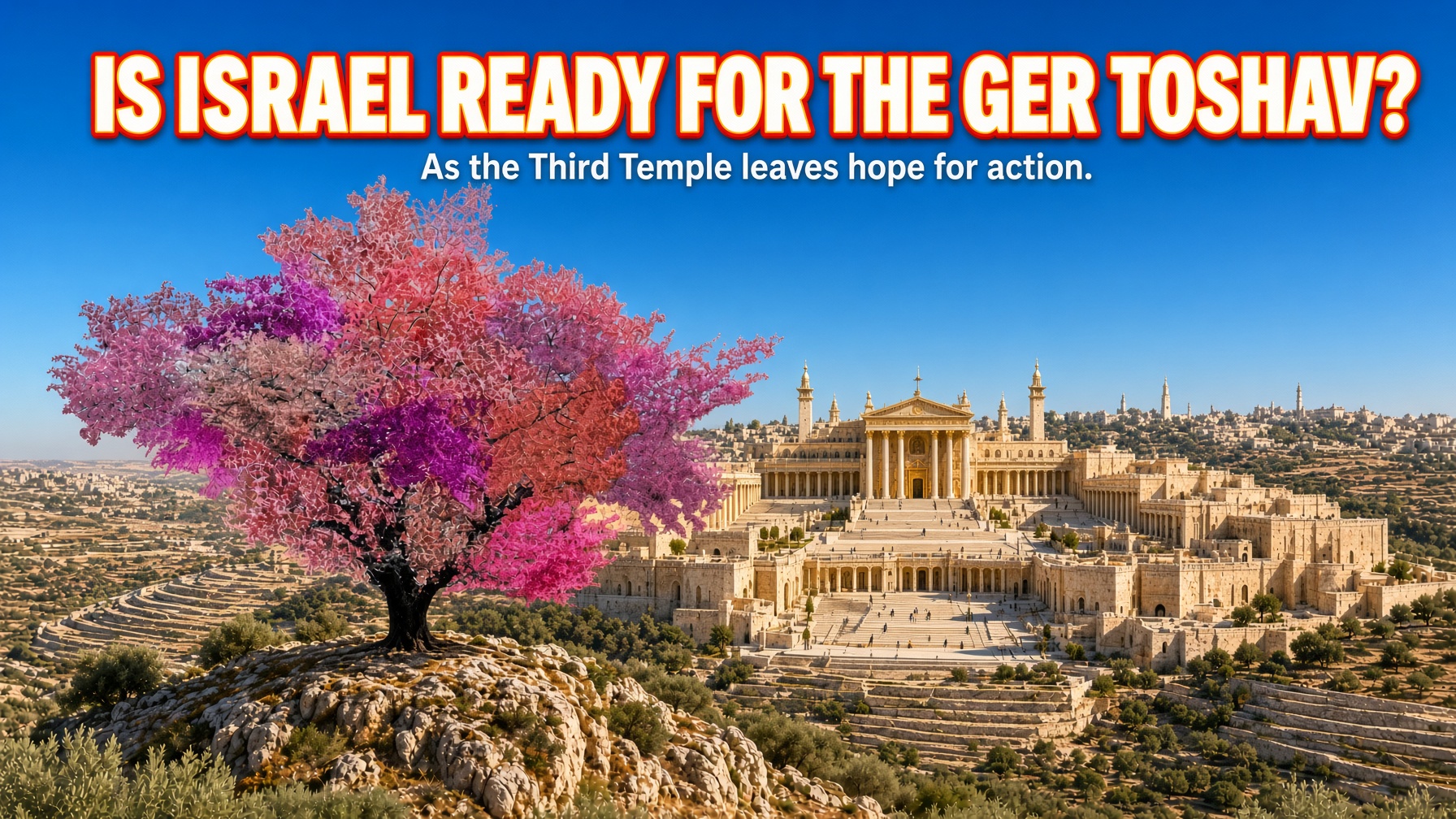
There is a tree that looks, at first, like a contradiction. One trunk. One root. In spring the canopy breaks into mixed pinks, whites, and crimsons, as if several orchards had been folded into a single crown. In summer the same tree bears peaches, plums, apricots, nectarines, cherries—dozens of kinds, each limb still itself. Sam Van Aken built such trees by grafting. One life supports many natures. The fruit does not change species.
Friends of Israel already stand under that canopy. Many have left contempt for the Jewish people and learned to bless the root. That is not a small thing. For a generation the Third Temple has been hoped. It is becoming a file: oil, lambs, courtyards, who may enter, who may bring. In that file a second person is already waiting.
Torah has a name for him. The ger toshav is the Gentile who has left the idols of the nations, accepted the God of Israel, and asked to dwell beside the Jewish people without becoming a Jew. Christian friends of Zion often use another word for the same hunger: grafted in. Israel is not ready if it only knows how to say welcome, or only how to say no. It must know the difference.
Look closely at the union on the tree. The cut is clean. The living layer of the branch is set against the living layer of the stock. It is bound, sheltered, watched. If the join is accepted, the limb does not wither. It is not sawn off as a dead thing. Sap rises. Buds swell. In the second season the branch is no longer a guest tied on with tape. It is alive on the tree.
That is the legal picture, when Jewish law still had a working form for it. A Jewish court could receive a man or woman who had abandoned idolatry and taken the commandments that bind the children of Noah—the basic laws of the human race under the God of Israel. The court did not pretend that person was always Israel. It did something more modest and more merciful: it authorized the graft. He may dwell under Israel’s shade. The root may feed him. The household may protect the joint so that it does not dry out in the first heat. The limb is not cut away. It is kept.
And then the fruit comes.
Not thin, not bitter, not the wild scrap of a roadside tree. The resident who lives beside Israel begins to bear what he could not bear alone. The peaches are fuller. The plums darken as they should. The branch that might have died in a pagan field now hangs heavy in Israel’s air. This is next-level fruit: ordered, beautiful, admired in the market of the nations. Children reach for it. Travelers taste what the branch could not have grown alone, and they give thanks for the season. They stop under the mixed canopy and say they have never seen a tree like this—one life, many harvests, none of them a lie.
Israel’s root has done what a good root does. It has made another nature more itself.
Do not rush past that wonder. Christian–Jewish friendship can live under that tree. Restoration talk cannot survive if the next sentence is a slammed gate. The eye must love the harvest before the law asks its question.
Only then bring the lamp into view.
There is a fruit this tree does not bear. Olives. And there is a use this harvest does not serve. Torah commanded beaten olive oil for the light before the Lord, evening after evening, so that the lamp would never go out. There is also a basket this grower does not carry up the hill: bikkurim, the first fruits from land held as Israel, declared with the words that belong to the heirs—“the land which the Lord swore to our fathers.”
A Jew does not carry another man’s orchard into the House and call it his own. First fruits are not any good harvest that grows in the neighborhood of holiness. They are what a member of Israel raised on land that is his in the covenant. The basket must be his planting. The words must be words he is permitted to speak. Neighboring fruit may be sound, even beautiful. It is still a neighboring fruit.
The resident’s harvest is loved. It is blessed. It may feed cities. It holds short of the sanctuary because obligation, not affection, decides what crosses that line. No insult is intended. No beauty is denied. The boundary is commanded. That boundary will not be theoretical much longer. Courtyard, oil, and first fruits are becoming administrative questions.
Then the House itself must be seen, not as a festival backdrop, but as a daily life.
Every morning and every afternoon Israel is commanded to bring the Tamid, the continual offering—the daily lamb that is the pulse of the courtyard. Not the nations. Not the guest under the tree. Israel. The lambs are not a courtesy to visiting admirers. They are the heartbeat of the House. The same is true of the oil. The lamp is not lit with whatever fine pressing the markets admire. It is lit with the oil Israel was told to prepare. Whoever rebuilds the House will have to decide who funds that daily lamb. Admiration does not pay the Temple due. Israel does.
Priests move through appointed rooms. Levites stand at appointed songs. Ordinary Israelites appear with what is incumbent upon them. A former Gentile who becomes a Jew becomes Israel. He does not become a priest. He joins the people who must sustain the daily rite—not the men appointed to perform it. The House is not an idea. It is a rhythm of commanded acts that do not pause when the pilgrims go home.
Seventy nations can stand on the hill and bless the tree. Only Israel is commanded to keep the lamp from going out.
That rhythm is what the mixed canopy cannot yet enter.
What holds the resident’s harvest at the threshold is not a lack of love in Heaven and not a defect in the fruit. It is standing. He has not accepted the full yoke of Sinai—the 613 commandments given to Israel. He has not undergone tevilah, the immersion of one who is becoming a Jew. He has not entered the covenant of conversion—circumcision for a man, and for every convert the public acceptance of Israel’s law. Until a Jewish court performs that other act—the act that does not merely authorize a graft, but makes the person of the tree—his fruit remains his own kind: supported, splendid, and not incumbent upon the sanctuary.
When those steps are undertaken, the picture changes. He is no longer the friend whose orchard grows in Israel’s shade. He is Israel: a ger tzedek, a convert in righteousness. What he raises thereafter on Israelite holding is Israel’s produce. The basket may go up. The words may be spoken. He belongs to the people who must regard the oil and the daily offering as their own burden.
Two receptions, then, and they must not be collapsed.
The first court says: live. Take your place under this root. Bear your own fruit more beautifully than you could have borne it alone. You will not be cut away.
The second court says: become. Receive the yoke, the water, and the covenant. Then the harvest is no longer neighboring fruit. It is owned fruit. Then it may enter.
A tree of many fruits. Does that harvest enter God’s Temple?
Israel will have to answer that in public, not only in books. If the fruit is the resident’s, the answer is not a sneer. It is a blessing spoken at the edge of the court: your fruit is real; the nations may eat; the lamp is lit with what Israel alone was told to bring. If the grower has stood for the full law, the immersion, and the covenant, the answer becomes yes—not because peaches were always secret olives, but because the one who carries them may now say the words, and keep the day that belongs to the heirs.
Friendship that accepts that line will survive a living Temple. Friendship that treats love as a deed to the courtyard will not.
One root. Two receptions. Two fruits.
Let the tree be beautiful.
Do not replace the House.

