
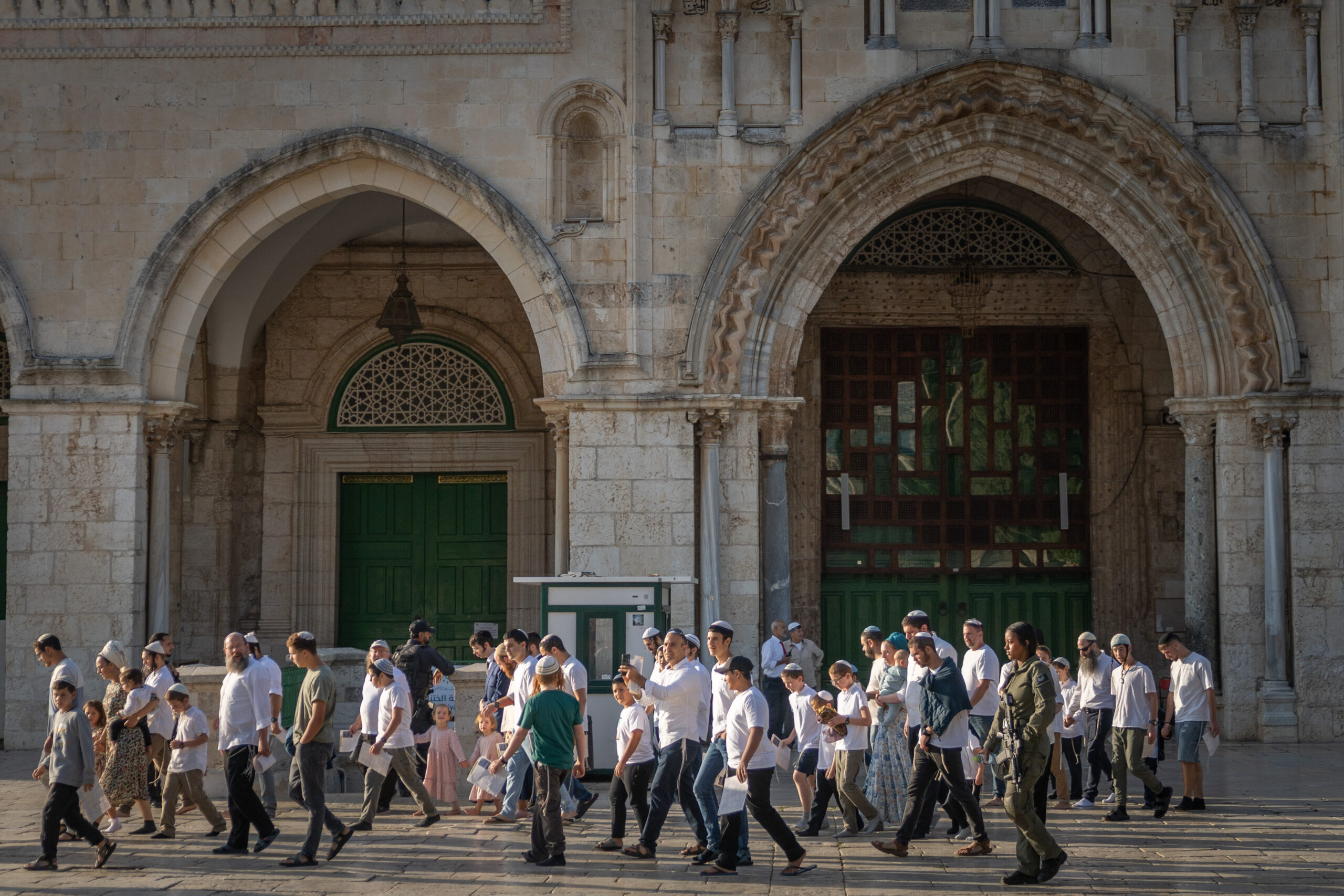
Three years after Hamas launched its massacre under the banner of the “Al-Aqsa Flood,” Israel’s National Security Minister Itamar Ben Gvir stood on the Temple Mount on Monday, in the middle of Sukkot, the Feast of Tabernacles, and turned the terrorists’ slogan back on them. “Hamas wanted to defeat us. They called it the ‘Al-Aqsa Flood,'” he said. “But today, we are the masters of the house on the Temple Mount.”
Over three days of the holiday, Ben Gvir prayed at the Western Wall, on the Temple Mount and at the Cave of the Patriarchs in Hebron. Turkish state media reported each visit as an assault on a mosque, including his prayers at the Western Wall, which the Arab press now describes as part of Al-Aqsa.
Why is Sukkot, of all the Jewish holidays, the one that draws Jews up to the Temple Mount by the thousands, and the one that most alarms the Muslim world?
“A holiday of joy”
Ben Gvir framed Monday’s visit around the festival itself. “October 7 was massive and enormous pain, great pain. But today, three years later, on the holiday of Sukkot, a holiday of joy, we can rejoice in many things that have happened since then,” he said.
He listed his achievements. Israel is “the master of the house in the prisons,” he said, referring to the restrictions he imposed on security prisoners, and “we turned their terrorists’ lives into hell.” He cited his expansion of civilian gun licensing, which grew the number of eligible localities from six in 2021 to 126 this year. “We handed out weapons and set up rapid-response squads,” he said. “Three years later, the people of Israel are heading toward total victory.”
He closed with a prayer. “On this holiday, I am praying here on the Temple Mount, in the most important place, for total victory, for complete redemption, for death to all the terrorists, and for sovereignty here in the most important place for the Jewish people. They wanted to win. We defeated them, first and foremost here on the Temple Mount.”
Officially, Jews remain barred from praying on the Mount, where the Islamic Waqf administers religious affairs while Israel controls security. Ben Gvir, who oversees the police, has repeatedly declared that Jewish prayer is now permitted there, despite contrary statements from Prime Minister Benjamin Netanyahu.
Ben Gvir delivered a similar message on the Mount one year earlier, on October 8, 2025, in a very different Israel. With hostages still held in Gaza, he said, “I only pray that our prime minister will allow a full victory also in Gaza, to destroy Hamas, with God’s help, to return the hostages.” Days later, the ceasefire brought every remaining living hostage home. This year, he returned to the same spot and prayed for “complete redemption.”
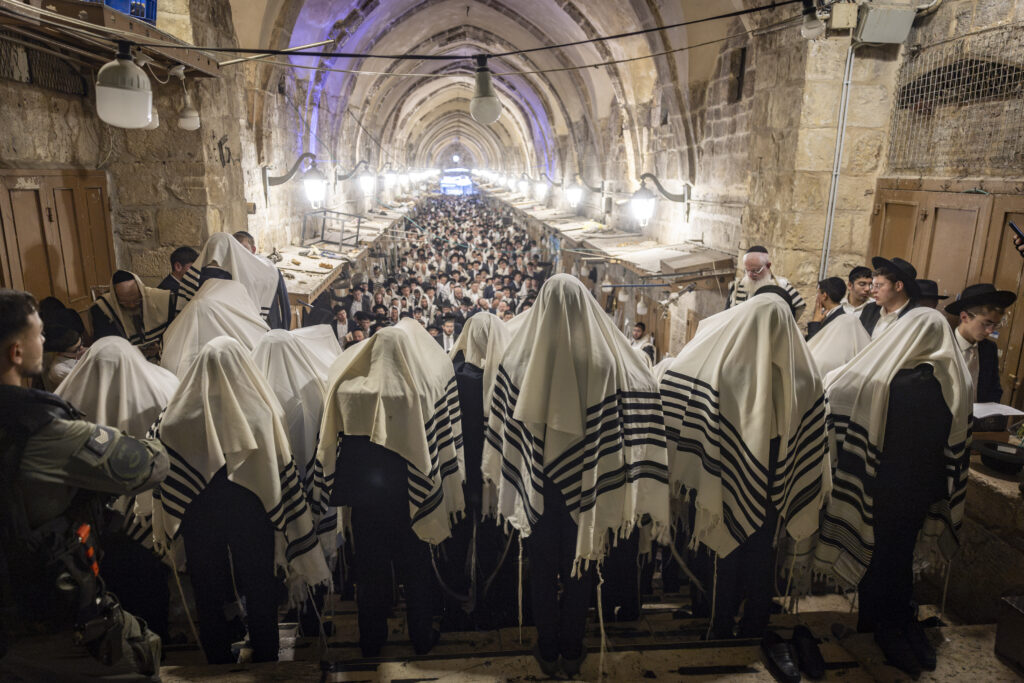
The same morning, tens of thousands gathered at the Western Wall for Birkat Kohanim, the Priestly Blessing. Defense Minister Israel Katz, a kohen, a descendant of Aaron the High Priest, blessed the crowd. Former U.S. Ambassador David Friedman, also a kohen, marked his 10th consecutive year at the ceremony, called the turnout “the largest in history,” and declared, “Israel is back!”
“Storming” the Western Wall
In the Arab media, the same holiday prayers became an invasion. Turkey’s state-run Anadolu news agency ran the headline “Israel’s Ben-Gvir storms Al-Aqsa’s Buraq Wall to mark Sukkot.” The “Buraq Wall” is the Arabic name for the Kotel, the Western Wall, which Anadolu described as “the western portion of Al-Aqsa Mosque complex.” The agency reported that on Sunday, Ben Gvir “performed Talmudic rituals at the site and held up a large Torah scroll.” In the same article, Anadolu wrote that Jews call the area the Temple Mount, “claiming it was the site of two Jewish temples in ancient times.” Citing the Palestinian Authority’s Jerusalem Governorate, it reported that 1,143 “occupiers stormed the Al-Aqsa Mosque” that morning.
Turkey’s TRT World described Jewish worshippers “performing Talmudic rituals, prayers and singing” on the Mount. The Jerusalem Governorate called Monday’s visit a violation of the status quo and an attempt to impose a new religious reality. Hamas said Israeli actions were “paving the way for total control” over the site. The United Arab Emirates, days after hosting Netanyahu in Abu Dhabi, condemned the visit as part of a “systematic extremist campaign.”
A winged horse and a political rival
The name “Buraq Wall” comes from an Islamic legend, and Dr. Mordechai Kedar, a scholar of Arabic and Islam at Bar-Ilan University, has traced how that legend was attached to Jerusalem for political reasons. Kedar has written that Jerusalem is not mentioned even once in the Quran, and that after the Muslim conquest, the capital of the province was Ramla, 30 miles to the west, a sign that Jerusalem meant nothing to the early Muslims.
According to Kedar, the change came decades after Muhammad’s death, driven by a civil war. In 682 CE, Abd Allah ibn al-Zubayr rebelled against the Umayyad rulers in Damascus, seized Mecca, and blocked pilgrims from reaching it for the Hajj. The Umayyad Caliph Abd al-Malik needed an alternative pilgrimage site and chose Jerusalem, which he controlled. To justify it, the Umayyads turned to a single Quranic verse, Sura 17:1, which speaks of a night journey from “the Sacred Mosque to the Farthest Mosque,” in Arabic al-masjid al-aqsa. The verse names no city.
The tradition built on that verse holds that Muhammad was carried there in one night on al-Buraq, a magical creature with the head of a woman, the wings of an eagle, and the tail of a peacock, and that he tethered it to the Western Wall of the Temple Mount before ascending to heaven.
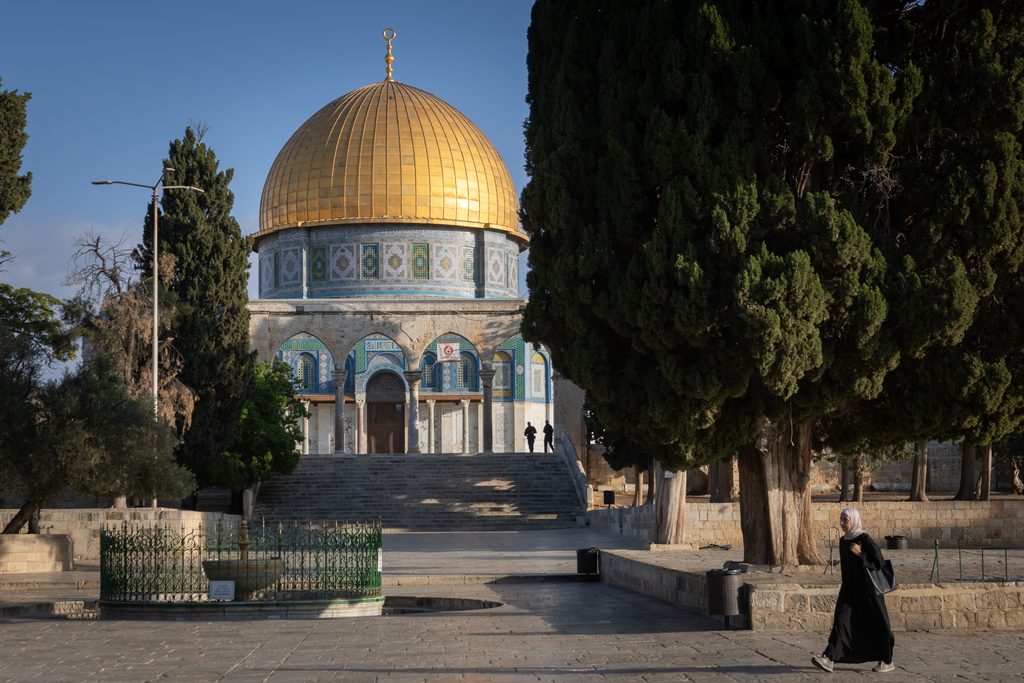
Kedar points to an earlier Islamic source that places the “Farthest Mosque” elsewhere. The early Muslim historian al-Waqidi, in his Kitab al-Maghazi, recorded two places of prayer in al-Ji’ranah, a village between Mecca and Ta’if: “the closer mosque” and “the further mosque,” al-masjid al-aqsa, where Muhammad prayed when he left town. That account was inconvenient for the Umayyads. Kedar writes that the caliphs invented many traditions upholding the value of Jerusalem to justify Muslim pilgrimage there, and in this way al-Aqsa was “transported” to Jerusalem. Abd al-Malik built the Dome of the Rock on the Temple Mount in 691 CE, while his rival still held Mecca.
Kedar’s conclusion is blunt: the holiness of Jerusalem to Islam has always been a politically motivated holiness. Saladin revived the same traditions in the 12th century to rally Muslim fighters against the Crusaders, and Palestinian broadcasters now routinely claim the Jews never had a Temple on the Mount. Anadolu’s line that Jews merely “claim” two Temples stood there comes straight from that script.
The argument surfaced in the Saudi press in November 2020. Osama Yamani, a Saudi lawyer and columnist, published an article in the Saudi state daily Okaz under the headline “Where Is Al-Aqsa Located?” Yamani argued that the mosque named in the Quran stands in al-Ju’ranah, near Mecca, and that the confusion comes from history books that placed it in Jerusalem. “Jerusalem is a city, and Al-Aqsa is a mosque,” he wrote, adding that “there are stories influenced by political considerations that served purposes of that time.” The column set off fury across the Arab world. Critics accused Yamani of spreading “perverse nonsense that contradicts the Quran and Sunni Islam,” and Turkey’s TRT claimed his remarks served the “Zionist agenda.” The same Turkish state media that called Ben Gvir’s prayers at the Western Wall an assault on Al-Aqsa had already branded a Saudi writer a Zionist agent for asking where Al-Aqsa is.
The Cave of the Patriarchs
On Tuesday, the holiday moved to Hebron. Some 10,000 Jewish worshippers, carrying their lulav and etrog, the palm branch and citron of the Four Species, gathered at dawn at Me’arat HaMachpelah, the Cave of the Patriarchs, the burial place of Abraham, Isaac, Jacob, Sarah, Rebecca and Leah. Rabbi Shmuel Eliyahu, Chief Rabbi of Safed, led the morning service and Hallel, the psalms of praise, marking 60 years since Jews returned to the city. Ben Gvir attended alongside Heritage Minister Amichai Eliyahu and Hebron’s chief rabbi, Rabbi Yitzhak Schwartz. Police reported more than 20,000 visitors in 48 hours. The Jewish Community of Hebron described the atmosphere as “likely the closest experience to the joy of the pilgrimage to the Temple.”
Anadolu reported the same morning that “Israeli national security minister storms Ibrahimi Mosque in Hebron with hundreds of occupiers.” Speaking to Channel 14 with the crowds behind him, Ben Gvir said, “When I arrive at the Ibrahimi Mosque, I draw energy that makes me want to sing and rejoice.”
Israeli authorities announced on Monday that the site would be closed to Muslim worshippers during Sukkot. Under arrangements in place since 1994, the building is divided between Jewish and Muslim prayer halls, and each community receives the entire site for 10 days a year on its own holidays. Middle East Monitor reported that since October 2023, Israel has not fully opened the site to Muslims on Islamic holidays. The Palestinian Ministry of Awqaf and Religious Affairs called the Sukkot closure “a blatant assault on the sanctity of the Ibrahimi Mosque,” insisting the mosque is “an exclusively Islamic endowment.” The outlet’s own photo caption described “Hundreds of Jews” who “flock to the Ibrahimi Mosque for the Sukkot (Feast of Tabernacles) holiday,” closed to Muslims “under the pretext of Jewish holidays.”
The Bible records that Abraham bought this cave at full price, before witnesses, so no one could dispute the purchase:
And Abraham hearkened unto Ephron; and Abraham weighed to Ephron the silver, which he had named in the hearing of the children of Heth, four hundred shekels of silver, current money with the merchant. (Genesis 23:16)
The festival of the Temple
Sukkot is the Temple festival above all others. The Bible commands joy on it more insistently than on any other holiday, and ties that joy to one location:
Seven days shalt thou keep a feast unto the LORD thy God in the place which the LORD shall choose; because the LORD thy God shall bless thee in all thine increase, and in all the work of thy hands, and thou shalt be altogether joyful. (Deuteronomy 16:15)
“The place which the LORD shall choose” is the Temple Mount. During the Temple era, Sukkot was the climax of the pilgrimage year, crowned by Simchat Beit HaSho’evah, the Celebration of the Water Drawing, when the priests poured water on the altar, and the courtyards blazed with torches through the night. The Mishnah declares: “Whoever has not seen the rejoicing of the Water Drawing has never seen joy in his life” (Sukkah 5:1).
Sukkot is also the festival the Bible gives to the nations. King Solomon dedicated the First Temple on Sukkot, and in his dedication prayer he asked God to answer the foreigner who comes from a distant land to pray at the house (1 Kings 8:41-43). The Sages taught that the 70 bulls offered over the seven days of the holiday atoned for the 70 nations of the world. Rabbi Yochanan lamented what the nations lost when the Temple fell: “Woe to the nations of the world, for they lost and they do not know what they lost. When the Temple stood, the altar atoned for them. Now, who atones for them?” (Sukkah 55b). The prophet Zechariah foresaw the day when the nations would join Israel on the Mount for this festival:
And it shall come to pass, that every one that is left of all the nations that came against Jerusalem shall go up from year to year to worship the King, the LORD of hosts, and to keep the feast of tabernacles. (Zechariah 14:16)
The irony is hard to miss. On the one holiday when the Temple was built to welcome every nation, when Israel offered 70 sacrifices on behalf of the peoples of the world and a Jewish king prayed for the foreigner, Turkish state media, the Palestinian Authority, Hamas, and the United Arab Emirates spent the week condemning Jews for praying on the Mount. Zechariah described the nations streaming up to Jerusalem every Sukkot. This year, they issued press releases accusing the Jews of “storming” it.
Anadolu writes that Jews merely “claim” two Temples stood there. The Bible records Solomon building the first on this very festival, the prophets foretold its rebuilding, and Zechariah promised that the nations who came against Jerusalem would one day come up to worship beside Israel. Three years after Hamas tried to drown Israel in the “Al-Aqsa Flood,” Jews came up to the Mount by the thousands on the festival of joy, and the door Solomon opened for the nations is still standing open.