

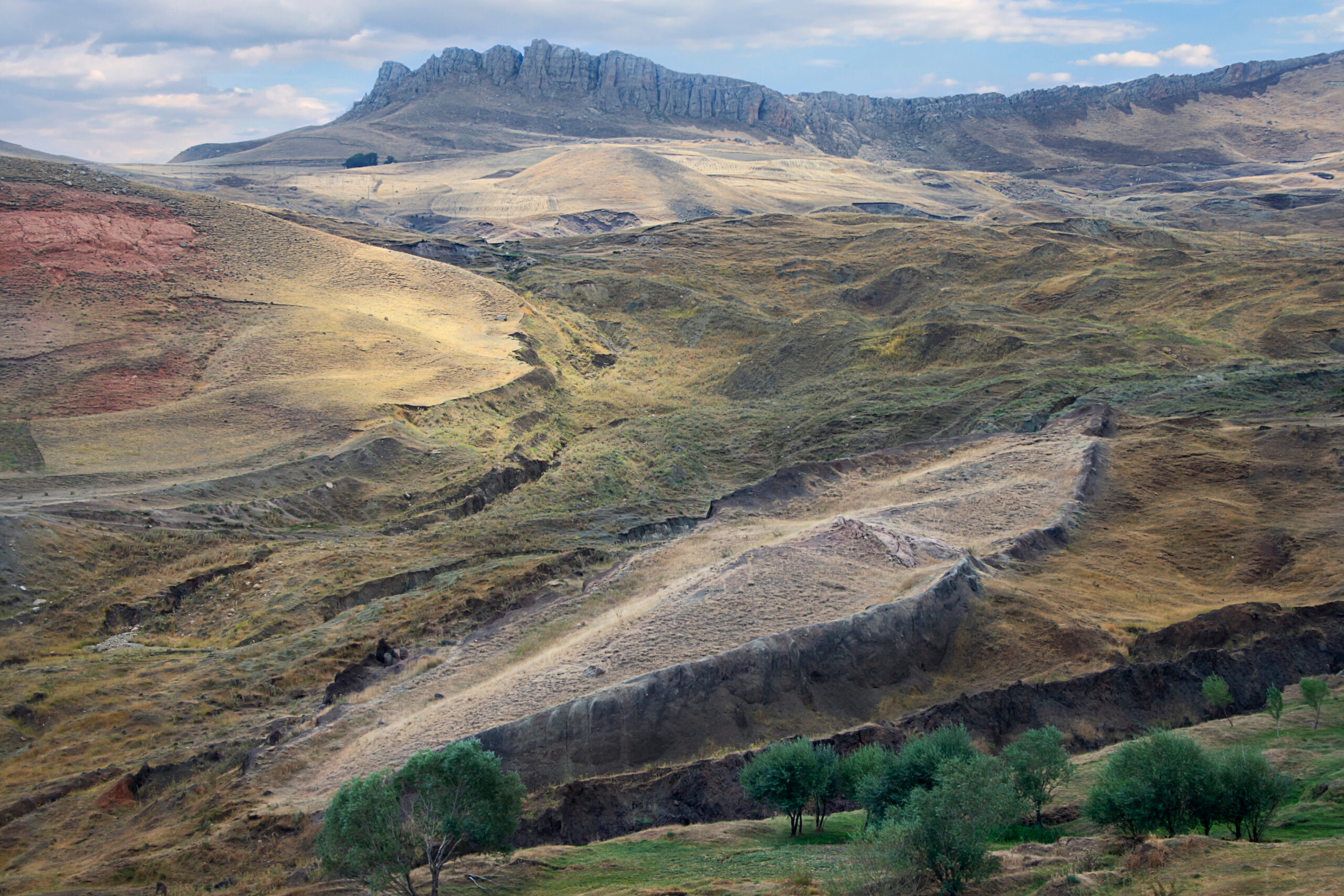
Five meters beneath a boat-shaped mound in the mountains of eastern Turkey, a drill bit shattered. On the second day of core drilling at the Durupınar site, the bit broke on a layer the team described as harder than limestone, and within hours the news was racing across social media: Noah’s Ark had been found. The expedition’s promoters spoke of petrified wood, hidden rooms, and a discovery that would dismantle Darwinism. The laboratories that will actually test the samples have yet to report a single result.
On Sept. 22, the international research team told the Daily Mail it had “100 percent confirmed” that the formation is man-made rather than a natural feature of the surrounding mountains. The expedition’s own leadership tells a more cautious story. Andrew Jones, founder of Noah’s Ark Scans, acknowledged that the evidence has not definitively identified the formation as the biblical vessel, while insisting, “I firmly believe the Durupinar Formation represents the buried remains of Noah’s Ark.” Sivas Cumhuriyet University, the expedition’s Turkish partner, has scheduled the public release of its results for 2027.
The Bible records the Ark’s dimensions down to the cubit and the exact day it came to rest, yet says nothing about what became of it. Why would the Bible leave the fate of history’s most famous vessel untold?
The drilling
Core drilling began on Sept. 21. The field program is led by Prof. Cenker Atila of Sivas Cumhuriyet University’s archaeology department, with Jones serving as vice president of the Noah’s Ark Research Project, under official authorization from Turkish government agencies. The team is collecting core samples at depths of up to 18 meters and preparing to send a robot it calls “Gopher” into what it describes as mapped voids, tunnels, and corridors inside the formation. Holes were drilled both inside the boat-shaped outline and in control locations beyond it so laboratory results can be compared against the surrounding mountainside.
The robot’s designer, Dr. Robert Ross of La Trobe University in Australia, told news.com.au it was repurposed from a machine he originally built for wildlife ecologists “to explore wombat burrows (WomBot) and Armadillo Burrows in French Guiana (ArmaBot).”
The team posted footage of Gopher’s first descent under the caption “FIRST LOOK: footage from inside Noah’s Ark.” The same post acknowledged that the robot needed modifications before it could look around, as its wheels struggled to move on the loose sediment, according to WION.
The expedition’s marketing and fundraising director, Lauren Witzke, has framed the dig in sweeping terms. “Good morning from the outer rims of Noah’s ark,” she wrote as drilling began, the New York Post reported. “Core drilling has begun and the big bang evolutionists are already in damage control mode.” She predicted that “when we are done, university curricula will need to be rewritten, and Darwinism will be dismantled,” adding, “This is the place where creation began anew.”
What the team claims, and what it concedes
The project’s public statements contradict one another. The team posted on X that “as radar scans accurately told us, no rock or bedrock found.” In a statement reported by Newsweek, the same team said it wanted to test the solid-rock explanation and determine where the true bedrock lies beneath the formation. And the drill bit broke on a layer hard enough to destroy it. Jones’s own formulation is far narrower than his promoters’: he said the preliminary radar data does not show “a simple homogeneous solid-rock signature.”
The petrified wood claim follows the same pattern. In the expedition’s press release, Jones said petrified or highly mineralized wood is a possibility the team wants to investigate through third-party lab testing. A widely shared post promoting the project announced that “we believe we have hit a floor of petrified wood,” followed immediately by the words “to be confirmed.”
Sixty years of claims
The Durupınar formation had already been declared as the Ark, after Turkish army Capt. İlhan Durupınar spotted it in aerial survey photos in 1959. Local researchers surveyed, dug, and even dynamited the site but found no archaeological evidence and concluded it was a natural anomaly, the New York Post reported.
In the 1980s, American salvage expert David Fasold measured the formation at 164 meters and became convinced he had found the Ark’s fossilized deck. He later reversed himself. In 1996, Fasold co-wrote a paper with geologist Lorence Collins concluding that the formation is a natural doubly plunging syncline, that its supposed metal braces are natural concentrations of limonite and magnetite, and that the “anchor stones” in a nearby village are local volcanic rock. In 1997, Fasold reversed his own claim under oath in an Australian court. He publicly called the Ark theory “absolute BS,” though his friend and biographer June Dawes maintained that he went to his grave believing he had found it.
The sharpest skepticism comes from Bible believers. Answers in Genesis, the young-earth creationist ministry led by Ken Ham, argues that Jones was convinced of the answer before the surveys were run, and that labeling radar smudges “decks” and “corridors” is interpretation dressed up as data. Christian commentator Peter Heck noted that Dr. John Morris and other Christian archaeologists studied the formation for years and concluded it is not the Ark, and argued that Noah’s family would never have abandoned the vessel’s lumber in a world stripped of resources.
The numbers
The dimensional match is the engine of the entire Durupınar case, and it rests on the choice of cubit. Genesis gives the Ark’s measurements as 300 amot (cubits) long, 50 wide, and 30 high. At the standard biblical amah of about 45 centimeters, the Ark measured roughly 135 meters. The formation measures about 157 meters, which approaches 300 cubits only if the Egyptian cubit of 52.3 centimeters is used. The formation’s length also shifts with the source: Fasold measured 164 meters, and the Catholic Herald puts it at 515 to 538 feet, longer than even the most generous calculation of the Ark’s 450 to 510 feet.
The shape poses a deeper problem. Genesis describes a tevah, a word meaning “box.” The Bible’s measurements describe a rectangular chest, and Rashi, the 11th-century French commentator, explains that its roof sloped upward to a width of a single cubit so that rainwater would run off. A tapered, pointed hull is the one shape the text excludes.
The word tevah appears in only one other story in the entire Bible:
“And when she could not longer hide him, she took for him an ark of bulrushes, and daubed it with slime and with pitch; and she put the child therein, and laid it in the flags by the river’s brink.” (Exodus 2:3)
Moses’ mother built a tevah of papyrus. Rashi, drawing on the Talmud, notes that she sealed it with pitch on the outside and clay on the inside so the infant would not have to smell the pitch. Neither tevah had a rudder, a sail, or an oar. Both vessels carried a righteous man through water that destroyed those around him, steered by God alone.
The three-deck claim runs into the same text. The research team says its scans show the bottom layer of the formation divided into three sections filled with chambers, corridors, and tunnels. Genesis 6:16 commands three stories stacked one above another: tachtiyim, sheniyim, u’shlishim, “lower, second, and third.” Rashi, citing the Midrash, assigns the top story to people, the middle to animals, and the bottom to refuse. Three sections within one layer describe an entirely different structure.
Even the age claimed for the wood departs from the Bible’s own count. Promoters describe the Ark’s timber as 4,300 years old, a figure drawn from the 17th-century chronology of Archbishop James Ussher. The Jewish chronology of Seder Olam Rabbah, built directly on the genealogies of Genesis, places the Flood in the year 1656 from Creation, or 2105 BCE. With the Jewish calendar now in the year 5787, the Bible’s count puts the Flood about 4,130 years ago.
Follow the funding
The expedition said it needed $600,000 to begin drilling and had raised only a small fraction of that when work started, according to the New York Post. Online appeals told supporters that $25 covers a scientist’s meals for a day. Noah’s Ark Scans also runs tours to the site, with tickets priced at $3,600, IFLScience reported. The team is racing the Turkish winter, which will freeze the ground and halt operations until 2027.
The lost city of Lake Van
A second Turkish discovery has joined the Ark in the headlines. Divers in Lake Van, about 90 miles southwest of Mount Ararat, have filmed a circular stone structure and a wall of interlocking blocks rising from the lakebed. Researcher Matthew LaCroix told the Daily Mail the ruins are at least 11,700 years old and could date back 40,000 years. “I measured over 150 feet that this causeway continues,” he said. “Over 150 feet, and it leads into the darkness.”
The Daily Mail’s own reporting undercuts the claim. LaCroix never descended to the wall; he spent eight minutes at the circular ruin in about 30 feet of water, and the causeway surfaced months later in another diver’s footage. “I have never been able to see it,” he said. No stone from the ruins has been independently dated. LaCroix’s figures come from his reading of when volcanic eruptions from Mount Nemrut blocked the lake’s ancient outlet, which dates the lake’s geology rather than the masonry. Archaeologists attribute the structures to the Urartian period, about 3,000 years ago, or to the medieval era.
That sober dating carries its own weight for readers of the Bible. Urartu is the biblical Ararat, and Lake Van was the heart of that kingdom.
The land of Ararat
Genesis 8:4 places the Ark on harei Ararat, “the mountains of Ararat,” in the plural. The verse names a region, the mountainous kingdom of Urartu that sprawled across eastern Anatolia, and never the single volcanic peak that carries the name today. Targum Onkelos, the authoritative Aramaic translation of the Bible, renders the phrase turei Kardu, “the mountains of Kardu,” pointing to the Kurdish highlands farther south. The Durupınar formation itself lies about 29 kilometers south of Mount Ararat, on the slopes of a separate volcano, Mount Tendürek.
Ararat appears in the Bible as a real kingdom long after the Flood. When Sennacherib, the Assyrian emperor who besieged Jerusalem in the days of King Hezekiah, returned home in disgrace, his own sons murdered him:
“And it came to pass, as he was worshipping in the house of Nisroch his god, that Adrammelech and Sarezer smote him with the sword; and they escaped into the land of Ararat. And Esarhaddon his son reigned in his stead.” (2 Kings 19:37)
Assyrian records confirm both the assassination and the kingdom of Urartu.
The plank that became a god
The answer to the Bible’s silence about the Ark’s fate hides inside that verse. The Sages asked who “Nisroch” was, a god who appears nowhere else. The Babylonian Talmud (Sanhedrin 96a) connects the name to nesar, a plank, and records that Sennacherib found a plank from Noah’s Ark. He declared it “the great god who saved Noah from the flood” and vowed that if he succeeded in his campaigns, he would sacrifice his two sons before it. His sons heard the vow and killed him first, then fled to the land of Ararat, the very region where the Ark had come to rest.
According to the Sages, a piece of the Ark did survive, and the man who found it turned it into an idol.
The same chapters of 2 Kings record the opposite response from the same generation. King Hezekiah, Sennacherib’s adversary, faced a genuine relic of God’s salvation: the copper serpent Moses had fashioned in the desert, which healed every Israelite who looked at it. “He removed the high places, and broke the pillars, and cut down the Asherah; and he broke in pieces the brazen serpent that Moses had made; for unto those days the children of Israel did offer to it; and it was called Nehushtan.” (2 Kings 18:4). The Talmud (Pesachim 56a) records that the Sages approved of Hezekiah grinding the serpent to dust.
Two kings stood at the same moment in history. The Assyrian bowed to a plank of the Ark and died at the hands of his sons. The king of Judah smashed a relic made by Moses himself and was saved from the Assyrian army by God. The Bible preserves the Ark’s blueprint to the cubit because the blueprint teaches obedience: Noah built exactly what he was commanded. It leaves the timber on the mountains because a vessel of rescue that outlives its mission becomes a temptation.
The mountains keep their secret
The drill cores from Durupınar will reach the laboratories, and the results will speak for themselves. A formation that shatters drill bits, measures longer than the Ark, and takes the shape of a ship where the Bible describes a box will need far more than radar anomalies and fundraising posts to earn the name Noah gave no one. The Bible was precise wherever precision mattered: the dimensions, the materials, the month and day of landing, the region of Ararat that archaeologists at Lake Van keep confirming. The generation that found a piece of the Ark worshipped it and died for it. The generation that followed God’s word to the letter survived the Flood without ever looking back at the ship.