



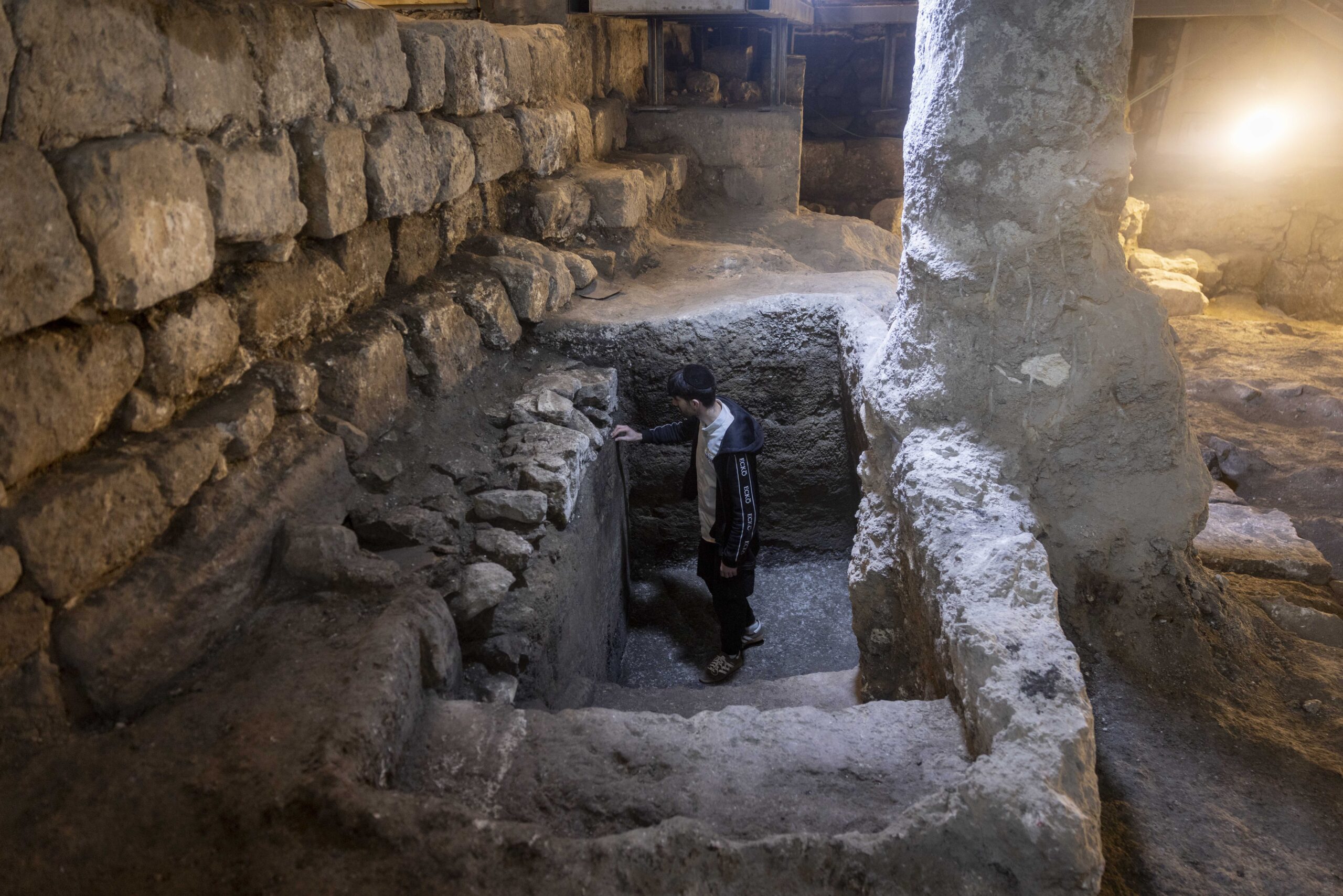
Two thousand years ago, a Jewish pilgrim climbing from the City of David toward the southern gates of the Temple stopped at a stone building fifty meters short of the entrance, walked down a flight of carefully cut steps into a vaulted chamber, and immersed his entire body in water. Then he climbed out the other side, pure, and went up to the House of God. Archaeologists from the Hebrew University of Jerusalem have now uncovered that building, and one of its baths still stands to its full height, vaulted stone roof intact, exactly as the pilgrims left it.
The discovery, announced as Sukkot pilgrims began streaming into Jerusalem, is being called Beit haMikvaot, the “House of Mikvehs.” A mikveh (plural mikva’ot) is a Jewish ritual bath, a pool of water used for purification. “A monumental ashlar structure devoted entirely to ritual purification, situated at the foot of the Temple Mount and near one of its gates, is a truly unparalleled phenomenon,” said excavation directors Prof. Uzi Leibner and Prof. Orit Peleg-Barkat in a joint statement.
A complex built for crowds
The complex sits in the Ophel, the elevated area immediately south of the Temple Mount, at the foot of the grand staircase leading to the Triple Gate, one of the Hulda Gates that served as a main entrance to the Second Temple. In antiquity, the gate opened onto an underground staircase that climbed directly into the middle of the Temple Mount plaza.
The complex covers about 280 square meters and was built around 10 CE, shortly after the reign of Herod the Great, a date based on the coins found there. At its center is a large plastered pool measuring roughly 12 by 9.5 meters, with steps descending from all four sides. Leibner believes it may have been used for purifying vessels. Northwest of the pool stands a structure of finely dressed ashlar stone containing four rooms, three of which held large public mikva’ot. A forecourt paved with large stone slabs lies between them.
One of the baths survives to its full height of 4.2 meters, complete with its vaulted stone roof and the shaft through which water was poured in. “This is the crown jewel of this discovery,” Leibner told the Times of Israel. A Second Temple-period structure preserved from floor to ceiling is exceedingly rare in Jerusalem.
The builders designed the complex for volume. During the three pilgrimage festivals, dozens of people likely immersed at the same time, and a low dividing line runs down the middle of one of the staircases. “People would go in on one side and come out on the other,” Leibner explained. “People entered to achieve a state of ritual purity, and you wouldn’t want to touch someone who hadn’t immersed yet.”
“During the Second Temple period, when pilgrimage to the Temple was a major part of Judaism, this area served thousands of pilgrims who had to come in a state of ritual purity,” he said. “What we find in this area, outside the main entry point to the Temple Mount, is a huge investment in infrastructure for serving these pilgrims, with walkways, stores, water reservoirs, and dozens of ritual baths.”
The broader area holds 18 pools within 1,600 square meters, according to the Armstrong Institute of Biblical Archaeology, the excavation’s partner. The Institute suggests the finely built complex may have served the upper classes or the Temple’s own workers, given its quality and its proximity to the Temple.
Plumbing fit for the Temple
Every bath in the complex has a drain hole carved into its floor, “with a plug, like a modern bath,” Leibner said. That feature is extremely rare. “It is uncommon in mikvaot that you can empty the immersion pool and replace the water,” he told the Jerusalem Post. “This is one of the hints that brings us to the idea that there was running water here. Not just collecting rainwater as [is] typical, but running water.”
The drains fed a network of tunnels standing more than two meters high, large enough to walk through, which carried the water down into the Kidron Valley. “This is an amazing drainage system that is extremely rare,” Leibner said, walking through the tunnels with a flashlight. “Water from the baths would still drain into it today.” The water most likely arrived through a branch of the aqueduct that ran from the Hebron hills through Solomon’s Pools near Efrat and supplied the Temple itself.
Beneath the complex, the team found an earlier public purification facility with its own large mikveh, probably dating to the first century BCE, in the late Hasmonean period or early in Herod’s reign. It went out of use when builders cut the later drainage channel straight through its immersion pool.
The last coins before the fire
The complex came to a violent end in the summer of 70 CE, when Roman legions destroyed Jerusalem and the Temple a few dozen meters above the baths. Peleg-Barkat described “dramatic evidence of destruction inside the structure.” Dozens of coins from the Great Revolt against Rome lay on the floors and in the debris, among them a silver half-shekel minted in the revolt’s third year and a bronze coin from its fourth and final year.
The half-shekel is the coin the Bible commands every Israelite to give for the Temple: “This they shall give, every one that passeth among them that are numbered, half a shekel after the shekel of the sanctuary” (Exodus 30:13). The rebels struck their own half-shekels to keep that commandment while the Roman army closed in.
“This is an area that was very active up to the destruction in the year 70,” Leibner said. “Then we find nothing for hundreds of years.”
The Byzantines who built homes over the ruins some three centuries later sealed the best-preserved bath beneath their floors and converted it into a water cistern, preserving it for more than 1,500 years.
Christians and Jews in the dirt
The central pool was first exposed in the early 1970s by students from Herbert W. Armstrong’s Ambassador College, who excavated the Ophel every summer from 1969 to 1976 under the legendary Hebrew University archaeologist Prof. Benjamin Mazar. His granddaughter, Dr. Eilat Mazar, uncovered part of the four-room structure in 2013 and 2018 with students from Herbert W. Armstrong College. After her death in 2021, Leibner took over the area, joined by Peleg-Barkat in 2023. The fifth and final season ended this summer with a team of students from the Hebrew University, Armstrong College, and Yeshiva University working side by side.
Water that makes a person whole
The Hebrew word mikveh comes directly from the Bible, which uses it to describe the one thing that cannot become impure:
“Nevertheless a fountain or a cistern wherein is a gathering of water shall be clean; but he who toucheth their carcass shall be unclean.” (Leviticus 11:36)
The phrase is mikveh mayim, “a gathering of water.” The same root appears in the account of Creation, when God gathered the waters and “the gathering of the waters He called Seas” (Genesis 1:10). A mikveh returns a person to the waters of Creation itself.
The Sages derived the dimensions of a mikveh from the Bible’s command that one who becomes impure must “bathe all his flesh in water” (Leviticus 15:16). The Talmud (Eruvin 4b) teaches that “all his flesh” requires a pool large enough for the entire body to enter at once, one cubit by one cubit by three cubits, a volume the Sages fixed at 40 se’ah, several hundred liters. The Mishnah (Mikvaot 1:8) ranks six grades of purifying water and places mayim chayim, “living water” from a flowing source, at the top. The running water the archaeologists believe fed the Ophel complex would have been the highest grade of all.
Maimonides, the 12th-century sage and codifier, addressed why the mikveh works. He wrote that purity and impurity are decrees of Scripture, since impurity is no kind of dirt that water washes away. Yet he found a lesson in it: just as a person who resolves to become pure immerses and emerges pure though nothing in his body has changed, a person who resolves to cleanse his soul of wrong thoughts and bad traits, and immerses his soul in mei hada’at, “the waters of knowledge,” becomes pure (Laws of Mikvaot 11:12).
No one ascends without immersing
The connection between the mikveh and the Temple runs through the entire service. The Mishnah (Yoma 3:3) rules that no one may enter the Temple courtyard to perform the service, even a person already pure, without first immersing. On Yom Kippur, the High Priest immersed five times in a single day.
The Bible required every Jewish man to make the journey three times a year:
“Three times in a year shall all thy males appear before the Lord thy God in the place which He shall choose; on the feast of unleavened bread, and on the feast of weeks, and on the feast of tabernacles; and they shall not appear before the Lord empty.” (Deuteronomy 16:16)
The first-century historian Josephus claimed that more than 2.7 million people celebrated Passover in Jerusalem in 66 CE. “Obviously, that number is a vast exaggeration, but it provides an indication of what a massive gathering it was,” Leibner said.
The Sages built their laws around these crowds. The Talmud (Chagigah 26a) rules that during the pilgrimage festivals, every Jew was trusted in matters of purity, including those ordinarily suspected of carelessness. The Sages derived the ruling from a verse describing the tribes of Israel gathered together: “So all the men of Israel were gathered against the city, knit together as one man” (Judges 20:11). The Hebrew word for “knit together” is chaverim, “companions,” the same term the Sages used for those scrupulous about purity. When Israel ascended to Jerusalem as one people, every Jew was a chaver.
Even the traffic pattern Leibner identified on the staircase appears in the Mishnah. Tractate Middot (1:3) names the two Hulda Gates in the southern wall as serving for entrance and exit, and rules (2:2) that everyone entering the Temple Mount enters on the right, circles, and exits on the left. The pilgrims who went down one side of the steps and came up the other were following the same orderly path that carried them through the Hulda Gates above.
God is the mikveh of Israel
The final Mishnah of tractate Yoma, studied in the days surrounding Yom Kippur, closes with the words of Rabbi Akiva: “Happy are you, Israel. Before whom are you purified, and who purifies you? Your Father in Heaven.” Rabbi Akiva cited the prophet Jeremiah: “Mikveh Yisrael Hashem,” “O Lord, the hope of Israel” (Jeremiah 17:13). The word for “hope” is mikveh. Rabbi Akiva read it as a declaration: just as a mikveh purifies the impure, the Holy One, blessed be He, purifies Israel.
The pilgrims who descended into the baths at the foot of the Temple Mount understood that the water was an instrument. The One who purified them waited at the top of the stairs.
The prophets promised that the purification would return with the exiles. “For I will take you from among the nations, and gather you out of all the countries, and will bring you into your own land. And I will sprinkle clean water upon you, and ye shall be clean” (Ezekiel 36:24–25). The order of the verses matters: first the ingathering to the land, then the purifying water.
Living waters from Jerusalem
On the first day of Sukkot, synagogues around the world read the prophecy of Zechariah as the haftarah, the portion from the Prophets. It promises that “living waters shall go out from Jerusalem” (Zechariah 14:8), the same mayim chayim the Sages ranked highest of all purifying waters. It promises that the nations will go up to Jerusalem “from year to year to worship the King, the Lord of hosts, and to keep the feast of tabernacles” (Zechariah 14:16).
This week, Jews and Christians from across the world are walking the same streets toward the same mountain for the same festival. The baths that received the pilgrims of the Second Temple have come out of the ground with their drains still open and their roof still standing. The coins on their floors stop in the year the Temple burned. The water channels are ready for the living water the prophets promised would flow from Jerusalem again.
