



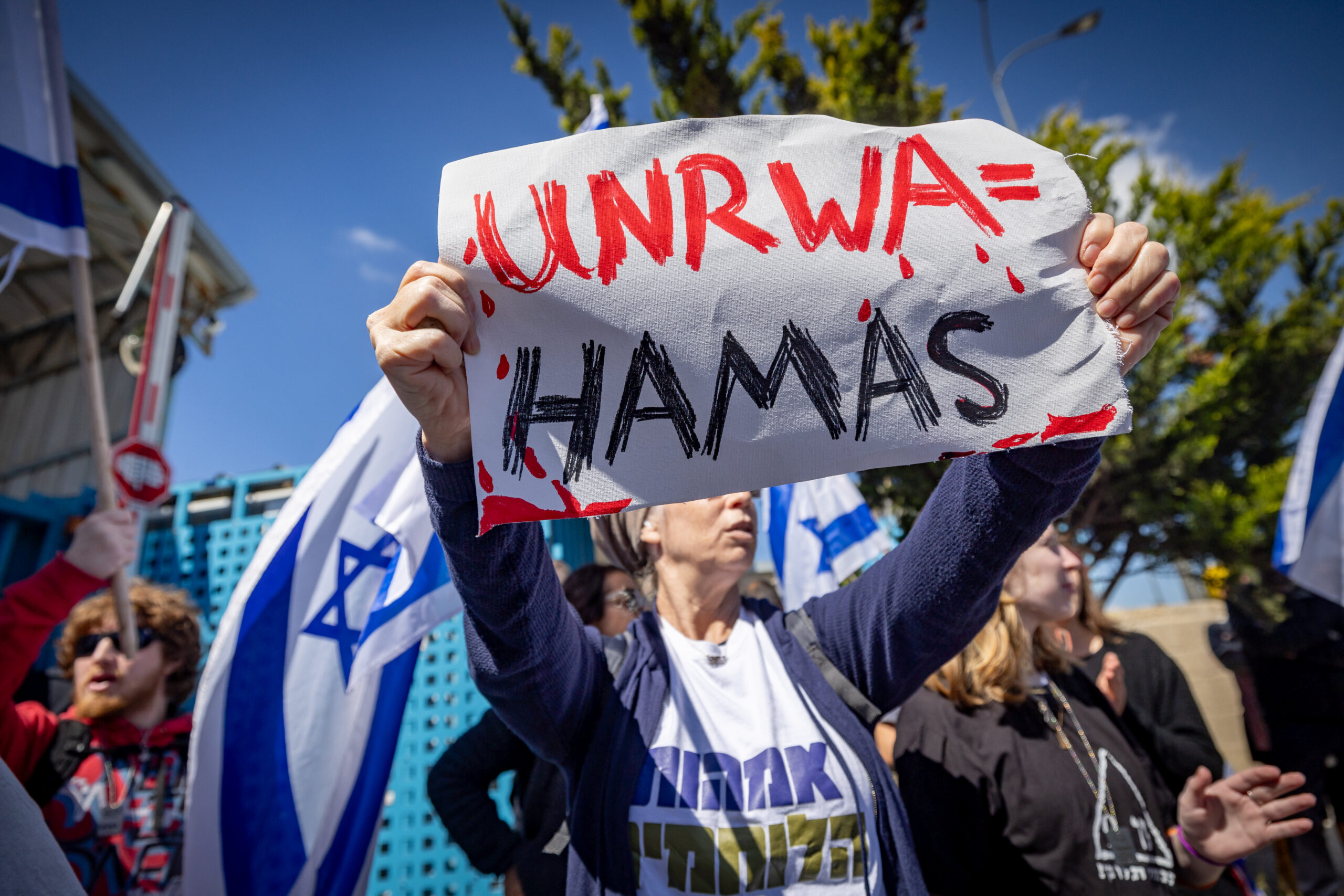
For two years, evidence has piled up connecting the United Nations’ largest aid agency in Gaza to the terrorist organization it was supposedly there to help contain. UNRWA employees held Israeli hostages on October 7. UNRWA schools sat atop Hamas tunnels and stored Hamas rockets. Hamas fighters looted UNRWA aid trucks at gunpoint while UNRWA’s own payroll system funneled millions of dollars a month into Hamas-controlled money exchanges. A newly disclosed watchdog report now confirms what Israel has said all along: the UN’s own internal investigation was built to keep that full picture from ever reaching the public.
A December 2025 report by the U.S. Agency for International Development’s independent inspector general, unpublished until the Washington Free Beacon obtained it through Senate Judiciary Committee chairman Chuck Grassley’s office, reaches a conclusion the United Nations has spent two years trying to avoid: its own internal investigation into UNRWA staff involvement in the October 7 massacre was not merely inadequate. It was structured, from its first day, to produce exoneration.
The mechanics of that structure are laid out in the report itself. The UN’s Office of Internal Oversight Services, known as OIOS, investigated nineteen UNRWA employees flagged by Israeli intelligence and concluded that the evidence against nine of them was “insufficient to support” a finding that they had participated in October 7. The USAID inspector general’s review of that same investigation found the deck had been stacked before a single document was examined. OIOS restricted its inquiry to one narrow question — did a given staff member physically participate in the attacks of October 7, 2023 — and refused to ask the far larger and more answerable question of whether the same staff members were simply members of Hamas. “The investigation did not review whether the UNRWA staff members were current or former members of Hamas,” the inspector general’s report states flatly. A narrower question produces fewer guilty verdicts by design, not by accident.
The report’s second finding is more damning still, because it exposes not carelessness but an argument constructed specifically to fail. OIOS dismissed the Israeli intelligence at the center of its own investigation — intercepted Hamas communications, cell phone data, recovered documents — on the grounds that it could not be “independently authenticated.” The USAID inspector general dismantled that reasoning in the plainest terms available to a federal watchdog. The material in question, the report notes, came from Hamas itself, a designated foreign terrorist organization; by definition, it qualifies as “collected enemy material,” and “it is thus unreasonable to believe that anyone could independently authenticate” material seized from a terror group’s own communications network. More pointedly, the inspector general noted that OIOS “presented no evidence to suggest that the materials were not authentic,” and that OIOS’s own objection amounted to nothing more than the fact that Israel supplied copies rather than physical originals it was never going to hand over from an active war zone. The inspector general’s conclusion on this point deserves to be read in full: it “has found no evidence to suggest that the authenticity of the materials collected by the Israeli government should be questioned.” OIOS was not confused about the evidence. It manufactured a standard no wartime intelligence could ever satisfy, and then used that standard to clear the people the evidence implicated.
“What’s well known here in New York is that the UN OIOS’s investigation was a complete cover-up,” a Western diplomat briefed on the findings told the Free Beacon. “They ignored the obvious, glaring linkages between UNRWA staff and Hamas. Their report gave the Secretary-General cover to hide behind a so-called investigation and hope the world would move right along.”
What a Narrow Question Was Built to Hide
The scope OIOS imposed on itself — participation in October 7, and nothing else — was narrow enough to exclude most of what is actually known about UNRWA’s relationship with Hamas. Israeli intelligence identified at least twelve UNRWA employees who actively participated in the October 7 attack, including six who crossed into Israel with the invading force and two who personally held Israeli hostages. Defense Minister Yoav Gallant made those twelve identities public in March 2024: seven teachers, two school administrators, and a social worker. NBC News, reviewing the same Israeli dossiers, reported that a counselor at a UNRWA school helped kidnap a female hostage, that a UNRWA elementary school teacher took part in the massacre at Kibbutz Re’im, and that another UNRWA teacher armed himself with anti-tank weapons the night before the attack. The IDF released audio from that same spring of a Hamas terrorist named Yousef al-Hawajara, who taught at a UNRWA school in Deir al-Balah, boasting on October 7 itself: “We have female hostages, I captured one!” Hostages freed during the November 2023 truce told Israeli debriefers they had been held inside the homes of UNRWA staff. A former UNRWA social worker, Faisal Ali Mussalem al-Naami, was documented dragging the body of murdered Israeli Yonatan Samerano through Kibbutz Be’eri and was separately tied to a kidnapping from the same kibbutz.
None of that is in dispute among the people who investigated it. It is simply larger than the question OIOS chose to ask. Israel’s ambassador to the UN, Gilad Erdan, put the mismatch in a single sentence: Israel handed the UN detailed information on more than one hundred Hamas-affiliated UNRWA employees. The UN investigated nineteen.
The Number the Cover-Up Was Designed to Bury
By walling off the question of Hamas membership from the question of October 7 participation, OIOS also walled off the much larger scandal that the USAID inspector general has since been forced to investigate on its own. The Wall Street Journal reported Israeli intelligence findings that roughly 1,200 UNRWA employees in Gaza — ten percent of the Agency’s entire Gaza workforce — are Hamas or Palestinian Islamic Jihad operatives. Working independently of Israeli intelligence, the inspector general has since confirmed that pattern case by case. Its first debarment, of former UNRWA school principal Hafez Mousa Mohammed Mousa, established that he simultaneously held a command position in Hamas’s East Jabaliya Battalion. By June 2026, the inspector general had referred 101 current or former UNRWA staff to the State Department for suspension or debarment over Hamas ties, including a deputy school principal serving as a Hamas deputy company commander, a second deputy principal serving as a Hamas squad leader, and a teacher who tracked the assignment of explosive devices for Hamas’s military intelligence unit. By July 2026, that referral count had passed 108. The inspector general’s investigation, which the Free Beacon has described as an “unprecedented dragnet,” now covers more than 1,500 UNRWA-linked individuals suspected of terror ties and has already pushed UNRWA to fire seventy staffers rather than wait for the result.
The physical evidence matches the personnel files. In February 2024, IDF combat engineers uncovered a Hamas tunnel network running seven hundred meters beneath UNRWA’s own Gaza City headquarters, eighteen meters underground, housing a data center with server racks, living quarters, and a guarded perimeter. Journalists who toured the site reported communications cables running directly from UNRWA’s own first-floor communications room into the Hamas server room below it. Colonel Beni Aharon of the IDF’s 401st Armored Brigade stated the obvious conclusion: “There is no doubt that UNRWA staff knew that Hamas was digging a massive tunnel beneath them.” UNRWA Commissioner-General Philippe Lazzarini claimed the Agency “did not know what is under its headquarters in Gaza” — a claim that sits badly next to the Wall Street Journal’s earlier report that the same building’s parking lot had visibly sunk a decade before, in 2014, from a tunnel Hamas was already digging beneath it. A former UNRWA official told the Journal at the time: “No one talked about what was causing the collapse, but everyone knew.”
A Question OIOS Never Had to Answer: Where the Aid Went
OIOS’s mandate never required it to ask what happened to the aid UNRWA moved into Gaza, which is its own unexamined scandal. Israeli officials estimate Hamas diverts thirty to fifty percent of the humanitarian aid entering the Strip, generating, by one Israeli-published estimate, fifty to one hundred million dollars a month through seizure, resale, and protection fees charged on trucks it does not even bother to steal outright — nearly a billion dollars since the war began. IDF footage has repeatedly shown armed Hamas operatives unloading UNRWA-marked trucks and striking civilians who tried to intervene before making off with the cargo. Israeli intelligence intercepted a Hamas operative describing the results in September 2024: “At this point, we have everything. The warehouse is at full capacity.” UNRWA’s own channels reported in October 2023 that Hamas had stolen fuel and medical supplies from its Gaza premises, then deleted the statement and insisted instead that no looting had occurred and that images circulating online merely showed “a movement of basic medical supplies from the UNRWA warehouse to health partners” — partners the Agency declined to name. Weapons turned up inside the aid itself. IDF forces found dozens of missiles and Grad rockets hidden underneath UNRWA equipment that December, and video that same month showed weapons stored inside UNRWA-labeled aid bags.
None of this is a wartime novelty. During the 2014 war, UNRWA was forced to admit three separate times that Hamas rockets had been stored inside its schools — on July 16, July 22, and July 29 — each time discovered, by the Agency’s own account, in schools that were vacant for the summer. A subsequent UN Board of Inquiry confirmed that Palestinian armed groups had hidden weapons in multiple UNRWA facilities, including a mortar tube, a bipod, and twenty mortar rounds with ammunition at one school, and found it “highly likely” that an armed group had used school premises to launch rocket attacks on Israel on at least two occasions. UNRWA’s own former Gaza director, Matthias Schmale, later told NPR that during his four years running the Gaza operation, “many people told me there’s tunnels everywhere, and it’s a safe assumption.” The USAID inspector general has since opened its own formal investigation into “credible allegations of Hamas interference, diversion, and theft of humanitarian aid in Gaza,” alongside allegations that contraband has been smuggled into the Strip inside humanitarian shipments.
A Question OIOS Never Had to Answer: Where the Paychecks Went
Nor did OIOS’s mandate touch UNRWA’s own payroll system, which more than one hundred October 7 victims are now litigating in New York federal court. The suit, filed by MM-Law, alleges that UNRWA led what the complaint calls a billion-dollar money laundering operation on Hamas’s behalf, built on UNRWA’s insistence on paying salaries and aid across Gaza in physical U.S. dollars — a practice unique to Gaza and used nowhere else in UNRWA’s operations — knowing that residents could not spend that cash without converting it through currency exchanges the lawsuit alleges are controlled by or affiliated with Hamas, at conversion fees of ten to twenty percent. Attorney Bijan Amini estimated the resulting damage at two to four million dollars siphoned into Hamas’s coffers every month, on top of guaranteeing Hamas the one currency its arms smugglers and weapons dealers will actually accept.
The amended complaint, filed in 2026, goes further still, alleging that Hamas openly controlled twenty-four of the twenty-six leadership seats in UNRWA’s own employee union, that UNRWA leadership met regularly with Hamas officials in the years before October 7, and that UNRWA was aware of and actively participated in channeling donor funds toward terrorism. Attorney Gabriel Mairone, who reviewed a decade of UNRWA’s own internal audits to build the case, described an institution that caught itself repeatedly and chose to do nothing: “Every time, reports were produced stating that this was illegal, that it violated UN policy, and that UNRWA was assisting terrorists. Each time, UNRWA’s management in New York claimed they would do something about it — and then did nothing.” Gadi and Reuma Kadem, who lost children and grandchildren on October 7 and joined the case as plaintiffs, stated the conclusion without qualification: “UNRWA strengthened Hamas and transferred funds and financed the murders, acting as a full partner in the growth of Hamas terrorists.”
The Reckoning the Free Beacon Report Forces
The State Department has already reached the conclusion OIOS was built to avoid. A department spokesman said flatly that “no State Department funding will be provided to UNRWA, which has been totally infiltrated by Hamas and terrorist sympathizers,” and that the administration has determined the Agency is “irredeemably compromised” and now seeks its “full dismantlement.” Grassley’s fresh August 27 letters to UN Secretary-General António Guterres and to the State Department demand the unredacted OIOS records the UN has refused to produce, and press for an explanation of why only one of the more than one hundred UNRWA employees referred for a federal blacklist has actually been added to it. A UN spokesman confirmed only that Grassley’s letter “will be answered.” UNRWA did not respond to the Free Beacon‘s request for comment at all.
The USAID inspector general did not set out to catch the United Nations lying. It set out to review a UN report and found, page by page, an investigation engineered to reach a predetermined verdict — narrowed in scope to exclude the larger crime, and armed with an evidentiary standard designed to reject the one body of intelligence that could prove it. That is not the record of an agency that missed the truth. It is the record of an agency that built the tools to avoid finding it, and very nearly succeeded, until an American watchdog read the file and said so on paper.

