




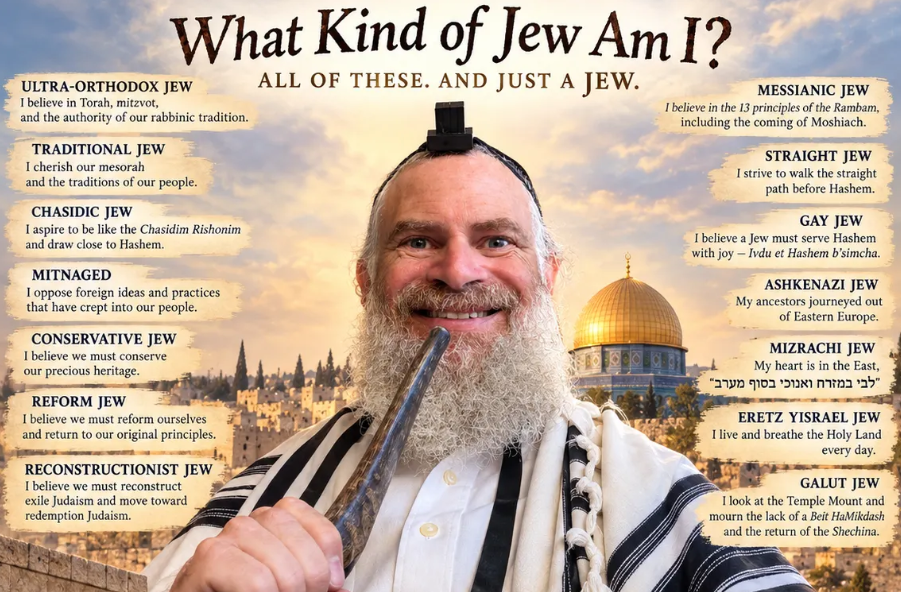
What kind of Jew am I? Well, I suppose I am an ultra-Orthodox Jew, because I believe deeply in Torah, mitzvot, and the authority of our rabbinic tradition. I am also a traditional Jew, because I cherish the traditions handed down to us through countless generations. I do not see them as relics of a distant past, but as a living inheritance entrusted to us to preserve, practice, and transmit to our children.
I am also a Chasidic Jew—at least in aspiration. Not necessarily in the modern denominational sense, but in the ancient sense of the Chasidim Rishonim described by Chazal, those exceptionally pious Jews who devoted themselves completely to prayer, mitzvot, and closeness to Hashem. I certainly cannot claim to have reached their level, but I can aspire to walk in their footsteps. At the same time, I am a Mitnaged, because I oppose what I believe are foreign ideas and practices that have crept into Jewish life during our long exile and obscured some of the original national character of Torah.
I am a Conservative Jew, because there is something extraordinarily precious that desperately needs conserving: our Torah, our mesorah, our language, our people, our Land, and the inheritance passed from parent to child since the days of Avraham Avinu. But I am also a Reform Jew, because I believe that some things desperately need reforming. Not the Torah—us. Jewish life must continually examine how far we have drifted from the Torah’s original vision and how we can return to it. Sometimes the greatest reform is not creating something new, but recovering something very old.
In that sense, I suppose I am even a Reconstructionist Jew, because I believe we have an enormous task of reconstruction before us. Two thousand years of exile forced Judaism to develop around the realities of a scattered, stateless people. Entire dimensions of national Torah life became theoretical, dormant, or reduced to prayers for a distant future. Now that millions of Jews have returned to Eretz Yisrael, we must begin reconstructing those dimensions of Jewish existence. We must learn how to move from an exile Judaism built for survival toward a redemption Judaism capable of national revival.
I am most certainly a Messianic Jew, because I firmly believe in the Thirteen Principles articulated by the Rambam, including the coming of Moshiach. Ani ma’amin b’emunah sheleimah b’viat HaMoshiach. I believe he will come, I await his coming, and however long it takes, I continue to await him. Belief in redemption is not some strange addition to Judaism; it is embedded in our prayers, our prophets, our Torah, and our national consciousness.
I am a straight Jew, because I believe a Jew should strive to walk the straight path before Hashem. And, if we are playing with the literal meaning of words, I am also a gay Jew, because a Jew is supposed to serve Hashem joyously. Ivdu et Hashem b’simcha—“Serve Hashem with gladness.” Judaism should not merely be endured. Serving the Creator of the universe is an extraordinary privilege, and that service should ultimately be filled with simcha.
I am an Ashkenazi Jew, because my ancestors journeyed out of Eastern Europe carrying their Torah, their traditions, their memories, and their longing for Zion with them. But I am also a Mizrachi Jew, because my heart is in the East. Rav Yehuda HaLevi expressed that longing nearly a thousand years ago in words that still capture the Jewish soul in exile: לִבִּי בְמִזְרָח וְאָנֹכִי בְּסוֹף מַעֲרָב—“My heart is in the East, while I am at the farthest West.” Wherever a Jew wandered, his spiritual compass remained pointed toward Jerusalem. After generations in which my ancestors could only turn toward Eretz Yisrael in prayer and dream of returning, I have been privileged to make that journey myself.
So I am an Eretz Yisrael Jew, because I live and breathe the Holy Land every day. I see Jewish children speaking Hebrew in the streets of Jerusalem and watch an ancient people rebuilding its homeland before my eyes. I don’t view Eretz Yisrael merely as a safe haven for persecuted Jews, but as the place in which the Jewish people can ultimately fulfill its national and spiritual destiny.
Yet strangely enough, I am still a Galut Jew, because when I look toward the Temple Mount and see that there is still no Beit HaMikdash, I know that our redemption remains incomplete. When I mourn the absence of the Shechinah from its proper place and pray for the complete restoration of Jerusalem, I know that simply returning to the Land was never the final destination. A Jew can live in Jerusalem and still yearn for Yerushalayim.
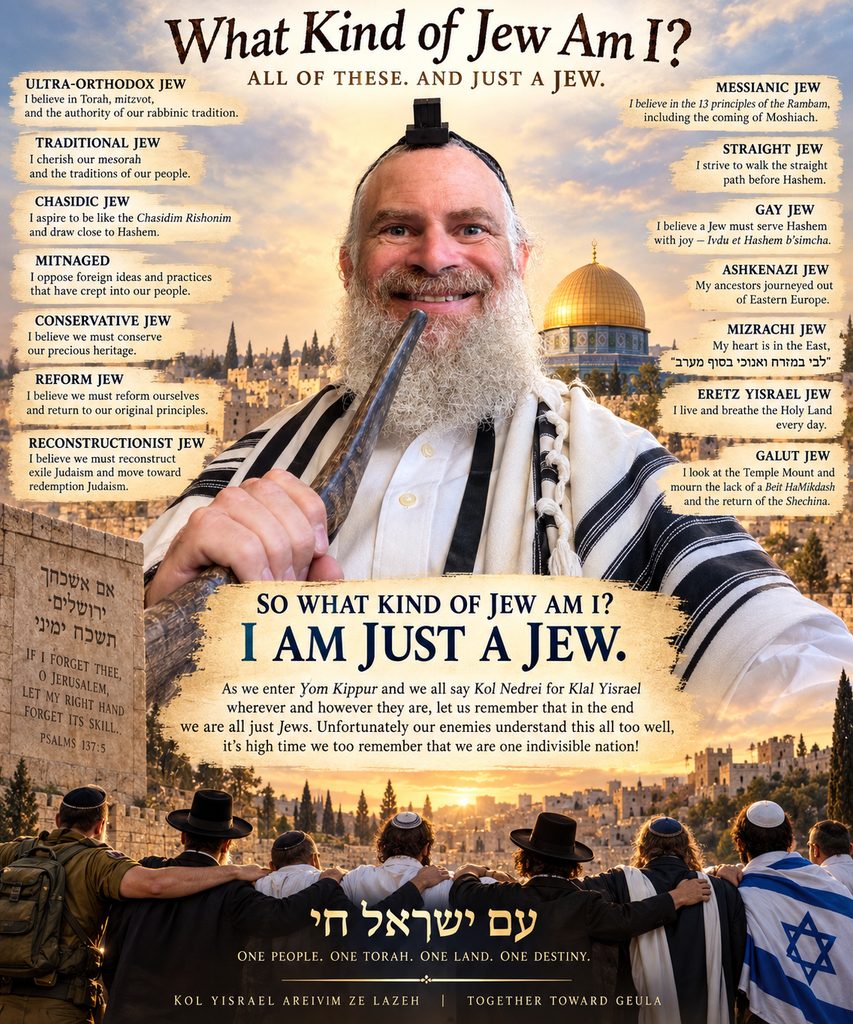
So after all these labels, what kind of Jew am I? I am just a Jew—a Jew trying, imperfectly, to serve his Creator to the best of his ability; a Jew trying to understand what Hashem wants from him and from His people; a Jew who sometimes succeeds and sometimes fails, but who continues trying. And perhaps that is something particularly important to remember as we enter Yom Kippur.
When Kol Nidrei begins, Jews throughout the world will gather together: Ashkenazim and Sephardim, Chasidim and Mitnagdim, religious and secular, Israelis and Jews of the Diaspora, Jews who enter a synagogue three times every day and Jews who may enter one only once a year. We may spend the rest of the year inventing increasingly precise labels to describe ourselves and increasingly narrow categories into which to place everyone else, but on Yom Kippur we stand before Hashem together as Klal Yisrael.
Our enemies have understood this frighteningly well. They rarely pause to ask what kind of Jew we are before deciding that we are Jews. Perhaps it is high time that we understood it just as clearly ourselves. We are one people—an extraordinary, argumentative, stubborn, ancient, eternal people. We can disagree passionately, as Jews always have, but beneath those disagreements lies something infinitely deeper than the labels we have accumulated.
As we stand before Hashem on Yom Kippur, asking Him to forgive us, to inscribe us for life, and to bring His people closer to complete redemption, perhaps we should also ask for the wisdom to see one another again—not first as Orthodox or secular, Chasidic or Litvish, Reform or Conservative, Ashkenazi or Sephardi, Israeli or Diaspora, right or left, but simply as Jews. We are one people, with one Torah, one Land, one destiny, and one Father in Heaven. עם ישראל חי. May this be the year when we finally remember it—and begin to live like it.
Gmar Chatima Tova!
This article was republished with permission from Rabbi Wander’s Substack.

