




There are moments in Jewish history that seem ordinary while they are happening. Only years later do people look back and realize that something fundamental had shifted. For those watching the process of Geula unfold before our eyes, however, there are times when its significance is impossible to miss. Rosh Hashanah 5787 was one of those times.
Two extraordinary events took place this Rosh Hashanah in Jerusalem. To much of the Jewish world they may appear obscure, technical, or even insignificant. But to anyone who understands Geula not merely as something we pray for, but as the gradual restoration of Jewish national and spiritual life in Eretz Yisrael, they were groundbreaking. Practices that had disappeared from Jewish public life for generations—and in one case are directly associated with the avodah and institutions of ancient Jerusalem—were heard again.
The first occurred on the first day of Rosh Hashanah, which this year fell on Shabbat. Throughout virtually the entire Jewish world, no shofar was sounded that day. This follows the longstanding halachic practice established after the destruction of the Beit HaMikdash: when Rosh Hashanah falls on Shabbat, the shofar is generally not blown. Yet Chazal preserved an extraordinary exception connected to a Beit Din, and the precise parameters and contemporary applicability of that exception have been debated by major halachic authorities.
This year, I merited to participate in a minyan in the Old City of Jerusalem where the shofar was actually sounded on Shabbat in the presence of a specially designated Beit Din. Hundreds of people packed into the room at Machon HaMikdash to witness something almost no Jew alive has experienced as part of the normal Rosh Hashanah landscape: the sound of the shofar on the first day of Rosh Hashanah even though it was Shabbat.
There was something profoundly symbolic about the setting. This was not occurring in New York, London, Paris or even elsewhere in Israel. It was happening in Yerushalayim, in the Old City, within sight of the place toward which Jews have directed their prayers throughout nearly two thousand years of exile. A mitzvah whose Shabbat observance became intimately connected in Chazal with Jerusalem and the authority of Beit Din was once again being performed there before a large Jewish gathering. But remarkable as that was, it was only the beginning.
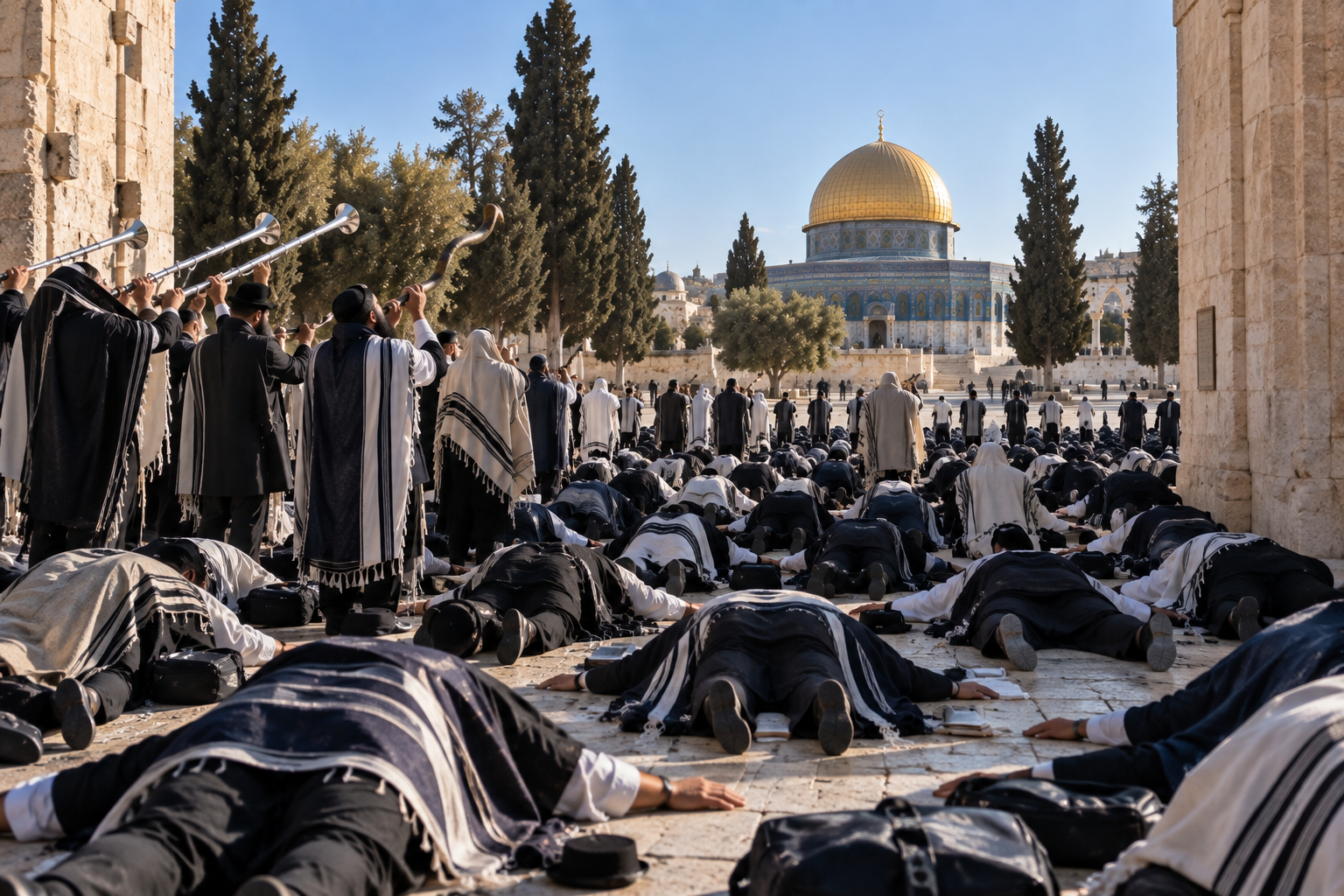
On the second day of Rosh Hashanah, I merited to participate in something even more astonishing. Approximately 120 Jews ascended to the permissible areas on the Har HaBayit, The Temple Mount, and, under strict security supervision, successfully davened using police-sanctioned machzorim. This was no brief visit or hurried prayer whispered while walking. The davening continued for more than four hours on Har HaBayit. Many of us were even wearing tallitot on the Mount for the first time. To stand there on Rosh Hashanah, wrapped openly in a tallit and holding a machzor, surrounded by Jews doing the same, was itself an extraordinary sight. The atmosphere was electric. Four hours of organized Jewish prayer on Judaism’s holiest site on Rosh Hashanah was unprecedented in modern times and would have been almost inconceivable only a few years ago.
Think about the transformation contained in that one scene. For years, Jews could be detained or removed for visibly praying on Har HaBayit. Even bringing a siddur onto the Mount was unheard of. Yet on Rosh Hashanah 5787, approximately 120 Jews spent more than four hours there openly davening from machzorim, many wrapped in tallitot. What had once required a whispered prayer, a barely perceptible movement of the lips, was now taking place openly and collectively. Regardless of where one stands in the broader debates surrounding Har HaBayit, the historical transformation itself is impossible to deny.
Then came a sound that made the significance of the occasion even more tangible. One hundred blasts of the shofar were sounded alongside chatzotzrot—the silver trumpets whose use is rooted explicitly in the Torah and which played a central role in the national and sacred life of Am Yisrael. The Torah commands, “And on the day of your gladness, and on your appointed festivals, and on your new moons, you shall sound the trumpets over your elevation offerings and over your peace offerings, and they shall be for you a remembrance before your God; I am Hashem your God” (Bamidbar 10:10).
For generations we have read these words. We have studied them and spoken about them, while the actual sound of the chatzotzrot remained something belonging to another age of Jewish history. The public use of these instruments, so intimately associated with the national worship of Am Yisrael, disappeared with the destruction of our national religious institutions following the Roman destruction of Jerusalem. We even see a set of the Chatzotzrot that was stolen from the temple memorialized on the Arch of Titus in Rome. Yet in 5787, on Rosh Hashanah, shofarot and chatzotzrot were sounding together again on Har HaBayit.
It is difficult to describe the emotion of witnessing this firsthand. People were in tears. Others simply stood there trying to comprehend what they were seeing and hearing. Berachot of Shehecheyanu and HaTov VeHaMeitiv were even recited by participants who understood that they were witnessing something far beyond an unusual Rosh Hashanah minyan. Wrapped in tallitot, machzorim in hand, with the sounds of shofar and chatzotzrot filling the air, we were watching another small piece of Jewish history return to life.
Geula does not necessarily arrive in a single dramatic moment. The Yerushalmi famously describes redemption as emerging קימעא קימעא—little by little. A door opens that had been closed. Something considered impossible becomes controversial. What was controversial becomes tolerated, and what was tolerated eventually becomes normal. Suddenly we look backward and discover that the Jewish people have crossed a threshold without even realizing it.
That has been the story of modern Jewish history. Jews returned to cultivate the Land. Hebrew returned as a spoken language. Jewish sovereignty returned. Jerusalem returned to Jewish control. Jews returned to the Old City. Har HaBayit returned to Jewish hands. And now practices associated with ancient Jewish Jerusalem are beginning to reappear. Each individual development can be dismissed as small or insignificant, but when they are placed alongside one another, a much larger picture begins to emerge.
Perhaps the greatest danger is not that miracles will fail to occur, but that they will occur and we will fail to recognize them. Chazal teach, אין בעל הנס מכיר בנסו—the person experiencing a miracle does not always recognize his own miracle. Future generations may look back upon our period and wonder how Jews living through such extraordinary events could possibly have regarded them as ordinary. They may ask how a generation that witnessed the ingathering of millions of Jews, the rebirth of Jewish sovereignty, the liberation of Jerusalem and the gradual restoration of practices unseen for generations could still wonder whether anything significant was happening.
This Rosh Hashanah, I did not have to imagine the sights and sounds of ancient Jerusalem; I experienced a taste of them. On the first day, I heard the shofar sounded on Shabbat before a Beit Din in the Old City of Jerusalem. On the following day, I stood among approximately 120 Jews who spent more than four hours davening on Har HaBayit, many of us wrapped in tallitot there for the first time, machzorim in our hands, as one hundred shofar blasts sounded alongside chatzotzrot. Those sights and sounds carried something much greater than ceremony. They carried memory, restoration and the unmistakable message that Jewish history is moving again.
We have entered the year 5787, and if its first two days are any indication, this may prove to be a very Geuladik year indeed. We have prayed three times every weekday for generations, תקע בשופר גדול לחרותנו—“Sound the great shofar for our freedom.” This year, in Yerushalayim, we merited to hear a small taste of what that might sound like.
This article first appeared on Rabbi Wander’s substack

