




This article draws on analysis originally published by Efraim Palvano in Mayim Achronim, adapted from his book Garments of Light.
Every September, Americans return to the same images: two towers falling, a gash in the Pentagon, a nation watching in disbelief. Few know that centuries before airplanes existed, a Jewish mystical text described a city whose highest towers would collapse on a single day, along with another, more massive structure. The passage comes from the Zohar, the foundational work of Jewish mysticism, and it builds on a prophecy spoken not by a Jewish prophet, but by a gentile sorcerer named Bilaam who was hired to destroy the Jewish people.
How did a curse meant to annihilate Israel end up tied, three thousand years later, to America’s darkest day?
The story begins in the Book of Numbers. Balak, the king of Moab, watched the Israelites conquer the nations around him and feared he was next. Rather than face them in battle, he hired Bilaam, described by the Sages as a prophet equal in stature to Moses, to curse the Israelites into oblivion. The comparison is not casual praise. The Sages note that no prophet ever again rose in Israel like Moses, but among the nations of the world, Bilaam came close (Sifri, Devarim 34:10). This was not a hired charlatan. Bilaam’s own donkey saw an angel blocking the road and spoke in protest before Bilaam himself could see it (Numbers 22:28), a sign of just how thin the wall was between this man and the supernatural. The Talmud records that Bilaam knew precisely when to strike: God has a single fleeting moment of anger each day, lasting roughly a fifty-eight-thousandth of an hour, and Bilaam intended to unleash his curse in that instant (Berakhot 7a). The plan failed. Every time Bilaam opened his mouth to curse Israel, a blessing came out instead. Furious and humiliated, Bilaam delivered a final oracle reaching far beyond his own lifetime:
“I see it, but not now; I behold it, but it is not soon. A star has gone forth from Jacob, and a scepter will arise from Israel which will smite the Moabite princes and uproot the sons of Seth. Edom shall be inherited, and Seir will become the inheritance of its enemies, and Israel shall do valiantly. And out of Jacob shall one have dominion, and will destroy the remnant of the city.” (Numbers 24:17-19)
The Sages identify the “star of Jacob” as Mashiach, the Messiah. The Zohar (III, 212b), first printed in Mantua in 1558, does not stop at identifying the star. It lays out an entire timetable for its appearance, describing a star burning with seventy pillars of fire and seventy sparks, ringed by seventy lesser stars, all of which will blaze for seventy days. The recurrence of seventy is not incidental in Jewish tradition. The Sages count seventy root nations descending from Noah, seventy elders who received the spirit of prophecy alongside Moses (Numbers 11:16-17), and seventy years of Babylonian exile before the return to Zion. A prophecy built on sevens and seventies is, by the Zohar‘s own internal logic, describing something at the scale of the world’s nations, not a single city’s troubles. The star is to be seen on the sixth day, on the twenty-fifth of the sixth month, and gathered back in on the seventh day, at the close of those seventy days. On the first day of that period, the Zohar says, the star will appear over a city of Rome. On that day, three towering structures in that city will collapse, a fourth great building will fall, and the ruler of that city will die. Wars will erupt across the earth, and, in the Zohar‘s own phrase, “no faith will be found” among the nations.
The identity of “Rome” is the key to the passage as a whole, and Jewish sources do not refer to the city on the Tiber. Rome functions here as a stand-in for Edom, the nation descended from Esau, and by extension for whatever city or power sits at the center of the Western world in a given generation. Historically, Jewish tradition has traced this succession in stages. Rome itself, the original seat of Edomite power, fell in 476 CE. Its role passed to Constantinople, sometimes called the “second Rome,” which itself later fell and became Istanbul. From there, the tradition holds, a “third Rome” was destined to rise. Scholars within this tradition have generally proposed two candidates for that role: Moscow, largely on the strength of its own historical self-description as a “third Rome,” and New York, as the financial and cultural capital of the modern Western world.
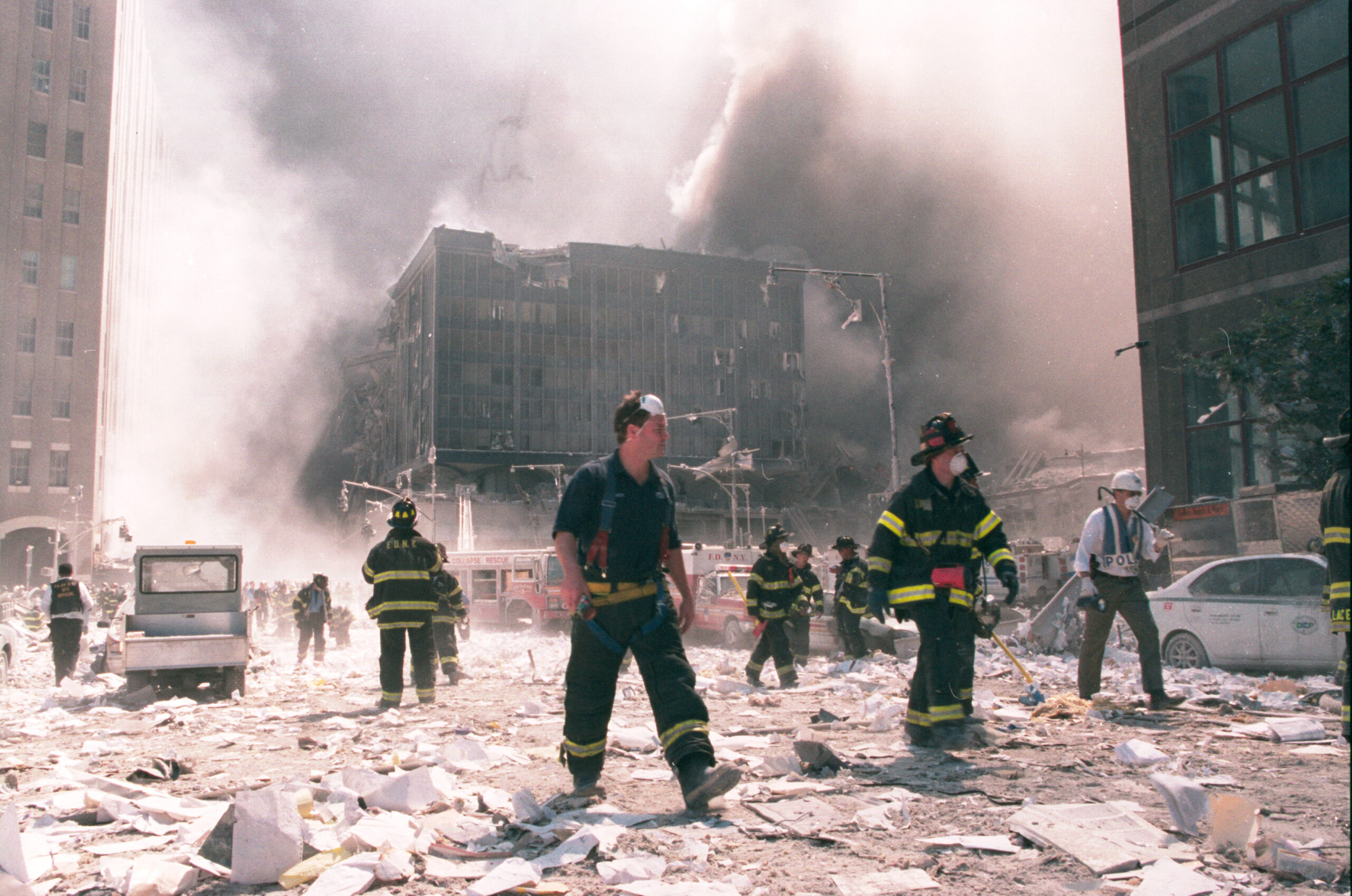
It is the New York reading that produces the striking parallel. If New York is the “city of Rome” of this generation, then the Zohar‘s three collapsing towers and one additional fallen edifice map with real precision onto the three World Trade Center buildings that came down that morning, the North Tower, the South Tower, and the 47-story WTC 7, plus the section of the Pentagon struck the same day. Washington, D.C. has its own case to make as well: it is the actual seat of the American government, matching the Zohar‘s image of a ruling city, it too came under direct attack that morning, and, in a detail worth noting for its own sake, the man who first surveyed and settled the land that would become the U.S. capital gave it the name Rome before the federal city existed at all.
This would not be the first time students of this tradition have applied the “third Rome” framework to a modern collapse. The Soviet Union, the twentieth century’s other great rival to the American-led West, fell apart within two months of Rosh Hashanah of the Hebrew year 5750, a coincidence of timing that Jewish sources have pointed to in the same spirit: not as proof, but as another data point in a pattern of major world powers unraveling on a schedule that traditional texts claim to have anticipated. Whether the power in question is Soviet Communism or the American colossus of September 2001, the underlying claim is the same: that Edom’s various incarnations are all running against a clock that the Zohar set down centuries before any of them existed.
Here, though, is where a careful reading has to slow down rather than speed up. The Zohar dates the star’s appearance to the twenty-fifth of the Hebrew month of Elul. In 2001, the twenty-fifth of Elul fell on September 13, not September 11, when the towers actually came down. The version of this story that circulates most widely accounts for that gap by going a step further: it holds that the Vilna Gaon, the eighteenth-century sage Rabbi Eliyahu Kramer, examined the Zohar‘s date and declared it off by two days, correcting it to the twenty-third of Elul, which in 2001 fell precisely on September 11. That correction, the claim goes, survives in a mystical work called the Sifra DiTzniuta. The claim does not hold up under examination. The Sifra DiTzniuta itself predates the Vilna Gaon by centuries, so he could not have inserted a correction into the original text, and a direct search through both the Sifra DiTzniuta and the Vilna Gaon’s own commentary on it turns up no mention of the twenty-third of Elul or any correction to the Zohar at all. The claim appears to be a later invention attached to his name after the fact, not a documented teaching.
The rest of the Zohar‘s sequence raises the same problem on a larger scale. The passage does not end with the falling towers. It describes the death of “the ruler of that city” on the day the towers fall, which did not happen on September 11. It describes a single great king rising afterward to rule the entire world, which has not happened either. It describes the star eventually disappearing and the Holy Land trembling for forty-five miles around the site of the Holy Temple, splitting open to reveal an underground cave from which a fire will burn the world and a “great branch” will emerge to rule it, at which point Mashiach is finally revealed. None of that has occurred; what 9/11 offers is a partial resemblance to the opening lines of a much longer prophecy, not a fulfillment of the prophecy as a whole.
What is harder to dismiss is the Zohar‘s claim about what follows the falling towers, regardless of which city they belong to: great wars stirring in every corner of the earth, and faith disappearing among the nations. The two decades after September 11 produced exactly that kind of upheaval: wars in Afghanistan and Iraq, the rise and territorial collapse of ISIS, and a wave of conflict across the Middle East that has not fully subsided. Religious observance across the Western world has fallen sharply over the same period, with church attendance and formal religious affiliation in the United States and Europe dropping to levels unimaginable a generation earlier. The Zohar did not need to name the specific buildings correctly to describe the world that came after them.
That distinction matters more than it might seem. Jewish tradition has never treated Bilaam’s prophecy, or the Zohar‘s elaboration of it, as a prediction to be checked off against a single news event. It treats both as part of a longer map of the “Footsteps of Mashiach,” the period the Talmud says will precede the final redemption (Sanhedrin 97a, 98b), a period the Sages describe elsewhere as chevlei Mashiach, the “birth pangs of the Messiah,” marked by war, confusion, and the gradual weakening of Edom’s grip on the world (Sanhedrin 97a). Viewed that way, September 11 is not the fulfillment of Bilaam’s curse-turned-blessing. It is, at most, an early tremor in a sequence the Zohar insists is still unfolding, one that includes a dying ruler, a world conqueror, and a cave beneath Jerusalem that has not yet been found. Bilaam set out to erase Israel from the map entirely. Three thousand years later, his own words are still being read for what they say about Rome, about Edom, and about how much of that story has not yet been written.
