


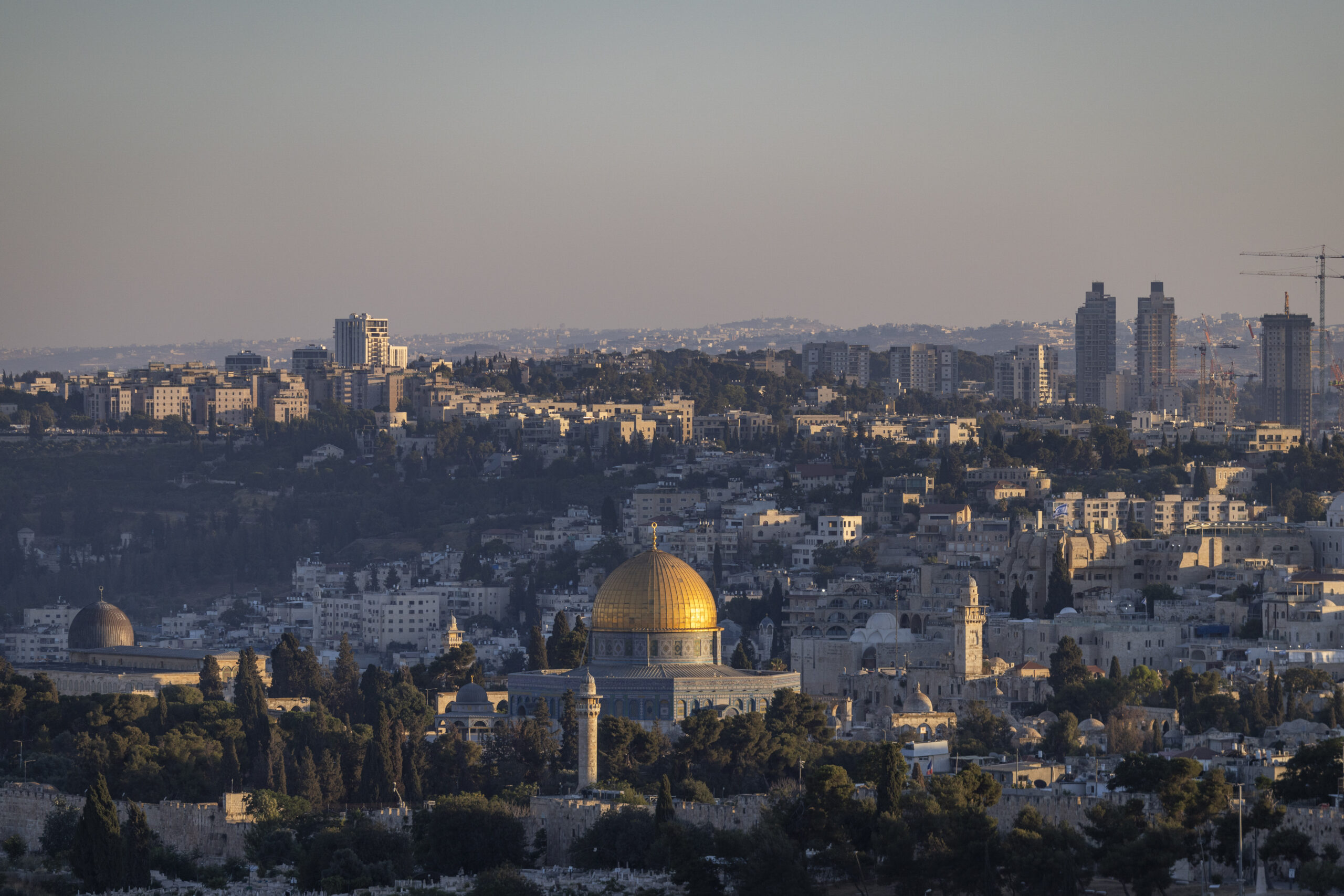
In a pre-election Q&A session, a questioner posed something Israeli politicians rarely answer directly: what happens to the mosque on the Temple Mount when the Third Temple rises? Speaking to supporters this week, Zehut chairman Moshe Feiglin answered without flinching.
Feiglin, who founded Zehut in 2015 after Prime Minister Benjamin Netanyahu blocked his advancement inside Likud, has spent three decades building a political identity around Jewish sovereignty and rejection of the Oslo Accords. He has called the accords something to throw “into the trash bin of history.” On September 1, he signed a joint Knesset list with Religious Zionism chairman Bezalel Smotrich, taking the No. 2 slot ahead of the October 27 election, after Zehut spent years polling below the electoral threshold on its own.
Asked how the mosque on the Temple Mount would ever open up to make room for the Temple, Feiglin gave his full answer, translated here in its entirety:
“The Zehut party will not build the Third Temple. Am Yisrael [the nation of Israel] will build the Third Temple. The Third Temple will not be built by some accidental majority, at midnight, in some Knesset committee. Am Yisrael will build it because an entirely new consciousness will descend and envelop all of us. I believe the Third Temple will be built ish echad b’lev echad — as one man, with one heart — when we all want it. This will no longer be a partisan matter. Because if it becomes a partisan matter, it won’t be something that lasts. So no — Zehut isn’t the one who will build the Temple. Am Yisrael will build it.
“What about the mosque? I believe the Arabs will vacate it. I truly believe this. I really, truly believe this. I believe we will reach a point where the entire world will want to see the Temple built.
“In the consciousness we’re in right now, this sounds far-fetched, impossible. But we’ve seen how quickly things can change. Why will it happen? Because it is written in the Torah — just as it was written in the Torah — that we would return to our land after nearly two thousand years, and that was the most far-fetched thing in the world. The most far-fetched thing in the world, far more so than building the Temple. And that came true too. That came true too.”
מה יקרה למסגד אל אקצא כשיגיע זמנו של בית המקדש השלישי? pic.twitter.com/AmDZNjsE1a
— משה פייגלין Moshe Feiglin (@moshefeiglin) September 6, 2026
Feiglin is pointing to a promise that the Sages read directly from the text. “For I will take you from among the nations, and gather you out of all the countries, and bring you into your own land” (Ezekiel 36:24). Ezekiel wrote those words to a nation in exile, with no state, no army, and no plausible path home. It happened anyway.
Feiglin’s larger claim is not really about the mosque. It is about the mechanism. He is arguing that the Temple, like the return to the land before it, will come from the same source the Sages have long attached to Jewish national restoration: “Not by might, nor by power, but by My spirit, said the LORD of hosts” (Zechariah 4:6) — a verse that echoes Feiglin’s argument almost precisely, whether he cited it or not. The Temple will not be built by whoever controls sixty-one seats.
Building With What Was There Before
The Dome of the Rock and Al-Aqsa Mosque did not rise on an empty plateau. Archaeological surveys of the Dome of the Rock’s construction confirm that its seventh-century builders incorporated columns and stones from Jerusalem’s Jewish ruins into the structure itself, folding remnants of the destroyed Temple complex directly into the new building.
The two structures are also not the same building, a distinction that gets flattened in casual reporting. Al-Aqsa Mosque sits at the southern end of the Temple Mount platform and functions as an actual mosque, a congregational prayer hall built for that purpose. The Dome of the Rock stands further north on the same platform, a domed shrine rather than a mosque, constructed around the Foundation Stone — the bedrock outcropping that Jewish tradition identifies as the site of the Kodesh HaKodashim, the Holy of Holies, the innermost chamber where the Aron HaKodesh, the Ark of the Covenant, once rested.
Both previous Temples went up with non-Jewish hands doing part of the physical work. King Hiram of Tyre supplied the cedar, the craftsmen, and the shipping for Solomon’s Temple, and the biblical text records the joint labor plainly: “So Solomon’s builders and Hiram’s builders and the men of Gebal did hew them, and prepared timber and stones to build the house” (I Kings 5:18). Four centuries later, it was not a Jewish king who authorized the Second Temple but the Persian emperor who had just conquered Babylon. “Thus said Cyrus king of Persia: The LORD, the God of heaven, has given me all the kingdoms of the earth, and He has charged me to build Him a house in Jerusalem, which is in Judah” (Ezra 1:2). Isaiah goes so far as to call Cyrus “Mashiach” — God’s anointed — the only non-Jew in the entire Bible given that title (Isaiah 45:1).
Isaiah’s description of the Temple extends its reach past Israel’s borders entirely. “Even them will I bring to My holy mountain, and make them joyful in My house of prayer… for My house shall be called a house of prayer for all peoples” (Isaiah 56:7). Zechariah goes further still, describing outsiders as builders rather than visitors: “And those who are far off shall come and build the Temple of the LORD, and you shall know that the LORD of Hosts has sent me to you” (Zechariah 6:15). Radak — Rabbi David Kimchi, the twelfth-century commentator whose work remains standard in Jewish Bible study — reads that verse as a direct reference to Herod’s massive renovation and expansion of the Second Temple. Herod, grandson of an Idumean convert rather than a native Israelite, is precisely the kind of outsider Zechariah’s prophecy describes: someone “far off” who ended up building the house.
Rabbis Already Made This Offer, in Writing, in 2018
Feiglin’s confidence that the Arabs will vacate the Temple Mount is not a lone prediction. In March 2018, the nascent Sanhedrin — a body of ordained rabbis working to re-establish the seventy-one-member court mandated by the Bible — released a formal letter in Hebrew, English, and Arabic, addressed directly to the Arab world and inviting it to take up a defined role in the Third Temple.
The letter did not treat the Temple Mount as a zero-sum dispute. It addressed the Arab nations as “the distinguished Sons of Ishmael” and told them plainly that the time had come to rebuild the Temple on Mount Moriah “in its ancient place.” Rather than asking the Arab world to step aside, the letter asked it to step forward: “We are applying to your Honorable ones… to give oath, raise vows and gifts to the Temple as prophesied by prophet Isaiah concerning your essential role and honorable position in keeping the Temple and supporting it with lamb sacrifices and incense in order to receive God’s Blessings.” The letter backed that invitation with a specific text: “Raise your eyes and look about: They have all gathered and come to you… the wealth of the sea shall pass on to you, the riches of nations shall flow to you… Dust clouds of camels shall cover you, dromedaries of Midian and Ephah. They all shall come from Sheba; they shall bear gold and frankincense, and shall herald the glories of Hashem” (Isaiah 60:4-6). Twenty-three ordained rabbis signed it, with the Sanhedrin working at the time to gather the full quorum of seventy-one before sending it to major Arab institutions.
Rabbi Yeshayahu Hollander, one of the signatories, tied the gesture to Israel’s own biblical mandate rather than to diplomacy. “The Jews are commanded to be a nation of priests,” he said, citing God’s charge at Sinai: “But you shall be to Me a kingdom of priests and a holy nation” (Exodus 19:6). “We are to be of service to the whole world in connecting to Hashem,” Hollander explained. “This universal aspect is essential to what the Temple is: a house for all nations” — the same claim built into “My House shall be called a house of prayer for all peoples” (Isaiah 56:7), the verse already central to how the Sages read the Temple’s purpose. Hollander added the one condition the whole plan depends on: “Of course, for us to serve, the other people need to cooperate.”
Rabbi Aharon Yitzchak Shtern, a prominent Haredi rabbi and Sanhedrin member, framed the timing in terms of choice rather than inevitability. “Geula [redemption] is very near,” he said. “It can either come in war and hardship, or it can come in peace and mercy. We are inviting the B’nei Yishmael to choose peace and godliness.” Shtern invoked the eighteenth-century Vilna Gaon to underline the stakes of a single sacrifice: “If a single sacrifice is brought in the Third Temple, the shofar announcing the Messiah will already start to blow.”
Rabbi Hillel Weiss, the Sanhedrin’s spokesman, was explicit that the letter carried no political ask. “The letter is not asking for monetary support,” Weiss said. “The Sanhedrin is not asking for permission from foreign governments or from the Israeli government. Building the Temple is not political or legal. It is a mitzvah incumbent upon the Jews.” He grounded the invitation in lineage rather than religion: “The letter does not reach out to other religions because of their belief but rather because of their ancestral role as the Children of Esau and the Children of Ishmael. We are asking them to be prepared to take their part in serving God.”
Feiglin’s answer this week did not cite the Sanhedrin’s letter, and there is no indication he was drawing on it directly. But the overlap is exact. Both rest on the same verses. Both describe Arab participation as fulfillment rather than removal. And both make the same wager: that a role already written into the biblical text will eventually be claimed, whether or not any government forces the issue.
Feiglin’s claim draws directly from that well. His insistence that the Arabs would vacate the mosque and that the world would want to see the Temple built restates what Isaiah and Zechariah already put in writing: the house in Jerusalem, when it rises again, has never in Jewish text been described as a Jewish project alone.
Whether or not Feiglin sits in the next Knesset, he has staked out a position no coalition math can settle. He is betting that the same national will his tradition credits with ending two thousand years of exile will one day be strong enough to finish what it started.

