



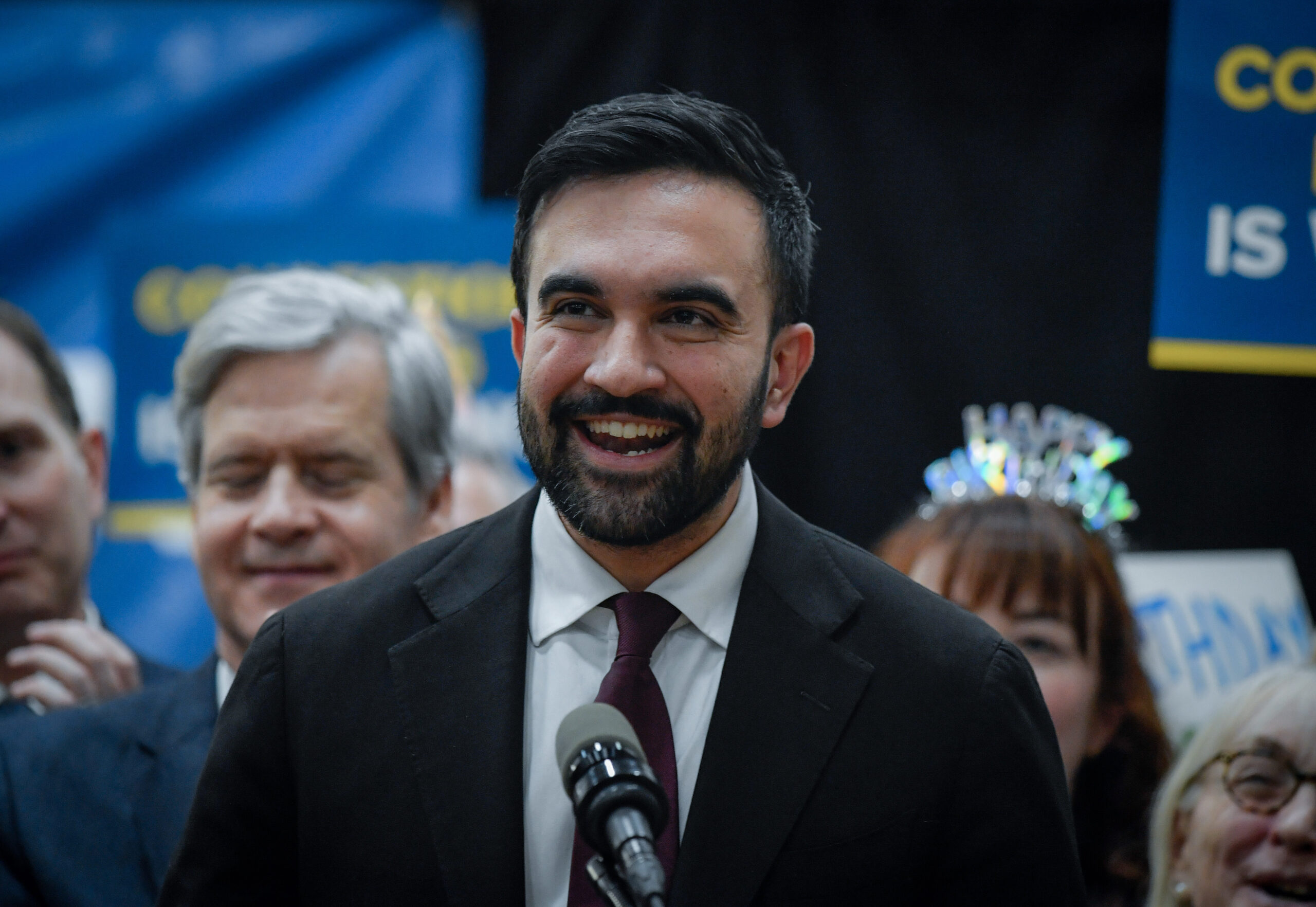
New York City Mayor Zohran Mamdani handed the ceremonial pen from a 9/11 remembrance ceremony to his chief counsel Friday, a lawyer who once represented a convicted al-Qaeda operative whose brother-in-law hijacked American Airlines Flight 77 and flew it into the Pentagon.
Mamdani signed two executive orders at City Hall ahead of the 25th anniversary of the September 11 attacks, one designating the date a citywide day of remembrance and service, the other strengthening the city’s defenses against future terror threats. After signing the final order, Mamdani turned to NYPD Commissioner Jessica Tisch, handed her the pen, and asked her to pass it along. Tisch handed it to Ramzi Kassem, Mamdani’s chief counsel, who had arrived only minutes earlier. She left the Blue Room shortly after, the first official to exit the press conference.
Kassem previously represented Ahmed al-Darbi, a Guantánamo Bay detainee who pleaded guilty to war-crime charges tied to al-Qaeda plots against commercial shipping, including the 2002 bombing of a French oil tanker off the coast of Yemen. Al-Darbi’s sister was married to Khalid al-Mihdhar, one of the five hijackers aboard Flight 77, which struck the Pentagon on September 11, 2001, killing 184 people.
City Hall told reporters that Kassem attended the ceremony because he and his staff had drafted both executive orders as part of his official duties as chief counsel. Kassem, who also founded a legal clinic at CUNY offering free representation to Muslims, has separately represented Mahmoud Khalil, a leader of the pro-Palestinian encampment at Columbia University who was detained by Immigration and Customs Enforcement.
The handoff drew swift condemnation. Retired NYPD detective and John Jay College adjunct professor Michael Alcazar called the gesture calculated. “It happened during a ceremony meant to be about the victims, and no one else,” he said. “Commissioner Jessica Tisch was reduced to a prop rather than acknowledging her role as the leader of the NYPD.” Dennis Warchola, whose brother Michael, a firefighter with Ladder 5, died in the North Tower, was blunter still. “It’s bullshit,” he said. “How can you defend a guy like that who wants to do Americans or any innocent person harm?”
City Council Member Joann Ariola, a Queens Republican, called the moment “breathtakingly tone-deaf and disrespectful.” “It shows exactly where his loyalties truly lie,” she said. “The families who lost loved ones on 9/11 have every right to be outraged. On the 25th anniversary, City Hall should be honoring their sacrifice with dignity, not forcing those families to endure yet another insult.” Council Member Vicki Paladino, also a Queens Republican, went further, arguing that Kassem’s presence at the ceremony was itself the point. “Ramzi Kassem said he was inspired by 9/11, not to join the fight against terrorism, but to defend the terrorists themselves,” she said. “His participation in anything related to 9/11 is an insult to every New Yorker who survived that day, and indeed all Americans. But I suspect that’s the point.”
The criticism spread quickly online. Podcaster Benny Johnson called the moment “a slap in the face to victims ahead of the 25th anniversary of 9/11.” Former New York state Senate candidate Maria Danzilo wrote that the incident illustrated the difficulty of living in a city under Mamdani’s leadership as the solemn anniversary approaches. Former Democratic political consultant David Sivella accused Mamdani of sending a signal to a specific constituency. “Was it deliberate on your part to give your Muslim base a hint that this is all BS to pacify other New Yorkers?” he asked on X.
🚨 NOW: Ugandan Mayor Mamdani is facing major backlash from victims' families after he signed a 9/11 executive order and gave the honorary pen to a lawyer who REPRESENTED an AL-QAEDA TERRORIST connected to the Pentagon attack — NYP
— Eric Daugherty (@EricLDaugh) September 5, 2026
The enemy is inside the gates.
The pen was… pic.twitter.com/AnfVXamkfM
Mamdani’s office did not respond to a request for comment on the criticism. Kassem also did not respond.
Mamdani’s own words about 9/11 had drawn scrutiny even before he took office. During an October 2025 campaign speech on Islamophobia outside the Islamic Cultural Center of the Bronx, Mamdani grew emotional describing a relative’s experience after the attacks. “I want to speak to the memory of my aunt, who stopped taking the subway after September 11 because she did not feel safe in her hijab,” he said. Within days, critics pointed out that Mamdani’s only documented biological aunt, Masuma Mamdani, had been working in Tanzania at the time of the attacks and was not seen wearing a hijab in available photos. Confronted with the discrepancy, Mamdani clarified that he had actually been referring to “Zehra fuhi,” a cousin on his father’s side who had since died — “fuhi” being a Hindi and Urdu term for a paternal aunt, not a biological one. Vice President JD Vance mocked the episode on X: “According to Zohran the real victim of 9/11 was his auntie who got some (allegedly) bad looks.” Terry Strada, a 9/11 widow, told the Daily Mail she found the comparison “completely insulting” to families who lost loved ones that day.
Friday’s ceremony was not the first time Mamdani’s relationship to 9/11 had drawn scrutiny. Weeks before the anniversary, a petition calling on organizers to bar Mamdani from the commemoration had gathered nearly 100,000 signatures, though only a small share of signers appear to be related to victims. The petition was launched by Giovanni Galante, whose wife Grace Catherine was killed in the attacks, who called Mamdani’s planned attendance “a slap in the face,” saying it was “not because he is Muslim” but “because of who he supports.” The petition pointed to Mamdani’s refusal, until recently, to condemn the phrase “globalize the intifada”; to a book published by Mamdani’s father shortly after 9/11 describing suicide bombers as a “feature of modern political violence rather than stigmatized as a mark of barbarism”; and to the mayor’s past praise for Brooklyn imam Siraj Wahhaj, an alleged co-conspirator in the 1993 World Trade Center bombing, and his having served as a character witness for Omar Abdel-Rahman, the “Blind Sheikh” convicted in 1995 of plotting terror attacks on New York landmarks. Mamdani has since said he would discourage use of the intifada phrase, and has condemned past 9/11 remarks by influencer Hasan Piker, a Mamdani supporter, though he has continued to associate with him.
The call for Mamdani to stay away drew a widening list of prominent voices. Former Republican Gov. George Pataki, who led the state on the day of the attacks, said anyone unwilling to distance himself from Piker or reject “globalize the intifada” — which he said calls for violence against Jews “not just in Israel but anywhere in the world” — should not attend. The Port Authority Retired Police Association, representing officers from the agency that lost 37 members that day, wrote to Mamdani asking him to skip the ceremony so it would not become “the center of political controversy.” Catholic League president Bill Donohue sent his own open letter asking Mamdani to stay away, noting the mayor had also skipped the city’s Veterans Day parade and Israel Day parade. Republican gubernatorial candidate Bruce Blakeman urged attendees to turn their backs on Mamdani should he show up. No New York City mayor has ever missed the annual memorial.
Not every family member agreed. Nikki Miller, whose father Douglas was among the 343 firefighters killed that day, and who belongs to the group September 11 Families For Peaceful Tomorrows, said plainly, “Mayor Mamdani is not a terrorist.” City Council Speaker Julie Menin, a frequent Mamdani critic, called the campaign to exclude him “absolutely inappropriate,” noting that officials of any party are permitted at the ceremony only as silent observers. Organizers of the memorial said elected officials of both parties have always been welcome.
Mamdani has said he intends to attend regardless, pledging to “proudly honor the families, the survivors, the first responders forever impacted by that horrific terror attack by standing alongside them.” In the weeks before the anniversary he visited firehouses that suffered some of the heaviest losses on September 11, and the city set aside $34.2 million in its fiscal year 2027 budget for a public online portal for documents related to the attacks. Trump, by contrast, will not attend the New York ceremony at all. He is expected to mark the anniversary instead with remarks at the Pentagon, reportedly after organizers of the Manhattan event declined to give him a speaking role, making him the only living president absent from Ground Zero on the 25th anniversary.
The pattern of scrutiny reaches back further still, to how Mamdani has spoken about terrorism against Israel. The day after the October 7, 2023, attack, Mamdani posted a statement on social media that named no attacker. “I mourn the hundreds of people killed across Israel and Palestine in the last 36 hours,” he wrote, attributing the violence to “Netanyahu’s declaration of war,” Israel’s decision to cut electricity to Gaza, and Knesset members “calling for another Nakba,” concluding that peace could only begin “by ending the occupation and dismantling apartheid.” Two years later, marking the anniversary, Mamdani’s language shifted to explicitly call the attack “a horrific war crime” that killed more than 1,100 Israelis and saw 250 more taken hostage, and he said he mourned the victims and prayed for the hostages’ return. But the bulk of that later statement again turned to criticizing Israel’s military response as a “genocidal war” and describing the American government as “complicit.” Israel’s Foreign Ministry called the language “a mouthpiece for Hamas propaganda,” writing on X that “by repeating Hamas’s lies, he excuses terror and normalizes antisemitism. He stands with Jews only when they are dead.”
Mamdani should just put “Hamas PR Department” on his profile pic.twitter.com/xaadEw1sHH
— Israel Foreign Ministry (@IsraelMFA) June 24, 2026
Mamdani’s positions on Israel’s legitimacy and on Holocaust remembrance have followed a similar pattern of ambiguity. During a June 2025 primary debate, when asked whether he believed Israel had a right to exist as a Jewish state, Mamdani said only, “I believe Israel has a right to exist,” and, pressed again, “as a state with equal rights.” In a separate interview with Fox News, he was more direct about his reasoning, saying he was “not comfortable supporting any state that has a hierarchy of citizenship based on religion or anything else.” That January, Mamdani had also declined to co-sponsor a New York State Holocaust remembrance resolution, though his campaign later said he had supported it by voice vote.
The “globalize the intifada” phrase itself became a defining flashpoint of Mamdani’s mayoral campaign. Pressed three times by NBC’s Kristen Welker in a June 2025 appearance on “Meet the Press” to condemn the phrase, which Anti-Defamation League CEO Jonathan Greenblatt has called “an explicit incitement to violence,” Mamdani repeated, “That’s not language that I use,” and said he did not believe a mayor’s role was to “police speech.” He gave a similarly evasive answer weeks earlier in an interview with The Bulwark. The refusal drew condemnation across party lines, including from Democratic Sen. Kirsten Gillibrand, Rep. Josh Gottheimer, and Rep. Ritchie Torres. Only after the backlash intensified did Mamdani tell a group of New York business leaders in July 2025 that he would “discourage” use of the phrase — language that still stopped short of an outright condemnation.
Mamdani’s posture toward Hamas itself has followed a similar arc. Asked directly by Fox News anchor Martha MacCallum in October 2025 whether Hamas should disarm and give up control of Gaza under the terms of the ceasefire it had signed, Mamdani said, “I don’t really have opinions about the future of Hamas and Israel beyond the question of justice and safety.” A day later, facing a moderator’s question at a mayoral debate about the “confusing” answer, he reversed himself: “Of course, I believe that they should lay down their arms.” On his first day as mayor, Mamdani revoked a series of executive orders signed by his predecessor, Eric Adams, including the city’s adoption of the International Holocaust Remembrance Alliance’s definition of antisemitism and a measure barring city agencies from participating in boycotts of Israel. Israel’s Foreign Ministry called the move “antisemitic gasoline on an open fire,” and a coalition of Jewish organizations, including the ADL, the American Jewish Committee, and the New York Board of Rabbis, issued a joint statement warning that “significant protections against antisemitism” had been reversed. Weeks later, when a crowd gathered outside Park East Synagogue in Manhattan and called for violence during a Zionist immigration event inside, Mamdani’s office “discouraged” the rhetoric without directly condemning the demonstrators, while separately describing the synagogue event itself as a “violation of international law.”
The pattern has extended to counterterrorism policy as well. In March 2026, two men authorities say were inspired by ISIS attempted to detonate bombs near Gracie Mansion during an anti-Muslim protest; the devices failed to go off. Mamdani has continued to press ahead with his plan to disband the NYPD’s Strategic Response Group, the unit trained in counterterrorism and large-scale crowd response, even after the attempted bombing, saying he wants to separate counterterrorism functions from protest policing.
Mamdani and the political left more broadly have spent months minimizing the significance of 9/11. Gasparino, who covered the attacks and their aftermath firsthand for The Wall Street Journal, pointed to a Michigan Senate candidate who recently campaigned alongside an influencer who once claimed America “deserved 9/11,” and argued that Mamdani himself has repeatedly declined to denounce the phrase “globalize the intifada.” Gasparino wrote that Mamdani has instead focused his public concern on “Islamophobia,” which he argued pales in scale next to the antisemitism he believes the mayor downplays. Mamdani’s supporters, Gasparino wrote, are disproportionately young, transplanted to the city, and largely without any lived memory of the attacks, a generational shift he said has made it easier for 9/11’s meaning to be reshaped a quarter century later.
