
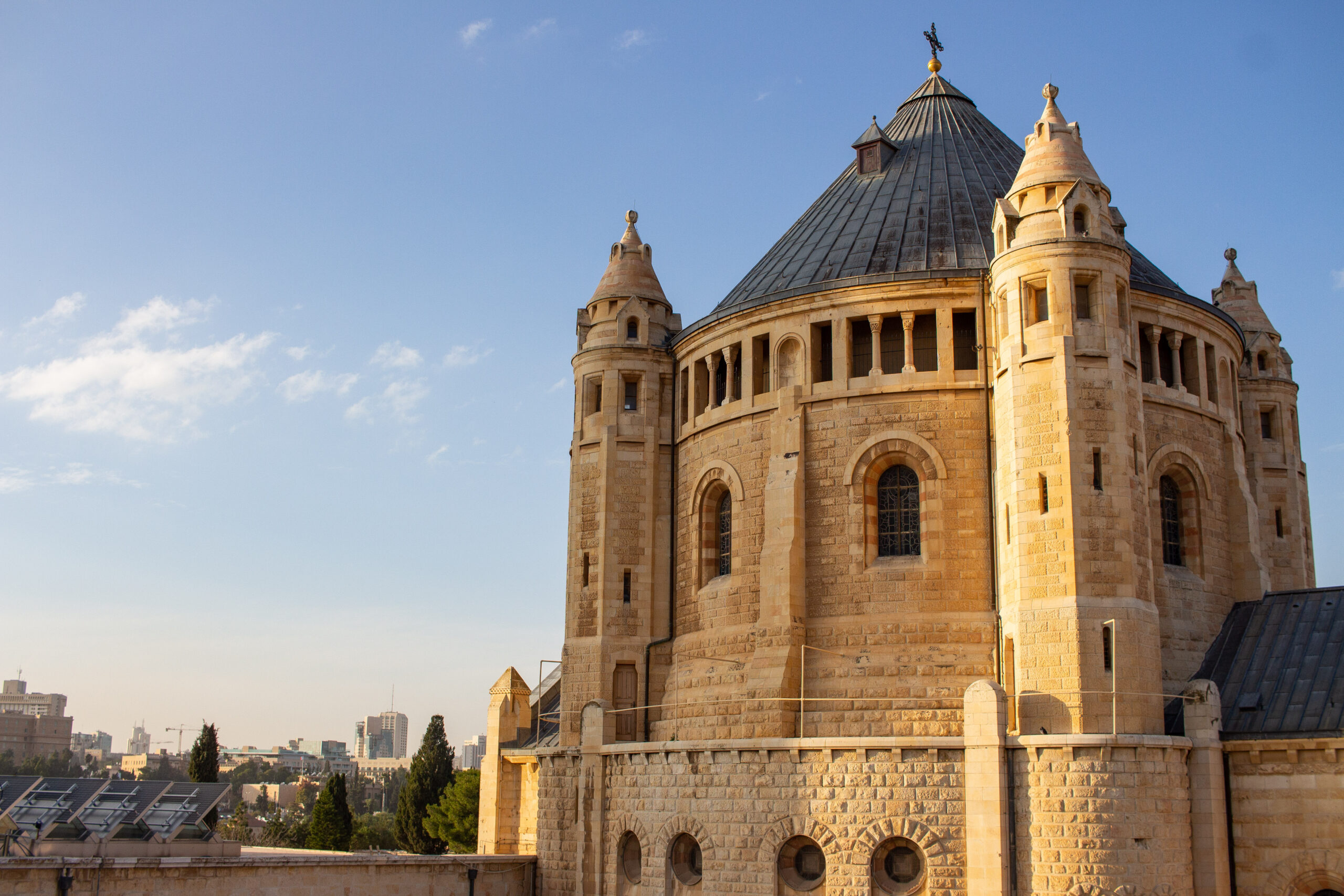
A multi-year excavation beneath the floor of the Church of the Holy Sepulchre has pulled back nearly two thousand years of buried history, revealing a stone quarry turned garden turned burial ground exactly where the New Testament places the crucifixion and burial of Jesus.
The excavation, led by Francesca Stasolla, an archaeology professor at Sapienza University of Rome, ran through 2025 and focused on the ground beneath one of Christianity’s most visited sites, located in Jerusalem’s Old City. The team’s findings were published in a 98-page preliminary report in Liber Annuus, the archaeological journal of the Studium Biblicum Franciscanum in Jerusalem.
The report lays out a clear sequence. The site began as a stone quarry outside the walls of ancient Jerusalem. Once quarrying ended, the land was converted to agricultural use, with olive trees and grapevines dated to roughly the first century CE. Rock-cut tombs, carved directly into the stone in the style typical of Second Temple period Jewish burial, appear in the same layer. Later strata show a Roman-era layout, including material sealed by the Emperor Hadrian’s construction in the second century CE, before Constantine’s builders erected the first church on the site in the fourth century CE.
Stasolla’s team recovered ancient seeds and pollen from the layer between the quarry’s abandonment and the Roman occupation, physical evidence for the transition from stone-cutting to farmland. “The quarry had to be gradually abandoned,” Stasolla said of the shift.
The Hebrew Bible gives clues as to how the ground outside Jerusalem’s walls actually looked like in the century Jesus lived and die. Long before the Gospels were written. Garden burial was already Judean practice centuries earlier. The book of Kings records the death of King Manasseh:
“And Manasseh slept with his fathers, and was buried in the garden of his own house, in the garden of Uzza; and Amon his son reigned in his stead.” (II Kings 21:18)
Manasseh ruled Judah in the seventh century BCE, some seven hundred years before the events described in the Gospels. His burial, and later his son Amon’s, in a private garden attached to a residence establishes that garden burial had deep roots in Israelite custom well before the Roman period. The tombs Stasolla’s team uncovered, cut into rock and set among cultivated land, sit inside that same tradition rather than outside it. Second Temple period Jews commonly buried their dead in niche-style rock tombs known as kokhim, carved into quarried stone precisely like the tombs found beneath the church.
The Gospel of John describes the crucifixion site as bordering a garden containing a new tomb where no one had yet been buried. Douglas Estes, an associate professor of religion at New College of Florida who was not involved in the excavation, said archaeology has “confirmed, again and again, details from the Gospel of John.” He pointed to an earlier example: nineteenth-century scholars doubted John’s description of five colonnades at Jerusalem’s Pool of Bethesda, a detail later confirmed by excavation.
Stasolla and her team are careful about what the findings do and do not establish. No inscription or artifact ties any specific chamber to Jesus of Nazareth by name. What the excavation confirms is that the landscape itself, a quarry gone to seed, planted with olives and vines, ringed with tombs cut into its own rock, matches the setting the Gospel writers described in specific, checkable detail.
That is the part worth sitting with. The Hebrew Bible recorded garden burial as ordinary Judean practice seven centuries before the Common Era. The Gospels recorded it again in the first century. Twenty centuries later, pollen grains and seed fragments pulled from beneath a church floor in Jerusalem’s Old City confirm both records were describing the same real ground. The Bible was not writing myth dressed as geography. It was writing geography, and the dirt underneath Jerusalem just backed it up.
Three alternative sites have real followings, and none of them threaten the Church of the Holy Sepulchre’s position with mainstream archaeologists, but each has its own history worth knowing.
The most serious rival is the Garden Tomb, located near Damascus Gate outside Jerusalem’s Old City walls. British general Charles Gordon popularized it in 1883 after he identified a nearby rock formation resembling a skull, matching the name Golgotha, meaning “place of the skull.” The tomb itself is an ancient rock-cut burial chamber, and the site includes an actual garden setting, which appealed strongly to nineteenth-century Protestant sensibilities uncomfortable with the ornate, incense-heavy Church of the Holy Sepulchre shared by Orthodox, Catholic, and Armenian communities. Archaeological dating has since placed the tomb itself several centuries earlier than the first century, likely from the era of the First Temple, which undercuts the case for it being a “new tomb” as described in the Gospel accounts. Even so, the Garden Tomb remains an active pilgrimage site, and many evangelical groups still hold services there specifically because of its quiet, unadorned setting.
A second and far more controversial theory centers on the Talpiot Tomb, discovered in 1980 during construction in East Talpiot, a Jerusalem neighborhood. The tomb contained ten ossuaries, several inscribed with names including Yeshua bar Yosef, understood as “Jesus son of Joseph,” along with names read by some as Maria, Yose, and Mariamene. Filmmaker Simcha Jacobovici and religious studies professor James Tabor argued in a 2007 documentary and later book that this was the family tomb of Jesus, and that one ossuary belonged to Mariamene, whom they identified with Mary Magdalene. The claim collapsed under scrutiny from the broader archaeological community. Names like Yeshua, Yosef, and Maria were among the most common names in first-century Judea, comparable to finding a grave marked “John Smith” today and declaring it uniquely significant. The statistical argument for the tomb’s significance, developed by a University of Toronto statistician working with the filmmakers, was independently challenged and largely rejected by scholars who examined the underlying assumptions.
A third theory sits well outside mainstream scholarship but persists in certain circles: the claim that Jesus survived the crucifixion, traveled east, and died decades later in Kashmir, in what is now Srinagar, India. The Roza Bal shrine there is venerated by some local traditions as his tomb. This theory has no support in early Christian sources, in Jewish sources from the period, or in serious historical scholarship, and functions more as a regional legend that gained international attention through a handful of twentieth-century writers than as a genuine archaeological contender.
The scholarly debate that actually matters, and the one Stasolla’s excavation speaks to directly, is narrower and more technical: whether the traditional site was truly outside Jerusalem’s city walls at the time of the crucifixion, since Jewish law required burial and execution outside city limits. British archaeologist Kathleen Kenyon’s excavations in the twentieth century already supported the case that the area was outside the Second Wall in the first century, and the newly confirmed agricultural layer beneath the church, with olive trees and grapevines dated to the same period, adds physical weight to that same conclusion rather than opening a new site to the debate.