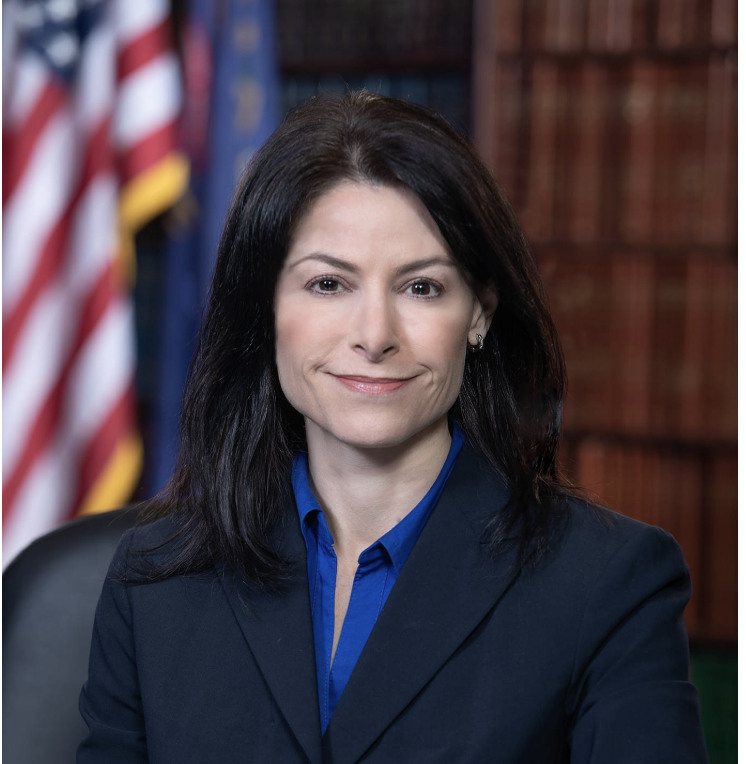
Michigan Attorney General Dana Nessel, who is Jewish, told a gathering of Jewish Democrats on Sunday that they carry a “moral imperative to place the needs of the world above even our own self-interest and, yes, even our own survival.”
Speaking at the Michigan Democratic Jewish Caucus’ annual “Summer Simcha” event in Birmingham, where she was being honored, Nessel invoked the Purim story of Queen Esther to make her case. “It is perhaps up to us now to follow in her path,” she said, “and sacrifice the comfort, safety, and security and even the very future of our own people in exchange for the opportunity to save the rest of humanity.” She extended the argument to Israel itself. “What good is defending the historic homeland of our ancestors and demanding that candidates acknowledge its right to exist,” she asked, “if the planet upon which it rests is no longer inhabitable?” She named climate change, artificial intelligence, nuclear war and economic inequality as issues Jewish voters must weigh alongside Israel and antisemitism, closing with a direct appeal: “Come November, what do your Jewish values tell you to do?”
Five Weeks Earlier, a Different Message
The speech came five weeks after Nessel gave Michigan’s Jewish community an entirely different message about her own party. At a July roundtable with Jewish leaders and community members, Nessel said she would skip the Michigan Democratic Party’s August nominating convention because she did not feel safe attending. “I feel like my presence isn’t going to be welcome. I don’t want to get chased around. I don’t want to get harassed. I don’t want to get yelled and screamed at. I don’t want to get booed off the stage, irrespective of what I’m saying,” she said. “And I believe that if I go, that is what will happen because it’s been happening to me.” At the same roundtable, Nessel compared the rise of antisemitism on the political left and inside the Democratic Party to the growth of neo-Nazi organizations on the far right. “This cannot continue,” she said. Derrick Honeyman, a spokesperson for the Michigan Democratic Party, responded that the party “reject[s] antisemitism, Islamophobia, and all forms of hateful conduct” and was working to secure the convention.
The July roundtable took place against the backdrop of the March attack on Temple Israel in West Bloomfield Township, which the FBI said it believed was inspired by Hezbollah. Rabbi Arianna Gordon, the synagogue’s director of education and lifelong learning, described the lasting toll on the congregation, which will be displaced for months. “The cost that we are putting in to secure our building right now is unbelievable, and that’s a cost that insurance doesn’t cover,” she said, adding that students, parents and teachers still panic at the sound of sirens or fire alarms. Other roundtable participants described antisemitism reaching into Michigan schools. Jennifer Stevens, a Brighton parent, said her 11-year-old son faced two explicit incidents of antisemitic language from classmates that the school punished but never addressed through education. “So far, we have been underwhelmed,” she said, adding that she fears for her younger daughter, who is Black, adopted and Jewish, entering the same school district in a few years. Dr. Michael Ambrose, a parent in Beverly Hills, said his district was more engaged but still overly cautious. “I still do get the sense that they’ve got to be walking on eggshells, and they’re worried about being so careful that they don’t want to upset anybody,” he said. “Call out antisemitism for what it is.”
Earlier this year, Michigan AG Dana Nessel announced she was skipping the state Democratic nominating convention because she didn't "feel safe" and feared harassment as a Jewish woman.
— CAMERA (@CAMERA4Truth) August 31, 2026
This week, Nessel reportedly urged Jewish Democrats during a private speech to "sacrifice the… https://t.co/gmpUsvFdBF pic.twitter.com/fHhjQ3rFpP
The Backdrop: A Synagogue Attack and a Senate Candidate’s Response
Democratic Senate nominee Abdul El-Sayed’s response to the Temple Israel attack became a separate flashpoint that has shadowed Nessel’s summer of public statements. In a video statement at the time, El-Sayed condemned the attack but also said “hurt people hurt people,” language Nessel later said many Jewish Democrats read as an excuse for the gunman’s actions. In an interview with The Atlantic’s David Frum, Nessel called the remark “concerning” given that the attacker “sought to murder over 100 pre-K schoolchildren.” She contrasted it with her own response to the 2019 Christchurch mosque massacre, when she visited a Dearborn mosque and condemned the attack without qualification. “I didn’t try to get into, like, what were the motivations of the person who killed these people,” Nessel said. “I just condemned it unequivocally, and I think that’s what people should have done with Temple Israel. You can’t make excuses for that kind of domestic terrorism.” She said El-Sayed privately regrets the remark but, as of late August, had not withdrawn it publicly. She also cited his post-primary reference to “breaking bread with Jews at Passover” — a holiday on which bread is forbidden — as evidence of a broader unfamiliarity with Jewish practice and with Israel’s history.
Despite those criticisms, Nessel made clear in the same interview that she would not back Republican nominee Mike Rogers, saying she would “amputate my right arm” before voting for him because “keeping a Republican majority in the Senate is incredibly dangerous.” Of El-Sayed, she said: “We have a lot in common in terms of our general beliefs and principles and policies… I have much more in common with Abdul El-Sayed than I do with Mike Rogers.”
Not the First Concession
Writing in the Jewish Journal, historian Rafael Medoff argued that Nessel’s Birmingham remarks fit a pattern rather than a single lapse. Medoff pointed to 2024, when Nessel’s office brought charges against eleven anti-Israel activists who occupied part of the University of Michigan campus and obstructed police sent to clear the encampment. Rep. Rashida Tlaib and others publicly attacked Nessel over the charges, calling them “a shameful attack on students’ rights.” Nessel later dropped the case, citing what she called the “circus-like atmosphere” surrounding it, despite acknowledging there was sufficient evidence to convict. “It wasn’t enough that Nessel let the anti-Israel lawbreakers go scot free; she had to be willing to sacrifice the very existence of the Jewish people,” Medoff wrote of the Birmingham speech. “And, sadly, she has now announced her willingness to do exactly that.”
Medoff also noted that Nessel’s July safety concerns were not abstract. He cited the case of California State Senator Scott Wiener, who was surrounded and chased by Hamas supporters in a San Francisco park earlier this year, and New York Democratic congressional nominee Brad Lander, who was harassed outside Madison Square Garden by protesters accusing him of being a “Zionist.” “Her concerns certainly were valid,” Medoff wrote, arguing that made her Birmingham remarks harder to reconcile with her own July warnings. “Unlike Dana Nessel, most Jews still consider the existence of the Jewish people, and the Jewish state, to be a Jewish value,” he wrote. “It’s not surprising antisemites don’t see it that way, but it’s troubling that Attorney General Nessel doesn’t, either.”
On March 2, 2023, Nessel announced that she was among several Jewish government officials targeted in antisemitic threats made on social media by a heavily armed Michigan man. Commenting on the threat on Twitter, Nessel stated: “It is my sincere hope that the federal authorities take this offense just as seriously as my Hate Crimes & Domestic Terrorism Unit takes plots to murder elected officials.” Carpenter was found incompetent to stand trial, suffering from a combination of unusually grandiose conspiracy theories and a persecution complex, with threatening posts toward others including a vow to execute Elon Musk.
Michigan’s roughly 100,000 Jewish voters, a historically Democratic bloc, remain divided over El-Sayed heading into November, in a race both parties see as a factor in control of the U.S. Senate.