


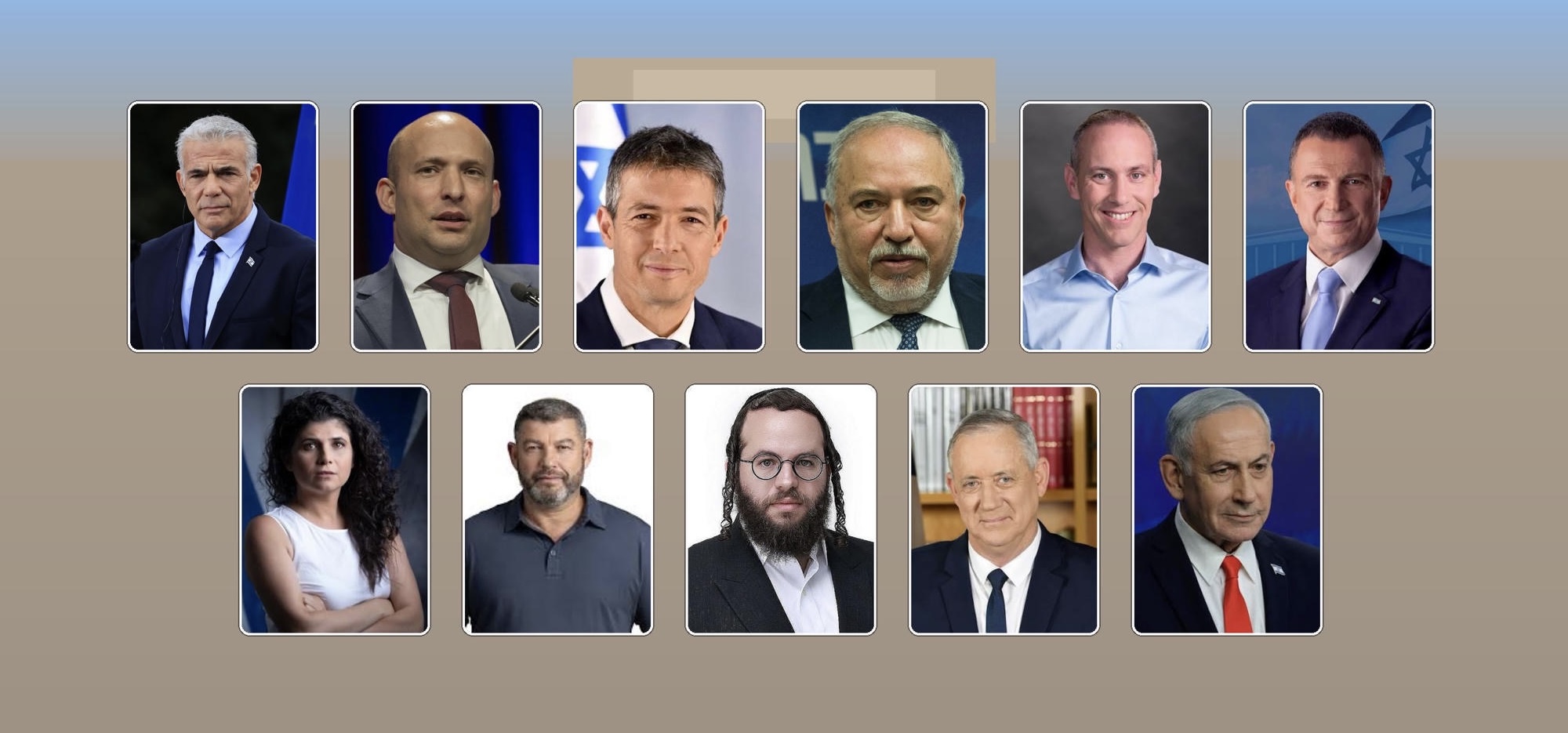
With Israel’s national elections two months away, pollsters, reporters, and pundits typically talk about the two main “blocks” of parties likely to make up the next coalition, based on projections from regular polls. The polls vary slightly, but show an overall similar trend.
The first block is that of the current government with five political parties, including the long-time dominant Likud party under Benjamin Netanyahu, the “Bibi block,” including two nationalist religious parties and two ultra-Orthodox religious parties. Many refer to this as the classic example of a “natural coalition” because it’s easier to bring together like-minded people and parties with common interests, or at least those who have not spent an entire campaign (and the term of the outgoing government) making public declarations and fighting one another.
The second block is referred to as the “change” block which is made up of most/all of the several parties that are currently in the opposition, as well as new parties that have emerged in the last several weeks, each seeking to be part of a government that will either discard all the parties of the existing government, or at least provide enough alternatives to form a coalition that will not be identical to the current government.
The variables here are the three Arab parties that are longtime members of the Knesset. Yes, for those that think Israel is an apartheid state, allow me to debunk that notion as Arab parties typically account for 10-15 seats in the parliament, plus or minus 10 percent of the total. With the exception of the previous government, in which the Arab Islamist party, Ra’am, joined the coalition, these parties typically become a third bloc of votes, as they neither want to support them nor have most previous governments wanted to include specifically non-Zionist Arab parties. That glass ceiling was broken last time, and technically anything could happen this time, despite polarizing declarations. But even if not formally part of the government, the Arab parties could find themselves “supporting” the government from “outside” in a parallel set of coalition negotiations.
But what if the “natural coalition” is not the one that represents two main blocks, but a hybrid of them? What if the statement that the formation of a government of one or the other blocks is “what the voters wanted” is a farce, and what the voters truly want is a coalition that straddles the center and right of the spectrum (as there is virtually no party that is firmly on the left of the spectrum except one, the Democrats (no relation to US politics).
In order to form a government, a coalition needs at least 61 of the Knesset’s 120 seats. Getting to 61 can be done through the traditional “natural coalitions,” but it can also be done by mixing and matching other parties. Following any election, there are various ways to reach 61+. Some are improbable, but some might surprise us.
What would have happened differently if, following the previous national election, Netanyahu went for a coalition that comprised other centrist and right-wing parties, not the reflexive “natural” coalition that he has now? What if after winning enough votes and being given the mandate to form the government, he made four phone calls to political rivals including former Prime Ministers Naftali Bennett and Yair Lapid of the same political party, to Avigdor Lieberman his once protégé and now adversary, and to Benny Gantz the former Chief of Staff who previously entered a coalition with Netanyahu during COVID to find himself cut out of the Prime Ministerial rotation agreement they had made to form the government to begin with?
What if Netanyahu offered these leaders and their parties’ seats at the table to govern without relatively polarizing extremists on either side? If they had said yes, the government would have been very different and probably something most Israelis could get behind. If they had said no, Netanyahu would have looked like a statesman rather than a divisive figure, even if he ended up creating the same coalition he has now, one so many Israelis want to see gone, especially after the October 7 Hamas attack and massacre.
If polls today are accurate, Gadi Eisenkot, another former Chief of Staff and former partner with colleague Benny Gantz’s party, and his new Yashar party will win the popular vote and be given the mandate to form a government. If that happens, the same polls show that he will still have trouble getting to the minimum 61 seats to form a majority government based on projections for the current opposition parties. What if his first call was to Netanyahu to talk about a coalition government with him and Likud, with parties that are currently part of the opposition, and 1-2 of the new parties that might pass the electoral threshold of 3.25% of the votes to count?
Although part of the opposition or “change” block is also known as the anti-Bibi block, what if Eisenkot were to offer Netanyahu the position of Foreign Minister, or Finance Minister, at which he excelled in the early 2000s under Ariel Sharon’s government?
Would Netanyahu accept, or attempt to force Eisenkot into a coalition that relied on Arab parties’ support so, from day one, he could be critical of that? If he were to reject such an offer, are there enough people in Likud who would break away and form a faction of one third of Likud’s 21-23 seats (based on current polls) and join an Eisenkot government, leaving Netanyahu and his close Likud allies a shell of what it was, and not even necessarily the main opposition party? Would Eisenkot leap out of the gate with the impression of being a unifying statesman in a broad center-right government that mathematically is no less “natural” than a Bibi-block vs a change block? Would Israelis who are just really driven to see Netanyahu be retired celebrate such a shake-up?
There are many ways to reach 61 seats and form a government. After years of widespread divisiveness between political parties, three years since the October 7 Hamas attack and massacre, and the ensuing war which has not ended, many Israelis are looking for a change. The vote may reflect that, but how any political party and its leadership choose to get to at least 61 seats may be even more important than the vote itself.
Join the conversation September 16 at 1:00 pm Eastern time with a panel of undecided Israeli voters to evaluate these and other factors that Israelis will consider on election day.

