
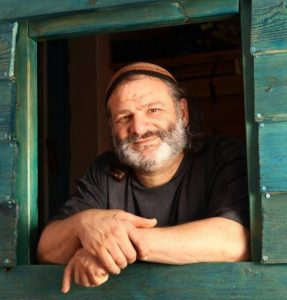
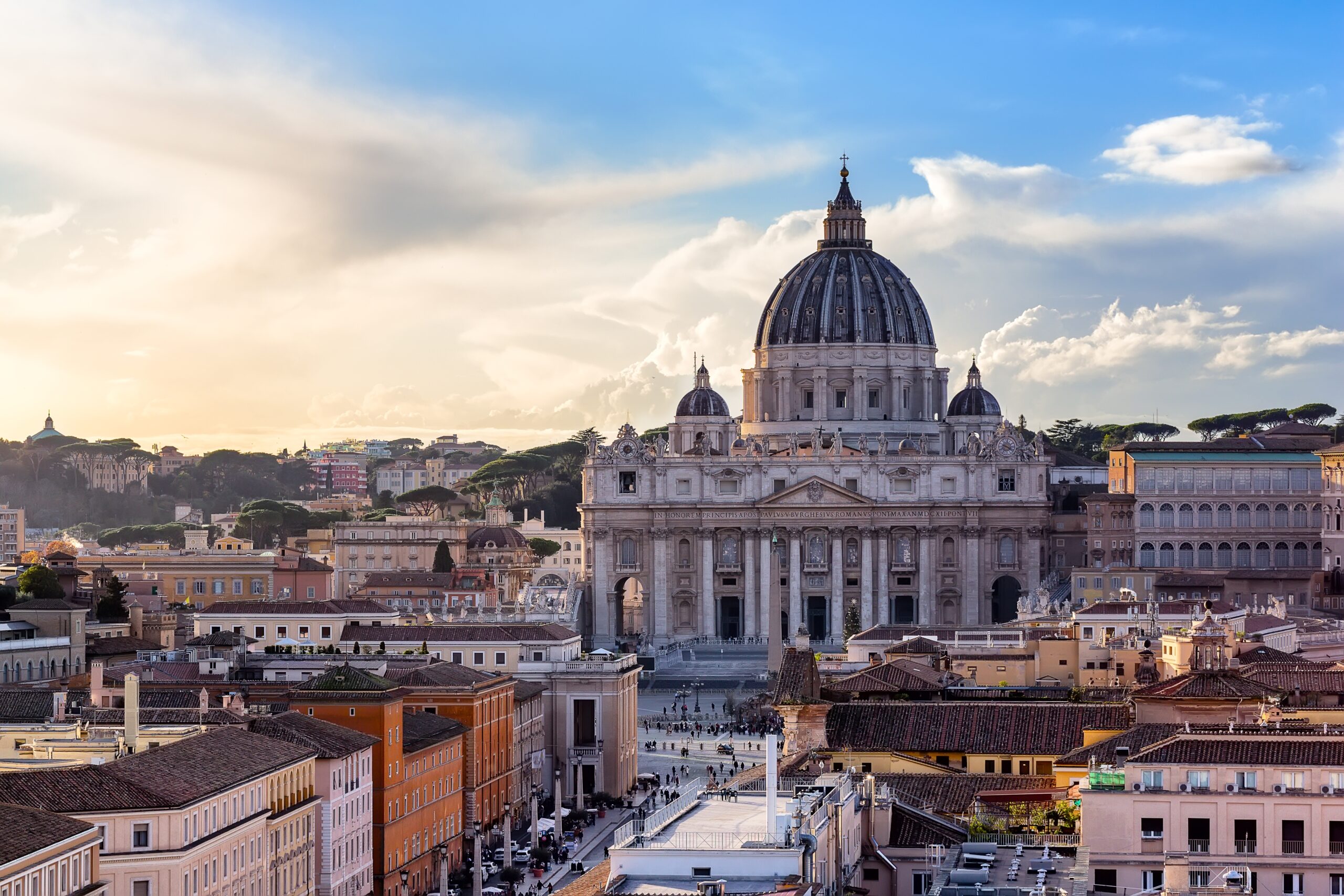
Deep beneath the Vatican, past checkpoint after checkpoint, Rabbi Harry Moskoff descended four or five stories below St. Peter’s Basilica. “Every three or four meters there’s a glass door,” he said, describing the tour Vatican officials arranged for him. “It was like James Bond.” He did not find the golden vessels of the Second Temple on that trip. But after more than twenty years of research, Moskoff says he knows exactly where they are, and who is keeping them there.
Moskoff, an investigative archaeologist and author of The Ark Report and The Vatican and Me, has built what he calls the Jewish Heritage Project around a single claim: that the sacred vessels carried out of Jerusalem after the Temple’s destruction in 70 CE survived intact for centuries, hidden inside Vatican City. “I haven’t seen the vessels myself,” he said, “but according to my research, there’s practically no doubt in my mind that the vessels do exist.” Asked directly about the menorah, he did not hedge. “That for sure is there. Don’t forget, I haven’t seen it, but I know people that have gone within ten meters of it, and other people that actually have seen it.”
His certainty rests on a chain of testimonies he has spent two decades collecting. The strongest, he said, involves the late Rabbi David Madashal, a French medical student in Vatican City in the 1960s who became close friends with the son of the Vatican’s governor, later the chief archivist of the Vatican archives. “If you convert to Christianity, I will show you the golden temple vessels that were taken from your forefathers,” the official told him. Madashal went back and forth for two weeks asking his own rabbi for guidance before agreeing to go down and see for himself. “It was wrapped in scarves,” Moskoff said of what Madashal was shown. “In the end he didn’t convert, thank God, but he agreed to go down there because he wanted to see if all this was real.” Moskoff said Madashal gave the full account to Israel’s Mossad and police in 2002, with Shimon Peres serving as president at the time. “So the Israeli government knows this stuff. They have it on file. His testimony.”
Moskoff described a second witness, a Swiss Guard who discovered his own Jewish ancestry and was taken underground after striking a deal with a nun. “He actually ended up seeing the menorah, lit, but it was bright,” Moskoff said. “Immediately afterwards he started losing his vision. By the time he actually came out, he could hardly see.” That guard gave his testimony to the former chief rabbi of Rome, Rabbi Elio Toaff, according to Moskoff. A third account, older still, comes from the former chief rabbi of Tripoli, who in the 1930s secured an audience with Vatican officials through Italy’s King Victor Emmanuel III. “He said, ‘Listen, if you don’t mind, I’d like to see the holy temple vessels from Jerusalem,'” Moskoff recounted. The rabbi was taken alone, at eleven at night, and afterward took a vow not to speak of what he saw. “Forty days later, in Tripoli, he passed away,” Moskoff said. “He was a big tzaddik.”
Moskoff pointed to a fourth episode, this one inside Jerusalem itself, at St. Anne’s Church near the Lion’s Gate. After the Six-Day War, an Israeli numismatics professor was sent to assess a collection of Byzantine coins and was locked, alone, inside a room for several hours. “He finds a door, practically hidden. He opens it, goes down the stairs, pitch black,” Moskoff said. “He sees a table, a big table in the middle. He approaches the table and he sees these are small vessels, and he recognizes them as keilim, vessels of the Second Temple.” According to Moskoff, the professor said aloud in Hebrew, “I can’t believe it, these are the temple vessels, and they’re in Jerusalem,” before a monk discovered him and had him removed. “That’s it. Thank you, but no thank you.”
On the location of the Ark of the Covenant itself, Moskoff is careful to separate theory from certainty. “Only Elijah the prophet knows where it is for sure,” he said. “Nobody knows for sure.” But his own research, and the backing of a number of senior rabbinic authorities in Jerusalem, points him to a chamber southwest of the Dome of the Rock rather than beneath it. “It has to be there,” he said, arguing that the Temple service required the Ark and the altar to stand together in the same location. “There’s no way the priestly service could continue without it.” He cited a book published weeks before the interview describing thermal and subsurface mapping of the Temple Mount that, he said, shows the outline of the Temple’s foundation walls shifted to the south and west of the traditional site. He also invoked rabbinic tradition holding that the location of the Holy of Holies has never been built upon by any other nation and never will be.
Moskoff acknowledged that none of it can be independently confirmed, but said the Vatican’s own posture has shifted. “For centuries they denied it,” he said. “Now they neither confirm nor deny it, which I think was a great milestone.” He has submitted a formal proposal asking the Vatican to publicly display Byzantine-era items connected to Jewish history, a project he said received word of papal cooperation before stalling. “The Gaza war set it back a little bit with Pope Francis,” he said, “but I didn’t want to burn the bridge.”
What does the Bible itself say becomes of sacred vessels carried into exile? When the vessels of the First Temple were taken to Babylon, the prophet Jeremiah gave the answer directly: “They shall be carried to Babylon, and there shall they be until the day that I visit them, saith the LORD; then will I bring them up, and restore them to this place” (Jeremiah 27:22). The vessels were not destroyed. They were preserved, waiting on God’s timing to be restored. It is the same claim Moskoff has staked twenty years of his life on, an unbroken thread running from Jerusalem to Rome and back again, waiting for the moment when it can be pulled.
Moskoff believes that moment is close. “I personally believe that we will get them back when the time comes,” he said. “I’m not pressuring them anymore. My project’s still going.” Asked what happens once the vessels are found, he was blunt about what would come next: “I have lawyers that would love to sink their teeth into this. Restitution, repatriation. But I can’t even mention that. I don’t mention it. I know that’s it for me if I say that.” For now, he is content to wait. “God willing,” he said, “as soon as in our days.”