
Why non-Jewish catalysts matter, where halakhic custody falls, and how we build together
A note before beginning: I write strictly in my own name. I hold no position with the Temple Institute or any other organization, and nothing I publish should be read as their statement or ruling. My earlier essay, “Ashes Without Authority,” was written as a technical paper for scholars engaged in Temple preparation—an attempt to raise a halakhic question that needed examination. It was never intended as a judgment on anyone’s character, nor as a rejection of the non-Jewish friends of Israel who have given so much of their hearts and resources to this work. Many—particularly Christian allies—understandably felt hurt and sidelined by its tone and conclusions. For my part in causing that offense, I am genuinely sorry. This essay is written directly to you, to speak openly about where we go from here.
— Yosef Eitan
For centuries, the commandments connected to the Temple and its purity remained largely theoretical. The sources were studied and the requirements catalogued, yet the practical pressure to raise candidates, refine blueprints, train participants, and prepare the physical and legal conditions was limited. In recent decades that pressure has returned. A great deal of the practical energy behind it has come from outside the people of Israel.
That fact deserves to be said plainly and without qualification before anything else is said at all.
Outside Hands That Stir the Work
Hiram of Tyre supplied cedar and skilled craftsmen for the First Temple. Cyrus issued the decree that permitted the return and the rebuilding of the Second Temple, and restored the sacred vessels. In each case, a non-Jew’s decision or resources created conditions that allowed the Jewish people to act. The construction, the service, and the ongoing obligations remained under Jewish responsibility, but without Hiram there is no cedar, and without Cyrus there is no return. Scripture does not treat these men as incidental. It names them.
The pattern continues in our day across every area of Temple preparation.
Non-Jews who identify with the God of Israel have funded research, raised public awareness, and invested substantial resources in the search for a red heifer, in architectural studies, in the recovery of ancient measurements and lost materials, and in the practical training of those who will one day serve. Byron Stinson’s breeding and advocacy work belongs to this stream, alongside dozens of others whose names never reach an article. So does the quieter, decades-long labor of researchers who have poured their lives into the physical and textual details of the House: Joseph Good on the tavnit, Vendal Jones and his family on the ketoret, and others working in near silence on questions most people do not know are open.
Two of those efforts deserve close examination, because they touch the service itself rather than its periphery, and because together they show exactly where the boundary of this discussion actually falls.
The Tavnit Is Not Background. It Is the Ritual.
There is a widespread assumption that the red heifer question is essentially a question about a cow: find an animal of the right color, age, and condition, verify its custody, and the rest is procedure. That assumption is wrong, and the error is not small.
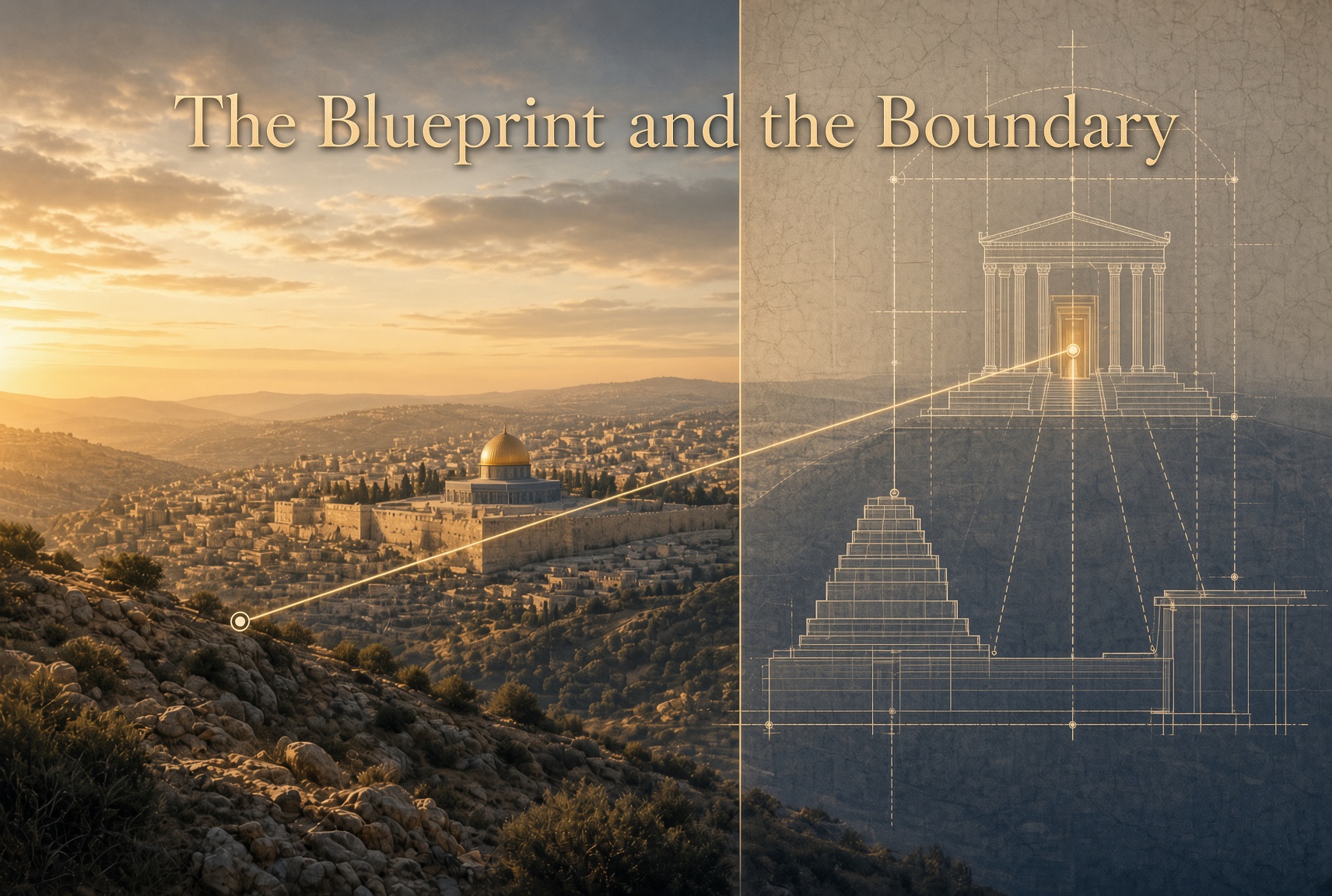
The parah adumah is not burned wherever it is convenient. The kohen stands on the Mount of Olives, and at the moment he sprinkles the blood he must direct himself toward the entrance of the Sanctuary and see it (Numbers 19:4). The Mishnah in Middot (2:4) preserves the architectural consequence: all the walls of the Temple complex were high, except the eastern wall, because the kohen who burns the heifer stands at the top of the Mount of Olives and must be able to direct his intent and see the opening of the Heichal at the time of the sprinkling.
Read that carefully. A wall height is specified in the sources not for aesthetics and not for defense, but because a wall built too high breaks a line of sight, and a broken line of sight breaks the ritual.
Now follow the line itself. It runs westward from the kohen’s position on the mount: over the eastern wall of the Court of the Women, under the Nicanor Gate, over the altar, and into the opening of the Ulam, the porch fronting the Heichal.
Notice the alternation, because it is the whole difficulty in one sentence. Two of those constraints require the line to be high enough to clear an obstruction. One requires it to be low enough to pass beneath an aperture. The line is not merely aimed at a target. It is threaded through a sequence of clearances and openings, and the openings and the clearances pull in opposite directions.
Which means no single dimension can be adjusted independently of the others. Raise the standing position to clear the altar comfortably, and the line rises above the lintel of Nicanor, where it is no longer passing through the gate but into stone above it. Lower the position to pass cleanly under Nicanor and the altar rises into the way. The set of positions that satisfies every constraint at once is small. Finding it requires the height of the eastern wall, the height and clear opening of the Nicanor Gate, the height and placement of the altar, the elevation of the Ulam entrance, and the elevation of the standing point on a mountain slope — all in the same units, all reconciled, all correct together.
This is why precision here is not scholarly fussiness. An error in any one of those figures does not produce a ritual performed slightly imperfectly. It produces a kohen sprinkling toward masonry. And unlike a question of color or age, this cannot be assessed afterward by looking at the result. It has to be right beforehand.
The details are genuinely difficult and almost universally unknown, including among people who follow this subject closely. They require the reconciliation of Middot with Parah with the archaeological record; the recovery of the cubit actually in use; the resolution of elevations across a slope reshaped by two millennia of construction, quarrying, and burial; and the reconstruction of structures for which we have textual dimensions but no surviving stone. There is also a plainer obstacle that follows directly from the geometry: the line as it stands today runs through mature vegetation. Trees now standing on the slope would have to be cleared before anyone could sight along it at all. That is a small illustration of a larger truth — this is a physical line across real ground, not a diagram.
This is precisely the ground on which Joseph Good has worked for more than forty-five years. His study of the Temple’s tavnit — the blueprint preserved in the sources — has been directed at exactly these questions: wall heights, gate dimensions, the elevation profile from the mount to the Sanctuary entrance, and the geometry that determines where a kohen must stand and what he can see from there. His hundredth trip to Israel was completed only last week. That number represents repeated physical presence on the terrain, measurement checked against text and text checked against terrain, over four and a half decades.
It also represents something more than study. On that trip, as is often the case, the work moved onto the ground itself: the questions were examined on site, on the Mount of Olives, together with a rabbi engaged in a Temple restoration effort. The location under examination is not being publicly disclosed, and that discretion is appropriate — a site of this kind is not served by becoming a destination before it is settled. But the fact that the examination is now happening in that form is worth stating, because it marks a change in the character of the work. This is no longer research circulating in lectures and recorded in a notebook. It is being tested on the terrain, in conversation with those who carry responsibility for the act itself.
I want to state my own position plainly: this body of work needs to be examined closely by anyone who intends to see this mitzvah performed correctly. Not acknowledged politely — examined, tested, argued with, and where it holds, used. A qualified animal standing at the wrong point on the mount accomplishes nothing. The custody question and the tavnit question are two halves of one problem, and only one of them has received public attention.
The Ketoret: What Can Cross the Boundary
A second case makes the shape of this even clearer, and it belongs in the same discussion.
The ketoret, the incense of the sanctuary, is specified in the Torah (Exodus 30:34–38) and elaborated in the sources into a compound of eleven ingredients. Several of those ingredients cannot now be identified with confidence. The most famous is the maaleh ashan, the herb that caused the smoke to rise in a straight column, whose identity was held closely by the house of Avtinas and was lost when that knowledge ceased to be transmitted (Mishnah Yoma 3:11). Reconstructing the formula from texts alone has therefore never been fully possible. The words survive; the referents of some of them do not.
Vendal Jones and his family have worked this problem from the other direction — through material rather than text. Some three hundred kilograms of ketoret were located, and rather than being treated as a relic, an object of trade, or a private possession, the material was subjected to chemical analysis so that its composition could be documented, and the results were placed in the hands of those competent to test and evaluate them.
Consider what that choice actually was. Material of that kind could have been kept, sold, displayed, or made into a claim. Instead, it was turned into data and handed over. That is not the behavior of someone seeking credit; it is the behavior of someone who understood that the value lay in the information and that the information belonged with the Jewish people and the House.
And here the same boundary appears that appeared with the heifer, for the same reasons. The physical material cannot itself serve on the altar. Incense for the service must be compounded under the obligations that govern the service — by those charged with it, in purity, with a chain of accountability for every stage of its handling. Material recovered from outside that framework carries no such record, and no analysis performed afterward can supply one. What is missing is not a fact about the substance. It is the obligated oversight that would have made the substance’s history testifiable, and that cannot be created retroactively.
Yet notice what was not lost. The composition is now recorded. The proportions, the constituents, the analytical evidence about ingredients that texts alone could not settle — that knowledge now exists in a form that can be examined, argued over, verified, and used. Centuries of loss have been partially reversed, permanently, by a non-Jewish family who gave the results away.
This is the distinction the whole discussion turns on, and it is worth naming directly:
Knowledge crosses the boundary. Testimony does not.
A measurement is true or false regardless of who took it. A chemical analysis is accurate or inaccurate regardless of whose laboratory produced it. A reconstruction of the eastern wall’s height, an identification of an ingredient, a resolution of an elevation across the slope of the mount — these are received on their merits, and Jewish scholars receive them on their merits, because nothing in the halakhah makes the identity of the observer part of the finding. Good’s tavnit work and the Jones family’s ketoret work both pass through freely, and both make the eventual service more likely to be performed correctly.
What does not cross is testimony about custody — the sworn, obligated, continuous account of what happened to a particular object or animal across the whole of its existence. That form of witness is generated by the obligation itself, and the obligation was never placed on those outside the covenant. It is not a judgment of reliability. It is a description of who was commanded.
Both of these efforts are therefore permanent contributions, and neither of them fails. In each case the physical item cannot serve, and in each case what was actually needed — the knowledge — has been recovered and preserved.
What the Earlier Essay Did and Did Not Say
Here I want to be exact, because a great deal of pain has come from a misreading I should have anticipated.
My earlier essay argued a narrow point: that a particular animal, raised for its formative years under non-Jewish custody, cannot carry the specific form of testimony that the parah adumah requires — and therefore that ashes derived from it cannot satisfy the Torah’s standard. That is a claim about a chain of records. It is not a claim about the sincerity, the righteousness, or the standing before Heaven of the people who raised the animal.
The distinction matters enormously, and the two are easy to collapse into one. If a document requires two witnesses and only one was present, the document fails — and the man who was present has done nothing wrong. He was not disqualified. He was simply not asked to be a witness, because the obligation that generates that kind of witness was never placed upon him. His labor is not erased by the shortfall in the record.
Nor did I write as anyone’s spokesman. I raised the question in my own name because I believed it needed raising, and I addressed it to the scholars best positioned to weigh it. If my voice was mistaken for an institutional verdict, that is a failure of framing on my part, and I regret the additional sting it caused.
What I will not do is soften the halakhic finding itself, because a boundary that bends under social pressure is not a boundary, and an ash that does not purify does not become purifying because we wished it would. Honesty in both directions is the only kind worth offering.
The Boundary of Obligation and Testimony
The Torah’s requirement is absolute: the animal must be one “upon which a yoke has never been laid” (Numbers 19:2). Because the disqualification is irreversible, the only way to establish that it never occurred is through continuous, reliable testimony covering the animal’s entire history from birth.
That form of ne’emanut belongs to those who bear Sevel Yerushah — the inherited burden of obligated diligence against corpse impurity that certain Jewish lineages have carried across generations. The reasoning is not about worth. It is about obligation: only one who is himself commanded in the matter generates the kind of testimony the halakhah accepts when the stakes are this high and the error is unrecoverable.
Rambam (Hilchot Parah Adumah 1:7) rules that one may purchase a red heifer from a gentile, and that we do not suspect the gentile of having sodomized the animal, since he would not destroy its value. This is a genuine permission and it should not be minimized. But it addresses the absence of certain disqualifying suspicions; it does not create a mechanism by which non-Jewish testimony establishes the continuous absence of any yoke or labor throughout the formative years. Later rabbinic inspection can assess present physical condition — color, absence of visible blemish, approximate age. It cannot reconstruct a missing period of continuous, obligated oversight. Nothing can.
The account of Dama ben Netina is sometimes brought as a counterweight. The narrative is told to illustrate the extraordinary extent of the mitzvah of honoring parents: a non-Jew’s remarkable righteousness is rewarded with the birth of a red heifer, which the sages then purchase. The story teaches that Heaven responds to genuine moral greatness wherever it is found — and that lesson is precisely relevant to the friends of Israel reading this. What it does not establish is that non-Jewish custody and non-Jewish testimony can positively prove the continuous absence of labor from birth. To read it as a full halakhic precedent asks the story to do work it was never telling.
The same structure appears with Noahides and the Ger Toshav. Noahides are honorable; they follow the path Hashem has set for the nations. A Ger Toshav stands closer still — formally recognized by a Jewish court, living under a defined legal relationship with the people of Israel. Even so, he remains outside full membership and therefore outside Sevel Yerushah. Full naturalization through circumcision and complete entry into the covenant is required to carry that inherited form of reliable testimony. If one who stands that close cannot supply it, a Noahide, however sincere and however intentional, cannot either. Ownership can be transferred. The chain of obligated shmirah cannot be restored retroactively.
The same principle governs the land on which the slaughter and burning take place — which is, not incidentally, the same ground the tavnit research is trying to locate precisely. David refused Araunah’s threshing floor as a gift and insisted on purchasing it at full price. The site of a sacred act must be fully and unambiguously owned. An offer of use, or incomplete title, does not satisfy the requirement — and note that here too the refusal implied no disrespect toward Araunah, whose generosity was real.
Collecting the Ashes and the Scarcity of the Pure Gatherer
After the heifer and the wood of the pyre have been completely burned, the remains are beaten with rods and sifted into fine ash (Mishnah Parah 3:11); some opinions prefer stone implements at this stage. A pure individual then gathers the ashes and deposits them in a pure place outside the camp, as the Torah requires (Numbers 19:9). Historically the ashes were kept in vessels — often earthenware flasks called kalal, and in some practices stone vessels — and divided among designated pure locations: one portion near the Temple, one on the Mount of Olives, and portions distributed among the priestly watches.
The gatherer must himself be pure: either never having contracted corpse impurity, or already purified by the ashes of a previous red heifer. In our day that standard is almost impossible to meet. Only a very small number of individuals could potentially qualify, drawn from the one family known to have maintained continuous diligence against corpse impurity across generations, and all of them kohanim. And because the one who slaughters and burns becomes impure through the act itself, he cannot be the one who gathers. A second pure person is required.
This is worth stating clearly for a reason beyond itself: the difficulty is not concentrated in one place. Even were every question about a candidate animal resolved tomorrow, this bottleneck would remain — and so would the geometry. The obstacles are structural, not personal, and no one’s good faith created them.
The historical distribution of the ashes served a practical purpose. Mixed with spring water, portions held in outlying locations allowed people to complete the seven-day purification in their own towns, or in the nearest place with a court, so that those traveling to Jerusalem arrived already pure. The throngs coming up for the festivals did not have to begin the process only upon reaching the city.
Legitimate Use and the Path Forward
None of the foregoing renders the Texas-born animals worthless. They may properly serve as breeding stock. If acquired for that limited purpose and thereafter raised under continuous Jewish supervision, a new and verifiable chain of testimony begins with the next generation — and every subsequent generation raised under that supervision can meet the full requirements of the mitzvah. The years of breeding work are not lost. They become the foundation of something that qualifies.
Until such a chain is established from the outset, the animals themselves remain disqualified for the parah adumah, and ashes derived from them cannot satisfy the Torah’s standard. Both halves of that sentence are true at once, and holding them together is the honest position.
A new red heifer calf was recently born in Israel under local Jewish oversight. The animal displayed a fully red coat at birth and has been under continuous supervision from its first day. At only days old it stands far from the required age and remains subject to the ordinary risks of later blemish or white hairs; nothing about it is settled. Its significance lies not in immediate eligibility but in the simple fact that a candidate has entered the world under the only conditions the sources recognize as capable of producing a verifiable record — Jewish obligation and continuous custody from day one, the presence of Sevel Yerushah.
It is also worth noticing how that calf came to be looked for at all. The searching, the funding, the awareness, the decades of insistence that this matters — much of that came from outside. The catalyst worked.
Hashem and His House
Hiram and Cyrus created conditions that allowed the Jewish people to act. In our generation, breeders, funders, and advocates — Byron Stinson among many — have forced examination of requirements that had lain theoretical for centuries. Joseph Good has given more than forty-five years to the tavnit: to the wall heights, gate dimensions, elevations, and sightlines without which the ritual cannot be performed in the place and manner the Torah specifies. Vendal Jones and his family have restored to the record a formula that had been incomplete since the house of Avtinas fell silent, and gave the results away. These findings are received and weighed by Jewish scholars not grudgingly, but naturally, because that is exactly where such expertise belongs.
If anything, the balance of attention has been wrong. The animal is one requirement among several. The geometry is another; it is at least as demanding, and far fewer people are working on it, while the line itself must be threaded over a wall, under a gate, and across an altar with no margin for a wrong figure anywhere along it. The composition of the incense is a third. Anyone who wants to see this service performed, and performed validly, should be reading that research now, rather than after a qualified heifer reaches its fourth year. Set a seat for Joseph Good and his team to capture the information before it is lost!
And the specific mitzvah of the red heifer remains under Jewish obligation. Continuous, obligated testimony covering an animal’s entire history from birth cannot be supplied from outside the covenant. Permission to purchase, recognition of righteous intention, and deep gratitude for catalytic energy do not erase that particular boundary — not because the boundary honors us, but because the House is to be prepared according to the statute given by the Master of the House. We do not own the terms. Neither do we get to relax them on behalf of people we love.
So the response is twofold, and both halves are obligatory: receive the catalyst with appreciation, and insist on the integrity of each commandment according to its own requirements. Patient fidelity to continuous Jewish custody of a candidate animal, reliable testimony, a pure gatherer, land under clear ownership, and the precise measurements of the tavnit — that is the path that honors both the sincere labor of those who have stirred this work and the holiness of the House itself.
To those who felt dismissed by what I wrote: you were not dismissed. You were, and are, part of how this generation came to be asking the question at all — and in the matters of the blueprint and the incense, you are holding pieces of the work that no one else is holding. What you have recovered does not expire, cannot be revoked, and does not depend on any ruling about any single animal. It is already in our hands, and it will be there when the House is built.