
Divers have located the wreck of the Altalena, the cargo ship that brought weapons to the Irgun militia during Israel’s 1948 War of Independence before it was shelled on the orders of Prime Minister David Ben-Gurion and sunk off the coast.
National Security Minister Itamar Ben Gvir and Heritage Minister Amichai Eliyahu, both of the Otzma Yehudit party, announced the discovery Monday in a joint statement, saying the ship was found intact at 12:30 a.m. at a depth of 503 meters, roughly 1,650 feet, some 20 kilometers off Israel’s coast. “At 12:30 am, at a depth of 503 meters, west of the coast of Israel, the Altalena ship was located intact, 78 years after that painful and seminal event that shook the young State of Israel,” Eliyahu said. The ministers credited “long months of meticulous planning and preparation” and “special sensors and advanced survey systems” for the find.
Eliyahu, who is politically right-wing and serves in the governing coalition led by Prime Minister Benjamin Netanyahu, called the Altalena “the story of a deep national wound, and the story of the historical responsibility that Menachem Begin showed when he prevented a civil war.” He added, “A country that is not afraid to touch on the painful chapters of its history is a stronger country.” A military spokesperson told The Times of Israel the IDF had no involvement in the search.
According to Hebrew media reports, the operation was led by the Marine Mapping Division of the Survey of Israel, the government’s mapping and surveying agency, whose director-general, Hagai Ronen, called the discovery “an exciting historical moment, in which knowledge, technology and advanced mapping capabilities allow us to touch on a significant chapter in the history of the State of Israel.” The ship was located using sonar technology, Ynet reported, adding that lifting the vessel from the water is likely impossible given its depth and location; the Heritage Ministry is weighing options for a monument, including a floating marker, while an effort to document the wreck underwater is underway. Kan public broadcaster reported in August 2025 that Eliyahu had invested NIS 1 million, about $335,000, in the recovery effort, funding the marine research vessel Bat-Galim, which was equipped with the technology used to locate the remains. Israel erected a monument to the fallen Altalena fighters on the Tel Aviv seafront in 2008, and search crews had been working to locate the wreck for years, often in secrecy.
The Altalena was brought to Israel by Menachem Begin’s right-wing Irgun militia, also known as Etzel, in June 1948, weeks after the state’s founding, loaded with roughly 940 fighters and a large quantity of arms purchased with funding that included weapons valued at 153 million francs donated by the French government under a secret agreement. The ship, a former US Navy landing craft renamed after a pen name used by Zionist leader Ze’ev Jabotinsky, was captained by ex-US Navy lieutenant Monroe Fein and, on the Irgun side, commanded by senior commander Eliyahu Lankin. Its arrival came during the delicate process of folding the Irgun into the newly formed IDF; an agreement signed June 1 had required the Irgun to halt independent arms acquisition, and the ship’s sailing forced an immediate crisis. Ben-Gurion initially agreed to Begin’s request that 20 percent of the weapons go to the Irgun’s Jerusalem Battalion, still fighting independently, but rejected Begin’s further request that the rest go toward equipping Irgun battalions absorbed into the IDF, viewing it as an attempt to maintain an army within an army.
The Altalena reached Kfar Vitkin on June 20 and began unloading cargo through the night, with 2,000 rifles, two million rounds of ammunition, 3,000 shells and 200 Bren guns brought ashore. Ben-Gurion, convening his government that same evening, declared, “We must decide whether to hand over power to Begin or to order him to cease his separate activities. If he does not do so, we will open fire!” The Alexandroni Brigade surrounded the area the next day, and its commander issued Begin a ten-minute ultimatum to surrender the weapons. Begin did not respond immediately, and as evening fell, gunfire broke out on the beach, killing two IDF soldiers and six Irgun members. Begin fled by rowboat to the Altalena as the ship’s captain maneuvered to shield him, and the remaining Irgun fighters on shore surrendered.
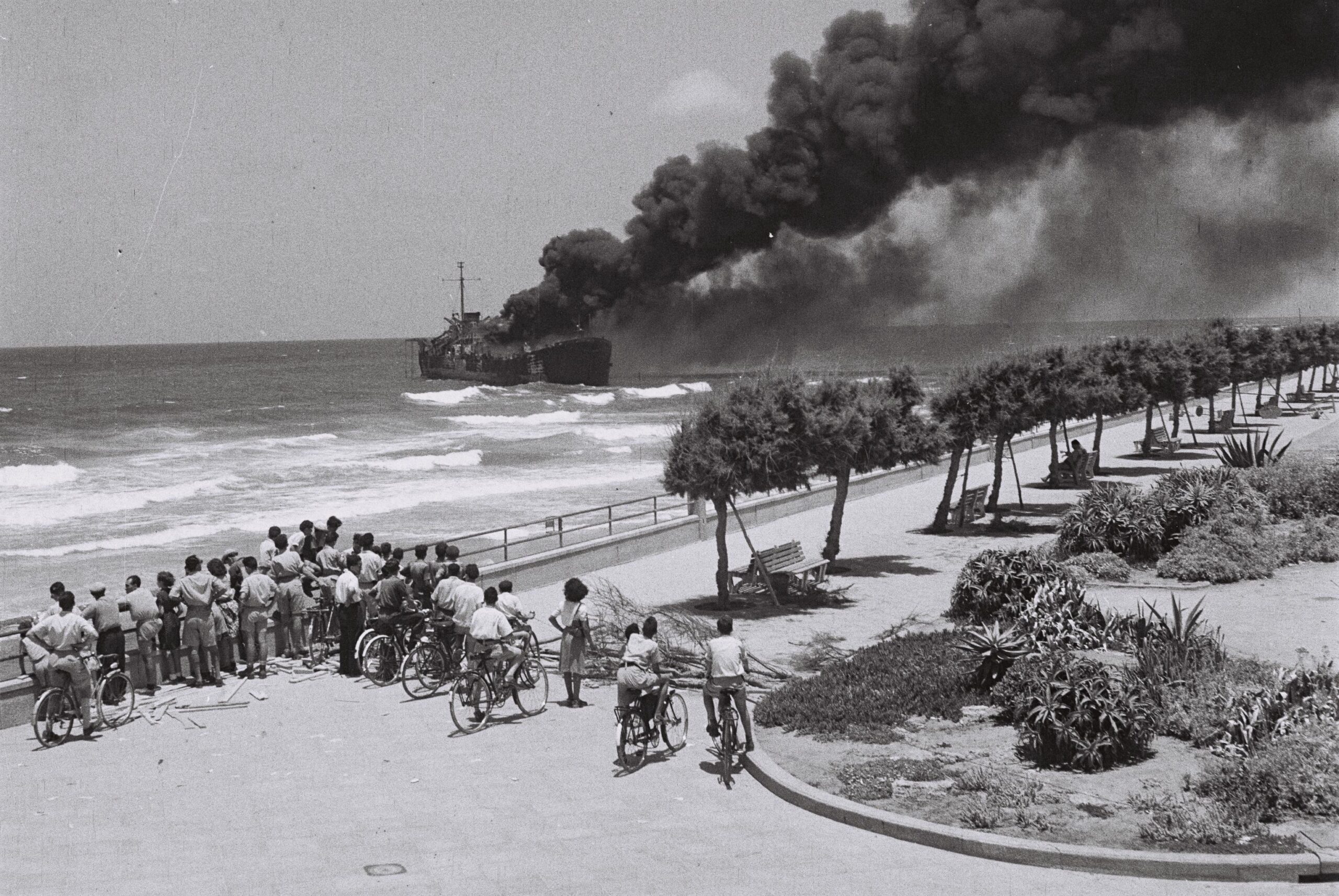
Begin then ordered the Altalena to sail for Tel Aviv, where it ran aground near the foot of David Frischmann Street in full view of journalists and UN observers watching from a nearby hotel terrace. Ben-Gurion ordered Yigael Yadin to concentrate forces on the beach and take the ship by force, and by the following afternoon ordered its shelling, a decision Begin would later suggest was neither necessary nor inevitable.
In his memoir, Begin wrote of the government’s choice to open fire rather than simply bar the ship from Israel’s shores: “The government could have said: ‘We will not let you unload the arms.’ It could have said: ‘Under the circumstances, we forbid you to bring the ship to our shores.’ It could have added a warning, which would have been entirely unnecessary in any case. But it simply never occurred to us that the cabinet decision and the IDF’s opinion would be disregarded, and the ship, from the moment it departed, would be sailing straight into the hands of the government!”
Begin and his commanders maintained for decades that Ben-Gurion had options short of deadly force and chose escalation instead; historians remain divided on why, with some scholarship pointing to Ben-Gurion’s determination to prevent any armed faction, including the Irgun, from operating outside state control, and Begin’s own camp long suspecting the shelling served to cement Ben-Gurion’s personal and political dominance over the fledgling state’s institutions. The order to fire on fellow Jews was so wrenching that the first gunner assigned to carry it out, a Red Army veteran named Yosef Aksen, refused outright, declaring he was willing to be executed for insubordination and calling that refusal “the best thing he did in his life.” He was jailed to await court-martial. A second soldier, Hillel Daleski, a recent immigrant from South Africa, protested that “I didn’t come to the Land of Israel to fight against Jews,” but complied only after his commander threatened him with a court-martial of his own. A shell struck the ship and set it ablaze. Yitzhak Rabin, then a young officer and later IDF chief of staff and prime minister, commanded the forces on shore. Begin, seeking to avert civil war, ordered his men not to return fire and raised a white flag, though fighting continued and some accounts describe automatic fire directed at survivors swimming from the burning ship. Sixteen Irgun members and three IDF soldiers were killed in the two-day confrontation, Jewish blood spilled by Jewish hands within weeks of the state’s founding. Begin called on his fighters to lay down their arms with words that would become famous: “There will be no civil war with the enemy at our gates.” More than 200 Irgun members were arrested in its aftermath, and Irgun units within the IDF were disbanded and dispersed among other formations.
Begin later said, “My greatest accomplishment was not retaliating and causing civil war.” That restraint is the reason the Altalena Affair did not become the opening battle of a Jewish civil war fought while the surrounding Arab armies were still attacking the infant state. Nineteen Jews died at the hands of other Jews that week, killed not by an external enemy but by a political struggle over who would control the guns of a nation three weeks old.
In a tragic irony that itself became a defining wound of the nation, Rabin, who commanded the forces that killed Irgun fighters on the Tel Aviv shore in 1948, was himself murdered by a fellow Jew, Yigal Amir, in 1995, this time in the name of the political right rather than the left. Both killings, separated by nearly half a century, left the same scar: Jewish blood spilled by Jewish hands over the politics of who would lead the nation.
Prime Minister Benjamin Netanyahu in a statement following the discovery of the ship ‘Altalena’, at the Etzel Museum in Tel Aviv:
— Prime Minister of Israel (@IsraeliPM) August 24, 2026
"My brothers and sisters, citizens of Israel, civil war – never again! This was the heartfelt cry of the commander of the Etzel, Menachem Begin. He… pic.twitter.com/XILbIK8EqO
The Irgun was fully absorbed into the IDF in the aftermath of the affair, and Begin went on to found the Herut movement, a forerunner of the Likud party, now led by Netanyahu. The burned hull remained visible off the Tel Aviv shore for roughly a year before it was towed out to sea and sunk in 1949. A first attempt to locate the wreck, funded in part by the Menachem Begin Heritage Center, placed it in December 2012 a few miles off Rishon LeZion at a depth of about 300 meters. The government at the time said it hoped to raise the ship and install it on dry land in Tel Aviv or Jerusalem as a monument. That plan was never carried out.
Netanyahu, who reportedly learned of Monday’s discovery from media reports rather than from Ben Gvir or Eliyahu directly, moved quickly to issue his own video statement, filmed on the Tel Aviv promenade, before the two far-right ministers held their press conference, a sequence widely read in Israeli political circles as an attempt by Ben Gvir to score points against the prime minister ahead of October’s election. Netanyahu called Ben-Gurion’s order to fire on the ship a “tragic decision” and said that “instead of letting it unload, the Haganah men on the beach opened fire.” For Netanyahu, as for much of Israel’s political right, the Haganah’s role in the shelling casts the affair as an early instance of the country’s Labor-led establishment turning force against the nationalist camp, a wound the right has invoked ever since to argue it has been treated as the perennial target of the state’s own institutions. He said he would order the wreck raised and turned into a monument that “will be a tangible symbol for our generation and generations to come,” while experts have said doing so may prove difficult or impossible given its depth. Netanyahu also used the moment to criticize demonstrators who have protested at the annual memorial ceremony for the Altalena’s victims, which he said he attends every year, calling their presence “absurd” and asking, “Have they not learned its lesson?” He closed by declaring, “We are brothers. Political rivals, yes, but we are brothers. We are of one nation, one future, one fate,” and repeated his campaign pledge to form a “broad national government” after the October 27 election.
Ben Gvir, delayed in starting his own press conference by Netanyahu’s video, spoke at the Etzel Museum on the Jaffa beachfront and pressed that reading further, saying the discovery closed “the bleeding wound” of what he called the historic marginalization of Israel’s political right by the left. “For decades they’ve tried to hide this wound, to silence this story,” he said, calling the Altalena “a symbol of the national camp, led by Menachem Begin,” and casting the shelling itself as an act of political violence the Israeli left has never fully reckoned with. He added, “In the face of all the prosecution, Menachem Begin held to his truth, with one very clear belief: We are brothers, the entire House of Israel; it doesn’t matter what our origins, color, or ethnicity are, or what party we vote for. There will never be a civil war. Against our enemies, we must not hesitate, be confused, or show compassion. But with our brothers, we need to be together.”
Both men reflected on the affair for the rest of their lives. Ben-Gurion died in 1973, a few months after the Yom Kippur War; Begin died in 1992. Late in life, Begin said, “After my death I hope that I will be remembered, above all, as someone who prevented a civil war.” Ben-Gurion’s own reckoning came earlier and more grudgingly. In 1965, after a government inquiry into the affair cast serious doubt on the narrative he had long maintained, Ben-Gurion offered only a spare admission: “Perhaps I was mistaken.”
Seventy-eight years later, the wreck resting 503 meters beneath the Mediterranean stands as a permanent record of what partisan politics cost the Jewish people at the very moment of national rebirth. The Altalena’s dead were not casualties of a war against an outside enemy; they were killed by their own brothers, ordered to fire by their own government, over a dispute about who would hold power in a state not yet a month old. That is the wound the wreck’s discovery reopens, and the lesson its defenders on every side of Israeli politics continue to invoke: a people surrounded by enemies bent on its destruction cannot afford to turn its weapons on itself.