

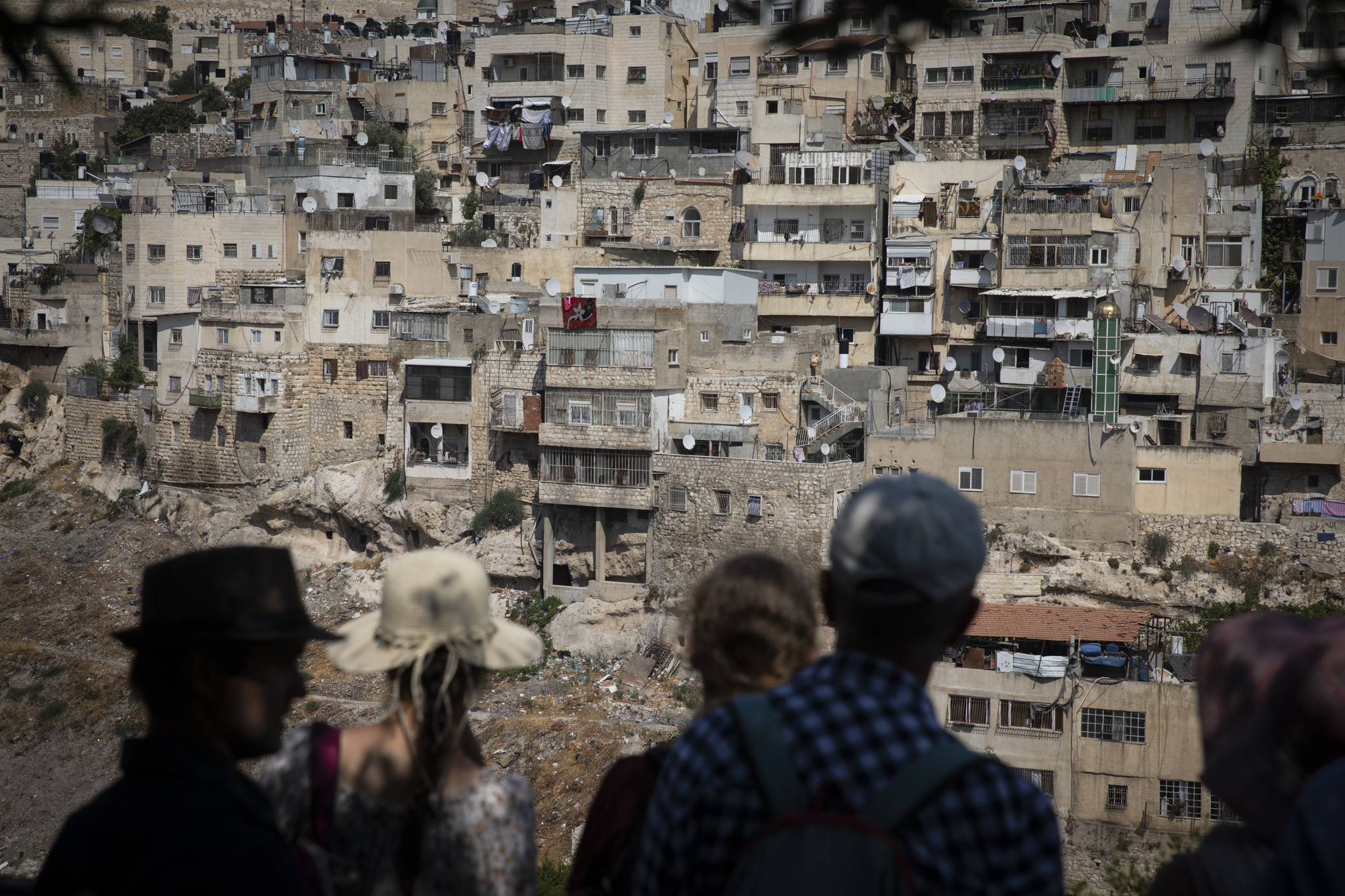
An ancient burial cave containing graves from the Second Temple period was discovered Monday beneath a building in the Silwan neighborhood of eastern Jerusalem, Israel Police announced, after Border Police officers came upon the find while searching homes connected to a violent clash between two feuding Arab families over the weekend.
The Israel Antiquities Authority (IAA) sent experts to the site after Border Police officers noticed archaeological features beneath one of the compound’s buildings during the operation. A preliminary examination confirmed the site as a burial cave, with graves dating to the Second Temple period, spanning 516 BCE to 70 CE. Additional archaeological artifacts were recovered alongside the cave. Israel and Border Police are securing the area in coordination with the IAA as study of the findings continues.
The discovery came in the course of a Jerusalem District operation searching the homes of those allegedly connected to the weekend’s violence, in which one person was killed, and two others were shot by police after they were identified as posing active threats, wielding blunt instruments, blades, and Molotov cocktails. National Security Minister Itamar Ben-Gvir said Sunday that early media reports describing “three murdered” and “bodies piling up at the police station” had mischaracterized the incident. “The truth? Two of them threw stones and Molotov cocktails and were shot by our heroic police officers during the incident,” he said. “This is exactly the mind games I was talking about.”
🇮🇱 ANCIENT BURIAL CAVE DISCOVERED UNDER JERUSALEM
— Mossad Commentary (@MOSSADil) August 25, 2026
Israeli Border Police discovered an ancient burial cave in Jerusalem’s Silwan neighborhood. Israel Antiquities Authority experts preliminarily date the burials to the Second Temple period. Archaeological examination is ongoing. pic.twitter.com/lqsuAKPaLX
The burial cave sits within one of Jerusalem’s most significant archaeological landscapes. The Silwan necropolis, cut into the rocky eastern slope of the Kidron Valley facing the oldest part of Jerusalem, is understood to have served the highest-ranking officials of the ancient city, with tombs dated to the 9th through 7th centuries BCE. Charles Warren attempted the first survey of the tombs in 1876, but no thorough documentation took place until 1968. By the late 1960s, roughly forty rock-cut tombs remained from an original count of similar scale, several bearing Hebrew inscriptions. Archaeologist David Ussishkin has noted that the tombs’ architecture — entrances set high above the surface, gabled and straight ceilings with cornices, trough-shaped resting places carved with pillows, above-ground structures, and inscriptions cut directly into the rock facade — has no parallel elsewhere in ancient Israel. Ussishkin argues the closest architectural parallels come from Phoenician building traditions, a connection he views as validating the Bible’s own description of Phoenician influence on the Israelite kingdoms.
What was buried within sight of Jerusalem’s oldest walls, and why there?
The Bible places the Kidron Valley, running directly below the Silwan necropolis, at the center of Jerusalem’s royal and religious life. Kings crossed it, destroyed idols in it, and were remembered in relation to it. The Book of Kings records the death of Israel’s greatest king in stark, direct language: “So David slept with his fathers, and was buried in the City of David” (1 Kings 2:10). The City of David sits on the hill directly opposite the Silwan necropolis, across the Kidron Valley, the very slope where, according to Ussishkin, ancient Near Eastern royal custom would have placed the kings themselves, buried beneath their own palace. The Sages understood burial in Jerusalem, and burial in sight of the Temple, as no small matter. A grave carved into the earth near the City of David was not an anonymous resting place. It marked a person, understood by those who buried them, as belonging to the story of the city itself.
The families who built homes over these tombs in more recent centuries, and the Byzantine monks who converted others into dwellings and churches before them, likely had little idea what lay beneath their floors. Monday’s discovery reminds us that Jerusalem does not require permission to reveal itself. A cave uncovered during a criminal investigation, in one of the city’s most contested neighborhoods, turns out to be the same place where, three thousand years ago, the city buried the people it deemed too significant to lay to rest anywhere else. Jerusalem keeps its dead close to its center. It always has.