Israel now faces the prospect of a new and unfamiliar danger on its northern border: several tons of nuclear material remaining inside Syria, in the custody of a government whose president has declared his intention to pursue a nuclear program, and who Washington itself was hunting under a ten-million-dollar bounty less than a decade ago.
This week’s disclosure that International Atomic Energy Agency inspectors found several tons of undeclared nuclear material inside Syria, and the resolution of a months-long, secret standoff between Israel, the United States, and Damascus over a second stockpile at a site known as “Site 99,” together mark the reemergence of exactly the kind of unconventional threat Israel has spent nearly two decades trying to ensure never took root on its border again, this time under a leader whose credentials for running the country holding it remain, at best, freshly laundered.
IAEA Director General Rafael Grossi told reporters in Damascus this week that inspectors had found “a few tons of nuclear material that could be put to bad use” at an undisclosed site dating to the Assad era, which Syria’s transitional government voluntarily reported to the agency on July 17. Syrian Foreign Minister Asaad al-Shaibani said the material, several tons of natural uranium metal along with quantities of graphite, would remain in Syrian custody under IAEA safeguards rather than be removed from the country, and asserted Syria’s “sovereign and legal right” to pursue a peaceful nuclear program. Al-Shaibani did not raise the possibility of the material’s removal at any point in his remarks. Separately, Axios reported that the United States, Israel, and Syria reached a quiet agreement to deal with nuclear material, including yellowcake, that Israel says the Assad regime stored at “Site 99,” material officials say cannot fuel a nuclear weapon but could be used in a radiological dispersal device, a so-called dirty bomb. Israeli forces reportedly bombed the site’s entrances shortly after Assad’s fall to block access to it, and Israeli officials told Axios they threatened further strikes and grew concerned that Turkey was helping Syria’s new government reach the material, before Washington brought the IAEA in to broker a resolution. That material, too, has not yet been removed from the country as of this week, according to US officials.
For Israel, the disclosures reopen a file it believed it had closed by force nearly two decades ago. Syria’s clandestine nuclear ambitions first became public when Israeli jets destroyed a reactor under construction at Al-Kibar, in Deir ez-Zor province, on September 6, 2007, in a strike Israel refused to acknowledge until 2018. The IAEA has since concluded the facility was very likely a nuclear reactor built with North Korean assistance, styled on Pyongyang’s Yongbyon reactor. Syria demolished the site and never fully answered the agency’s questions about it. Grossi’s visit this week to Deir ez-Zor, where he said “very comprehensive work of excavation and exploration is taking place now,” is the clearest confirmation yet that the 2007 assessment was correct, and a reminder that material from that program remained buried and unaccounted for until now.
Syria’s chemical weapons record supplies the reason Israel is treating this new disclosure with such wariness rather than reassurance. Bashar al-Assad’s government maintained one of the world’s largest chemical weapons stockpiles for decades, built originally as a deterrent against Israel. In August 2012, President Barack Obama warned that any movement or use of chemical weapons by the Assad regime would cross a “red line” and change his calculus on American military involvement. Almost exactly a year later, on August 21, 2013, rockets carrying sarin gas struck the Damascus suburb of Ghouta. Estimates for the number of people killed generally range from 1,100 to over 1,400 civilians, depending on the organization reporting the figures, making it the deadliest chemical attack anywhere in the world in decades. Washington ultimately did not carry out the strikes it had threatened, instead pursuing a Russian-brokered deal under which Syria agreed to surrender its declared stockpile, an outcome widely criticized as a red line stated but not enforced. Assad’s government went on to use chemical weapons again at Khan Sheikhoun in 2017 and Douma in 2018, despite having formally surrendered its declared arsenal. A regime capable of crossing that line while under direct international supervision is the same regime whose undeclared nuclear residue Israel is now watching a new government try to manage, on its own soil, with no removal plan yet in place.
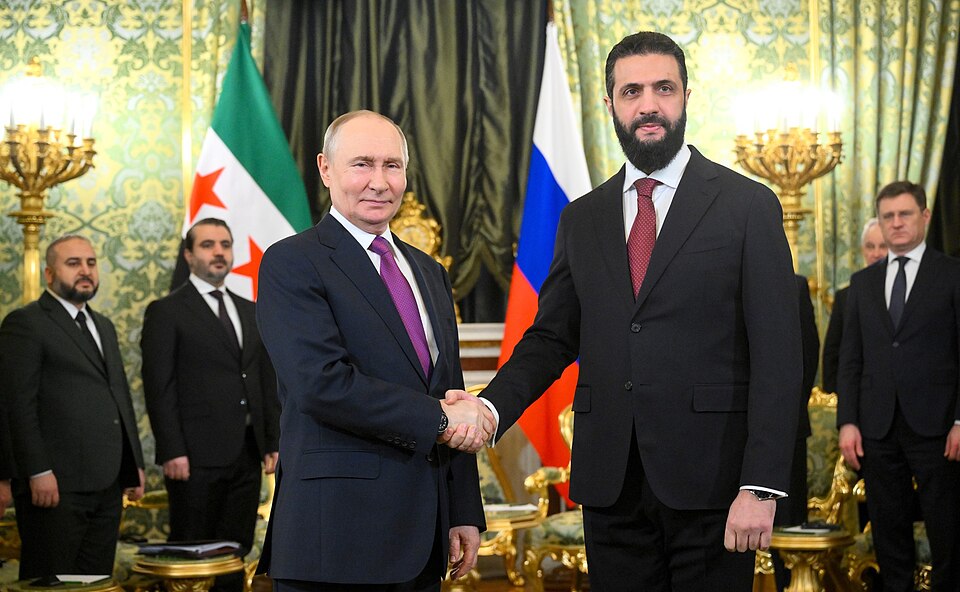
That new government is led by a man whose own history offers Israel little reassurance. Ahmed al-Sharaa, the Syrian president, is better known for most of his adult life as Abu Mohammad al-Jolani. Al-Sharaa carried a ten-million-dollar American bounty on his head as recently as 2017 for leading what was then called the Nusra Front, accused by the State Department of multiple terrorist attacks inside Syria. His path into jihad began in Iraq after the 2003 invasion, where he was jailed by American forces at Camp Bucca and crossed paths with future Islamic State leader Abu Bakr al-Baghdadi, who later encouraged him to found an al-Qaeda affiliate in Syria.
The rehabilitation of his image has moved at remarkable speed. After cutting formal ties with al-Qaeda in 2016 and leading the offensive that toppled Assad in December 2024, al-Sharaa traded combat fatigues for suits and met Trump in Riyadh in May 2025, with the president lifting US sanctions on Syria and describing him as a real leader with a strong past. By the time al-Sharaa visited the White House, becoming the first Syrian president to do so since independence in 1946, he had committed to joining the American-led coalition against the Islamic State and reopening Syria’s embassy in Washington. In December 2025, Trump sent him a personal handwritten note hailing him as a future great leader. Al-Sharaa has now paired that diplomatic rehabilitation with an explicit declaration that Syria intends to develop a nuclear program of its own, a declaration made in the same breath as the disclosure of tons of previously undeclared nuclear material still sitting inside his country.
Israel has not extended al-Sharaa the same welcome Washington has. Where the United States has moved toward full rehabilitation, Jerusalem has continued treating northern Syria as an active security theater, striking suspected weapons transfers and military infrastructure inside the country since Assad’s fall and voicing open concern, according to Axios, that Turkey may be assisting Damascus in reaching unaccounted-for nuclear material. A man the United States hunted as a terrorist for over a decade now governs a country holding undeclared nuclear material, with no removal plan yet finalized, and a stated ambition to build a nuclear program, all inside a state with a documented history of crossing every line the world drew around its chemical arsenal. For Israel, that combination, on its own northern border, under a leader whose transformation is measured in months rather than years, is not a diplomatic curiosity. It is a new front.