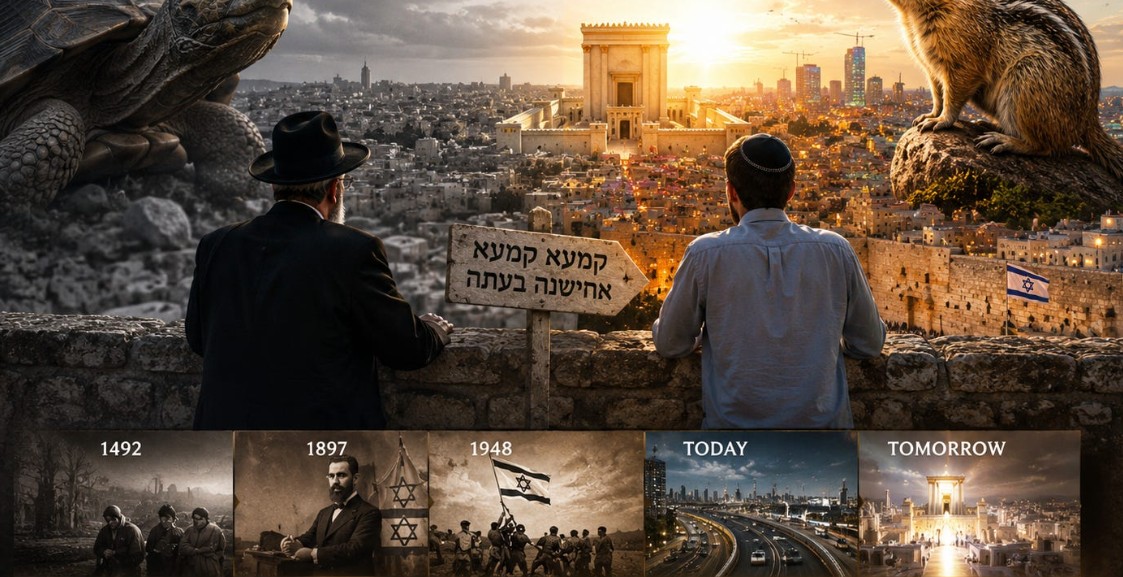
What if two creatures could look at exactly the same world, at exactly the same moment, and perceive its movement differently? That isn’t science fiction. Researchers studying what is called critical flicker fusion frequency have demonstrated significant differences in the speed at which different species process changing visual information. In one major comparative study, humans measured around 60 Hz, dogs around 80 Hz, pigeons and starlings around 100 Hz, while golden-mantled ground squirrels reached approximately 120 Hz. At the other extreme, the European eel measured around 14 Hz and the enormous leatherback sea turtle around 15 Hz.
The numbers don’t mean that one animal literally lives in slow motion while another lives in fast-forward. They describe something more subtle: temporal resolution. A creature with higher temporal resolution can distinguish rapid changes that another may perceive as one continuous event. The researchers found a general relationship between smaller body size, higher metabolic rate and the ability to process visual changes on finer timescales. Reality itself isn’t necessarily moving at a different speed; the observer’s ability to perceive that movement is different.
But this isn’t merely a difference between species. Even among human beings, our temporal processing isn’t completely fixed throughout life. Our brains change as we age. Children, younger adults and older adults do not necessarily process rapidly changing information identically. Reaction times generally slow with age, and research on human temporal processing shows age-related changes in how the brain integrates and distinguishes information occurring over very short intervals. The world outside hasn’t changed its speed; the biological machinery through which we experience it has changed. The same objective reality can therefore be experienced differently not only by two different species, but by two different people—or even by the same person at different stages of life.
Perhaps there is a profound lesson here about Geula. Two Jews can stand side by side in Jerusalem and look at exactly the same Jewish people, exactly the same State of Israel and exactly the same events unfolding around them. One sees nothing particularly remarkable. There are wars, elections, traffic jams, political arguments, terrorism, economic problems and another frustrating day of Israeli bureaucracy. He asks, “Where is the Geula?” The Jew standing beside him may be looking at precisely the same scene and wondering, “How can you possibly not see the Geula?” The reality is the same, but their perception of its movement may be entirely different.
Chazal teach us that Geula can unfold קמעא קמעא — “little by little.” That creates an enormous perceptual problem for the people actually living through it. Try watching grass grow. Sit in front of your lawn for an hour and absolutely nothing seems to happen. Yet photograph it today and again several weeks from now and the growth becomes undeniable. The grass wasn’t dormant during those weeks. It was changing constantly. The movement simply occurred beneath the threshold at which you could perceive it from moment to moment.
The same is true of sunrise. Chazal compare the redemption of Israel to the dawn. If you stare continuously at the eastern horizon, it is almost impossible to identify the precise second when night becomes morning. Each moment looks almost identical to the one immediately preceding it. Yet compare the sky at 4:30 a.m. with the sky at 6:00 a.m. and the transformation is overwhelming. Perhaps this is exactly our problem with Geula: we are standing too close to history.
We compare Israel today with Israel yesterday and complain that nothing has changed, but that is like checking the grass every thirty seconds. Change the temporal resolution. Compare today with 1948. Compare 1948 with 1897. Compare 1897 with 1492. Compare today’s Jerusalem with the Jerusalem that Jews mourned from afar for nearly two thousand years. Suddenly, history no longer appears to be crawling. It seems to be moving at breathtaking speed.
After centuries in which Jews wandered from country to country, millions have returned to Eretz Yisrael. A people that spoke dozens of languages once again speaks Hebrew. A nation that depended upon foreign rulers for protection now has Jewish soldiers defending a sovereign Jewish state. Jerusalem has returned to Jewish sovereignty. Torah learning in Eretz Yisrael has grown on a scale unimaginable to our grandparents. Ancient agricultural mitzvot have returned to daily relevance. Questions concerning the Temple Mount, Kohanim, korbanot and other mitzvot that generations could study only theoretically are increasingly being discussed as practical realities. Yet someone can live in the middle of all this and still insist that nothing is happening. Perhaps the problem isn’t the speed of Geula at all, but our ability to perceive it.
This gives new meaning to the teaching attributed to the Vilna Gaon concerning Yosef and his brothers. The Torah tells us that “Yosef recognized his brothers, but they did not recognize him.” The Gra sees in Yosef a model of the process of redemption: Geula can stand directly before the Jewish people and still remain unrecognized. The brothers weren’t blind. They saw Yosef perfectly well. They simply didn’t understand what they were seeing. That may be one of the defining challenges of our own generation: we can witness the events without recognizing the process of which they are a part.
Imagine compressing two thousand years of Jewish history into a two-minute time-lapse film. For most of the film, Jews would be scattered across the earth, ruled by others, repeatedly expelled and persecuted, while Eretz Yisrael remained beyond their sovereignty. Then, during the final seconds, everything would suddenly accelerate. Jews begin streaming home. Hebrew comes alive. Farms and cities spread across the Land. A Jewish state appears. Jewish armies rise. Exiles arrive from Yemen, Iraq, Morocco, Ethiopia, Russia and across the globe. Jerusalem is reunited. Jews return to places from which they had been absent for centuries, while the Temple Mount increasingly returns to the center of Jewish national consciousness. Viewed as a time-lapse, those final seconds would be absolutely dizzying, yet those are precisely the seconds in which we are living.
From inside the process, Geula can seem painfully slow. Viewed against the scale of Jewish history, it is astonishingly fast. Perhaps this is why one person can look around and see nothing but ordinary current events while another sees ancient prophecies taking physical form before his eyes. They aren’t necessarily looking at different facts; they are processing the same history at different temporal resolutions.
Scientists measure visual temporal resolution in hertz, but perhaps the Jew needs to learn to measure historical change in generations. Stop comparing today with yesterday and compare today with the world of your great-grandparents. Better yet, compare it with the world of the Rambam, Rashi or Rabbi Akiva. Suddenly the supposedly slow process begins to look remarkably fast. The grass has been growing the entire time and the sun has been rising all along. Perhaps the greatest danger isn’t that the Geula is happening too slowly, but that it is unfolding right before our eyes while we remain incapable of recognizing just how quickly history is moving.