

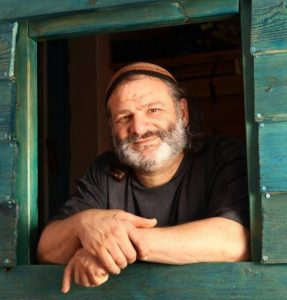
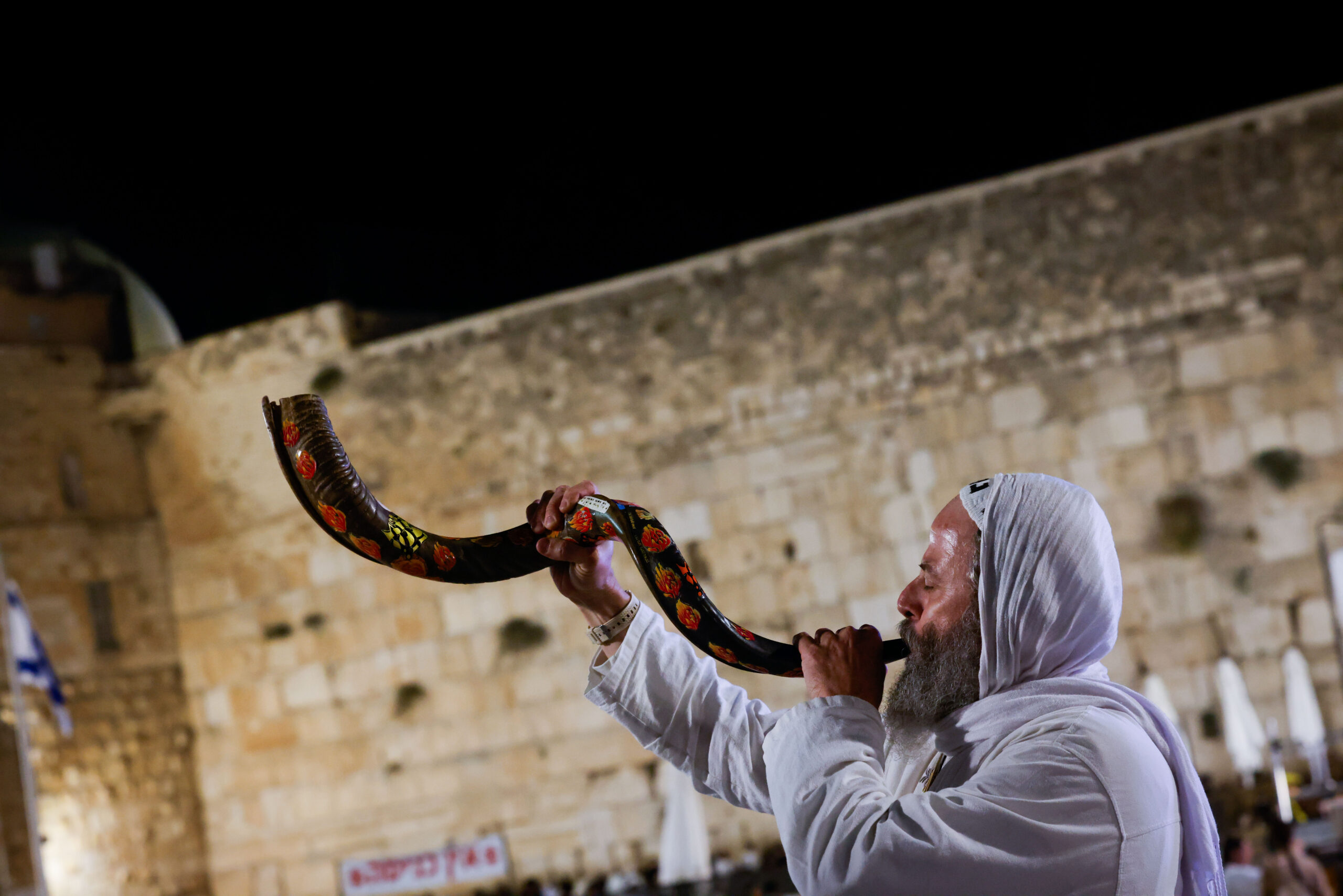
A beit din (rabbinic court) of three, led by Rabbi Yisrael Ariel on behalf of the nascent Sanhedrin, announced this week that it has renewed a ruling permitting the shofar to be blown on Shabbat when Rosh Hashanah falls on the seventh day of the week. Rabbi Ariel founded the Temple Institute in Jerusalem and has for years taken part in efforts to revive a modern rabbinical assembly modeled on the historical Sanhedrin. The body stated it will convene next Rosh Hashanah at the Temple Institute in Jerusalem’s Old City to carry out the practice, a ruling its members say rests directly on the Mishnah and on Maimonides.
The timing gives the ruling immediate relevance. Rosh Hashanah 2026 begins at sundown on Friday, September 11, and ends at nightfall on Sunday, September 13, marking the start of the Jewish year 5787. Because the first day of the holiday falls on Shabbat, the question the beit din addressed is not theoretical. It is the exact circumstance to which the ruling was issued.
For nearly two thousand years, in every synagogue in the world, the shofar has fallen silent whenever Rosh Hashanah lands on Shabbat.
The halachic (Jewish law) background begins in the Mishnah itself. Rosh Hashanah 4:1 records that when the Temple stood, the shofar was blown on Shabbat throughout the city of Jerusalem, and even beyond it, wherever a beit din, a rabbinical court, was seated. After the Temple’s destruction, Rabban Yochanan ben Zakkai instituted that the shofar continue to be blown, but only in the place where a beit din sat. Maimonides codifies this ruling in Mishneh Torah, Hilchot Shofar 2:6, explaining that the underlying concern was a rabbinic decree against carrying the shofar through a public domain to reach someone qualified to blow it, a decree the Sages waived only in the presence of a functioning court, whose authority could prevent error. Once the Sanhedrin itself ceased to sit, no place retained that exemption, and the practice ended everywhere. In every year since, when Rosh Hashanah falls on Shabbat, congregations recite the Rosh Hashanah prayers, including the verses that reference the shofar blasts, but the shofar itself stays silent.
Rabbi Ariel’s beit din is asserting that its own convening constitutes exactly the kind of beit din the Mishnah and Rambam had in mind, and that its ruling revives the original halacha rather than departs from it. The claim rests on the reconstituted Sanhedrin’s broader position that it functions as a legitimate rabbinical court with the authority described in the Mishnah. That position is not accepted by the mainstream Orthodox rabbinate, which does not recognize the modern body as possessing the classical Sanhedrin’s authority. The ruling announced this week should be understood in that context: a minority position, issued by a body that considers itself empowered to issue it, led by a rabbi who has spent decades working toward the institutions this ruling assumes are already restored.
The choice of the shofar carries meaning that goes well beyond the technical question of Shabbat law. Zechariah writes of the shofar’s connection to divine victory in battle: “Then the Lord will appear over them, and His arrow will go forth like lightning; the Lord God will sound the shofar, and will march in the storms of the south” (Zechariah 9:14). The verse binds the shofar’s blast to God’s own intervention on the battlefield, the same association the beit din invoked in its announcement. Its members spoke of the hope that the coming year, difficult at its outset, will not end in the sound of the teruah of war, but in a teruah announced by the shofar itself, calling down peace for the people and the land of Israel. With Rosh Hashanah falling on Shabbat this coming September, that hope now has a fixed date. In that framing, the sound the Sages once silenced out of caution becomes, in this ruling’s telling, an instrument the beit din hopes will hasten the end of war rather than announce its beginning.
