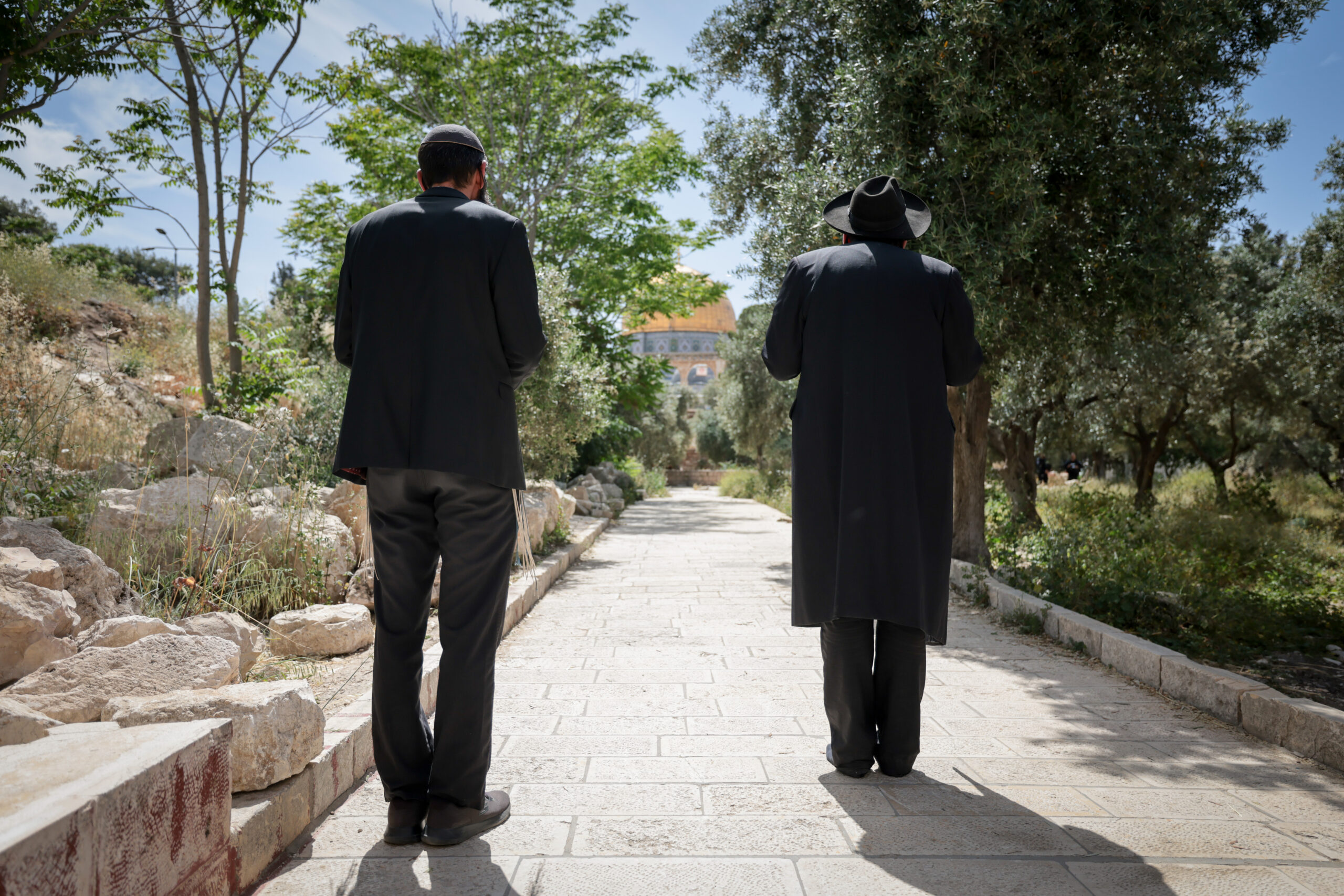
Jewish worshipers were allowed to carry and read from full siddurim (prayer books) on the Temple Mount on Sunday, the latest and most significant challenge to a decades-old policy barring non-Muslim prayer at Judaism’s holiest site.
Right-wing journalist Arnon Segal posted a photograph Sunday showing men praying at the site with siddurim in hand, towels laid on the ground before them signaling that the men had also prostrated themselves in prayer. “Still no blanket permit, but an initial experiment aimed at ensuring the Middle East doesn’t lose its mind over this,” Segal wrote, calling the moment “history.”
National Security Minister Itamar Ben-Gvir confirmed to The Jerusalem Post that the worshipers had been permitted to bring the prayer books onto the compound. The Israel Police, asked for comment, said only that the site is managed “in accordance with the instructions of the political leadership, standard practices at the site and based on an operational assessment.”
A Policy Eroding in Practice, Not in Law
The shift Sunday had its beginnings earlier this year when authorities began allowing Jewish visitors to carry a single pre-printed prayer page distributed at the entrance, while full siddurim and other ritual items remained formally prohibited. Enforcement has loosened steadily since: police have increasingly allowed Jewish and Christian groups to pray quietly at the site, prostrate themselves, and sing – all technically forbidden under the site’s governing arrangement- without intervening.
הבוקר בהר הבית: יהודים מתפללים עם סידורים. עדיין לא היתר גורף אבל ניסוי ראשוני במטרה לוודא שהמזרח התיכון לא יוצא מדעתו בגלל זה. היסטוריה pic.twitter.com/MduyD0YKmm
— ארנון סגל (@arnonsegal1) August 16, 2026
This reflects Ben-Gvir’s three-year campaign, as the minister overseeing the police, to stop enforcing a ban that was never actually supported by Israeli law in the first place.
What Israeli Law Actually Says
Israel’s own Basic Law: Jerusalem, Capital of Israel, passed in 1980, states plainly that the government must “protect the Holy Places against desecration and any other violation and against anything that is likely to violate the freedom of access of the members of the different religions to the places sacred to them.” The Protection of Holy Places Law, passed in 1967, says the same. On paper, Israeli law does not carve out an exception for Jews at the site the Bible identifies as their own holiest place.
The courts have said as much directly, and the gap between what the law recognizes and what police actually permit has a name in Israeli legal circles: the de jure/de facto divide. In 1993, then-Justice Aharon Barak, presiding over a Supreme Court panel on the question, ruled that Jews possess a genuine right of worship on the Temple Mount, a right police must enforce unless they determine themselves genuinely unable to protect public safety while doing so. As a matter of law, the question was settled: de jure, full freedom of religion at the site.
That precedent was tested directly in the case of Rabbi Yehuda Glick, an activist who was barred from the site for two years after police filmed him praying there. In 2015, the Jerusalem Magistrate’s Court ruled in Glick’s favor, with Judge Malka Aviv finding that police “must ensure that Jews can pray on the Temple Mount” and awarding Glick roughly 500,000 shekels in damages for the wrongful ban. Attorney Aviad Visoly, who represented Glick, said the ruling simply took the Supreme Court’s 1993 recognition of the right and “implemented it in practice.” The state appealed, and a district court later overturned the damages award, though the underlying legal recognition of the right itself has never been struck down.
What the Glick case exposed was the mechanism by which that de jure right gets curtailed de facto: police discretion. Barak’s own 1993 ruling built in the exception that would swallow the rule, allowing police to restrict the right whenever they judged public order to require it, a judgment call that has, in practice, meant near-total suppression for decades at a time, reversed only when a police leadership under a minister like Ben-Gvir chooses not to exercise that discretion. Glick himself described the gap in exactly these terms. “While Israel’s Supreme Court has recognized the right of Jewish worship on the Temple Mount, it has left the implementation of those basic civil and religious rights to police discretion,” he said. “This in turn has led to consistent civil rights violations in the name of short-sighted self-serving expediencies.” The law never changed between the years Glick was banned and Sunday’s siddurim. The policing did.
The Firman That Actually Exists, and How Its Logic Reached the Jews
“Status quo”, a Latin phrase that means the existing state of affairs or current situation, is frequently referred to in the media as determining policy at the Temple Mount. When applied to the holy sites in Jerusalem, the term takes on a totally different meaning. It refers instead to a doctrine originating in Ottoman firmans of 1757 and 1852, which froze a dispute among rival Christian denominations – Greek Orthodox, Latin Catholic, Armenian Apostolic – over control of the Church of the Holy Sepulcher and the Church of the Nativity. Jews go unmentioned. The Temple Mount goes unmentioned. The text is a settlement between churches.
The bridge to Jewish worship was built by the British, not the Ottomans. After the deadly 1929 riots over the Western Wall, a Waqf-owned wall against the Temple Mount’s retaining structure, Britain convened an international commission to settle the Jewish-Muslim dispute. Its 1930 report explicitly invoked the Ottoman status quo doctrine, citing the 1852 firman by name as precedent, though the underlying conflict had nothing to do with Christians. The commission affirmed Muslim ownership of the Wall while guaranteeing Jews prayer access under fixed restrictions, no furniture, no partitions, no shofar. This was codified in Britain’s 1931 Wailing Wall Order in Council. That is the actual origin of “status quo” governing Jewish practice: a colonial commission borrowing the name and logic of a Christian property doctrine for an unrelated dispute, thirty-eight years after the fact.
In 1967, Moshe Dayan simply extended that borrowed framework one level up, from the Wall to the entire Mount above it, barring non-Muslim prayer there to avoid a repeat of 1929. It’s a cabinet minister’s security decision, not a binding decree, wearing the authority of a much older word. Critics, including a 2022 Jerusalem Center for Public Affairs analysis, call the result religious discrimination by definition: one faith’s prayer permitted, another’s barred, at the same site, under the same government, however many layers of borrowed precedent separate it from Constantinople.
The Restrictions That Remain
Even after Sunday’s shift, Jewish worshipers still face restrictions found nowhere else in Israeli religious life. Jews may only ascend the Temple Mount during limited visiting hours set by the police and the Waqf, are barred from the areas nearest the Dome of the Rock, and continue to face screening for religious items at the entrance, including prayer shawls and phylacteries, that would raise no eyebrows at the Western Wall a few hundred feet away. Israel’s own Chief Rabbinate, separately, holds that Jews should not ascend to some or all of the site at all under Jewish law, given uncertainty about the exact location of the ancient Temple’s inner sanctuary, a religious caution entirely distinct from the political restriction imposed by police.
Christians face a version of the same exclusion. Christian visitors are generally permitted onto the Temple Mount only as tourists and, like Jews, are formally barred from praying, singing, or engaging in devotional activity there under the same status quo arrangement, even though Christian pilgrims may freely pray at the Western Wall and at Christian holy sites elsewhere in Jerusalem. The recent loosening that allowed Jewish men to pray openly with siddurim on Sunday has, in practice, extended informally to some Christian groups as well, with police increasingly permitting Christian visitors to pray and sing quietly at the site without intervention, the same unofficial, reversible tolerance that now governs Jewish prayer there.
Jordan’s Foreign Ministry, through officials meeting in Amman, condemned the recent changes as violations of the status quo and warned of escalation. Israel Police, for its part, announced no general change in policy following Sunday’s development, leaving Sunday’s siddurim, like the prayer sheets before them, one experiment among many that could be reversed as easily as it was permitted.