
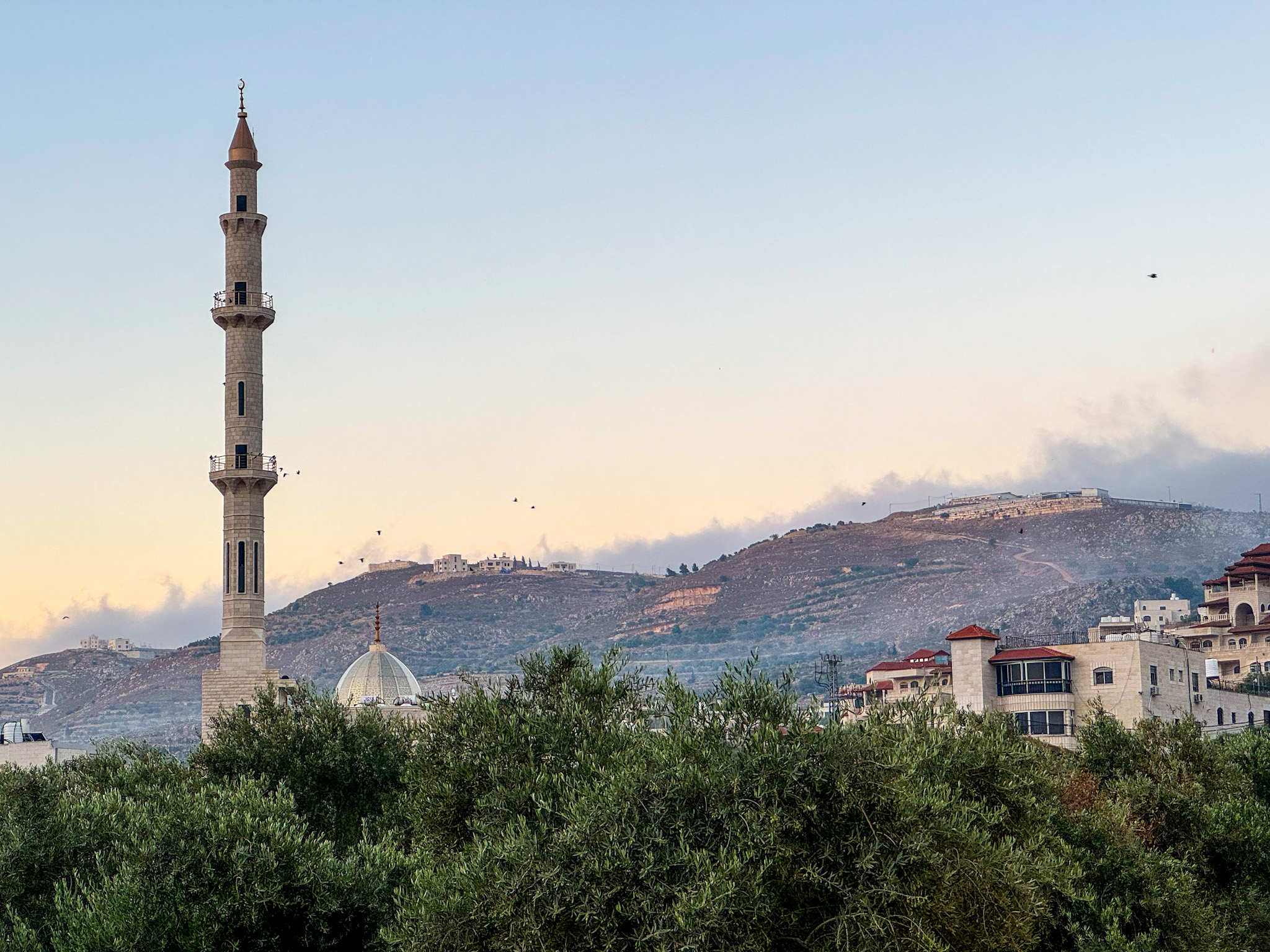
American citizens living in a Palestinian Authority village north of Ramallah have spent years praising Hamas, Hezbollah, and the October 7 massacre while systematically funneling local incidents into the American political system, according to a new investigation released Thursday by Regavim, a Zionist policy and legal advocacy organization focused on land-use and sovereignty issues in Judea and Samaria.
The report focuses on Turmus Ayya, a village in the Binyamin region with an official population of roughly 8,000, of whom an estimated 80 to 90 percent hold U.S. citizenship or permanent residency. Regavim’s investigation documents how key members of that American diaspora have built a functioning pipeline: promoting anti-Israel campaigns, glorifying Hamas and Hezbollah, celebrating the atrocities of October 7 and armed “resistance,” and then converting local incidents on the ground into congressional letters, demands for investigations, and proposed sanctions legislation in Washington.
Praising Terror, Then Calling Congress
Regavim’s central finding is that the same individuals driving anti-Israel activism in Turmus Ayya are also the ones channeling incidents there into American political pressure. “Turmus Ayya shows how an American passport can become a political weapon in the hands of activists who understand exactly how Washington works,” said Naomi Kahn, director of Regavim’s International Division. “It creates an incentive for violent confrontations at specific locations that automatically trigger US Congressional response, placing the people of Turmus Ayya at high risk. Local confrontations are catapulted into the Justice Department, Congress, the State Department and the media, while the people driving that pressure are rarely scrutinized for their own support for terror and political agendas.”
Regavim’s International Division head Naomi Kahn was direct about the scale of that failure. “Some of these activists openly praise Hamas, Hezbollah and October 7, yet are still treated as credible community representatives in the United States,” she said. “That is an extraordinary failure of scrutiny. Washington needs to stop looking only at the passport and start looking at the network behind it. Who do these activists represent, to whom do they answer, and how are they using American citizenship to influence U.S. policy toward Israel?”
Imad Daboob: Dancing to Songs of “Martyrs”
The investigation identifies Imad Daboob, a Turmus Ayya native active in the United States, as one of the network’s central figures. Palestinian sources repeatedly identify Daboob as holding senior roles connected to Fatah, the political arm of the PLO and the umbrella organization under which groups such as the Al Aqsa Martyrs Brigade operate. He also sits on the board of the U.S. Palestinian Council, and Regavim documents his contacts with senior Palestinian Authority and Fatah officials, including Mahmoud Abbas and Hussein al-Sheikh.
Regavim’s research catalogs Daboob’s own activity glorifying violence. At an event he organized in Memphis, Tennessee, participants danced to songs honoring armed Fatah fighters and commemorating the 1965 Eilabun Tunnel attack on Israel’s National Water Carrier, an operation Fatah marks as part of its founding history. The report also links Daboob to the Palestinian American Community Center and American Muslims for Palestine, two organizations currently under U.S. investigation for alleged terror ties, and notes that he served time in an Israeli prison for terrorism during the First Intifada, a record Regavim says he takes pride in publicly.
Mashal Alkook: Calling October 7 “Glorious”
The second figure at the center of the investigation is Mashal Alkook, a U.S. citizen based primarily in Chicago who returns to Turmus Ayya regularly to take part in demonstrations, confrontations with Israeli forces and civilians, and other activism. Regavim’s report catalogs numerous posts and public statements by Alkook praising or defending Hamas, Hezbollah, Iran, and the Houthis, including messages mourning former Hezbollah leader Hassan Nasrallah and senior Hamas figures, and praise for Hamas military spokesman Abu Ubaida. In one post cited in the report, Alkook described October 7 as a “glorious” day.
Alkook has his own history of imprisonment, though in his case the arrest came from the Palestinian Authority itself, over his affiliation with the Popular Front for the Liberation of Palestine, a Marxist terrorist organization responsible for the deaths of Americans and Israelis, including Israeli tourism minister Rehavam Ze’evi. His case was championed internationally by Samidoun, an organization designated as a terrorist entity by the United States, Israel, and Canada for its financial support of the PFLP.
From Turmus Ayya to the Senate Floor
Regavim traces a direct line from this activism to concrete outcomes in Washington. The report documents a growing list of congressional actions that have followed incidents in and around the village, including Senate letters, demands for federal investigations, and proposed legislation seeking sanctions over violence in the region. Because American law extends consular attention and political concern to any U.S. citizen harmed abroad, the report finds, an incident involving a Turmus Ayya resident who happens to hold American citizenship, regardless of whether that person has ever actually lived in the United States, can move through Washington’s political system almost automatically.
That structure, Regavim argues, is precisely what a network of activists glorifying Hamas and Fatah violence has learned to exploit. Individuals who publicly celebrate the killing of Israelis are, in the report’s telling, simultaneously positioning themselves as the ones Washington turns to for information and testimony when violence occurs in their own village.
Regavim’s Demands
Regavim is calling on U.S. authorities to examine Daboob’s activities under the Foreign Agents Registration Act, investigate the immigration and residency status of individuals whose public activity includes support for terrorism, and scrutinize the broader network linking this activism to Fatah and Palestinian Authority officials. The organization is also calling for a wider federal review of how American diplomatic and institutional protections are being leveraged by people who openly celebrate attacks on Israelis to shape U.S. foreign policy.
The brief was compiled by Naomi Kahn, with Arabic-language open-source research by Moran Tal and additional material from Elchanan Groner and Guy Goldstein.
Access it here.