
Jews have been the target of 18 hate crimes in Texas so far this year, making up roughly 5% of the state’s 345 recorded hate crimes, according to the Texas Department of Public Safety’s Uniform Crime Reporting system. Jews make up an estimated 0.72% of the state’s population, meaning they have been targeted at close to six times the rate their numbers alone would predict. The pattern is not new. In 2025, Jews were the target of 41 of the state’s 599 recorded hate crimes, 6.8% of the total, and over the twelve months from August 2025 to today, Jews accounted for 40 of 639 incidents, 6.3%. Arabs and Muslims, the next most disproportionately targeted religious minority, were named in about 4% of incidents across the same periods. Governor Greg Abbott announced Friday that overall crime in Texas fell 13% in 2025, the third consecutive year of decline, crediting bail reform and tougher enforcement of repeat offenders. Whatever is driving that broader improvement has not extended proportionately to the state’s Jewish community.
That statistical overrepresentation sits beside a fact that makes it genuinely strange: Texas is arguably the most institutionally pro-Israel state in the country, home to the country’s largest Christian Zionist organization, a governor who has built part of his political identity around defending the Jewish state, and an evangelical population numbering in the tens of millions that overwhelmingly believes supporting Israel is a matter of biblical obligation.
What the Numbers Look Like on the Ground
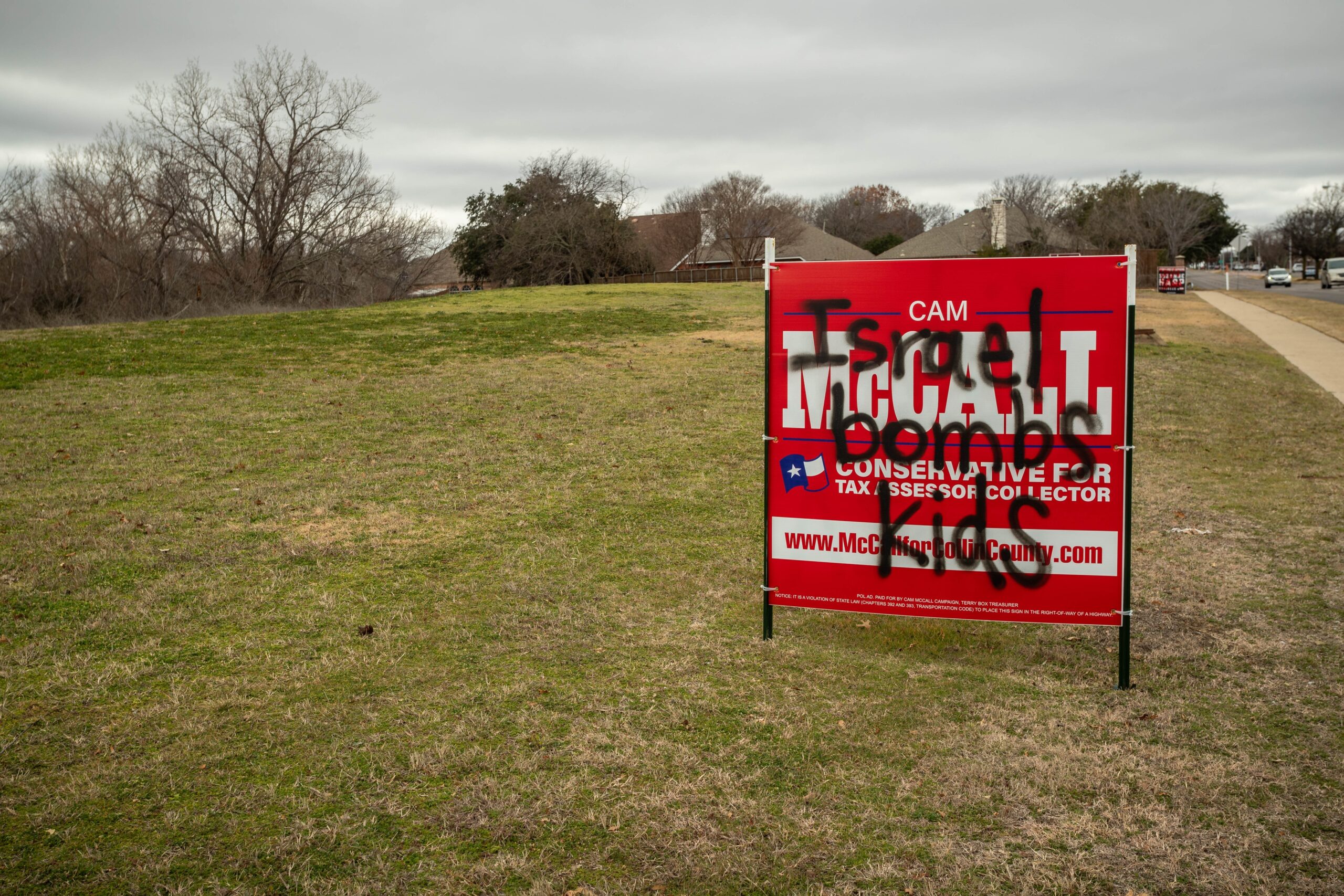
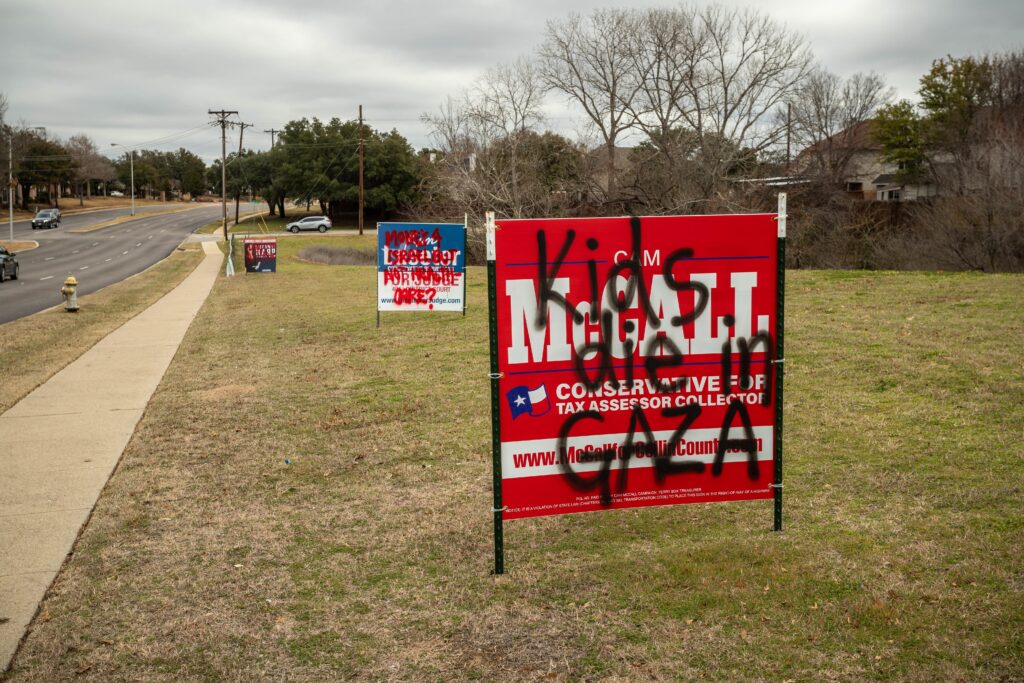
The statistics translate into a real, ongoing pattern of incidents rather than an abstraction. In April 2026, Congregation Beth Israel, a 150-year-old Reform synagogue in Austin, was vandalized with a swastika and the words “Death to Israel” spray-painted on its wall, the same congregation that was firebombed in 2021 by a former Texas State Guard member in an arson attack that caused $25,000 in damage. Around the same time, law enforcement thwarted a plot by a North Carolina woman and a Texas teenager to attack a Houston-area synagogue, an arrest the Texas chapter of the Council on American-Islamic Relations publicly welcomed while condemning the Austin graffiti in the same statement. In February 2025, two El Paso synagogues, B’nai Zion Congregation and Mt. Sinai, were vandalized with Nazi symbols on the same day, prompting an FBI investigation alongside local police. And the incidents follow years of higher-profile attacks: the January 2022 hostage crisis at Congregation Beth Israel in Colleyville, where a British national held four people for ten hours before they escaped, remains one of the most widely remembered antisemitic attacks on US soil in recent memory. The ADL has separately documented a 418% rise in antisemitic vandalism incidents in Texas in a single year, even before the current wave, alongside targeted harassment campaigns by groups like the Goyim Defense League.
Texas’s Jewish population, while a small share of the state’s roughly 31 million residents, is not small in absolute terms. Estimates put the statewide Jewish population at somewhere between 130,000 and 180,000, concentrated overwhelmingly in a handful of metro areas: the Dallas-Fort Worth area is home to an estimated 75,000 Jews, Greater Houston to roughly 50,000, San Antonio to about 7,000, and Austin’s Jewish community has grown from 5,000 in 1990 to an estimated 18,000 today. Smaller but historic communities persist in El Paso, Fort Worth, Corpus Christi, Waco, and Galveston, the port city where the early-1900s Galveston Plan resettled more than 10,000 Jewish immigrants fleeing Europe. Jewish Texans have served as mayors in at least 35 municipalities across the state, from Dallas and Austin down to small towns like Lockhart, a level of civic integration that makes the current run of vandalism and threats land as particularly jarring to a community that has, by most measures, been thoroughly woven into Texas public life for more than a century.
The Other Half of the Picture
Set against that backdrop, Texas’s institutional relationship with Israel is unusually deep, and it runs through both faith and government simultaneously.
San Antonio is home to Cornerstone Church, Pastor John Hagee’s roughly 20,000-member megachurch and the headquarters of Christians United for Israel, the country’s largest pro-Israel advocacy organization, which says it has reached tens of millions of evangelical supporters through its media network since Hagee founded it in 2006. Hagee has preached for decades that supporting Israel is not optional for a believing Christian. “Supporting Israel is not a political issue,” he has said. “It is a Bible issue.” That framing traces back to Genesis, where God tells Abraham: And I will bless them that bless thee, and curse him that curseth thee; and in thee shall all the families of the earth be blessed. (Genesis 12:3) It is the single most cited verse in Christian Zionist theology, and Texas pastors invoke it as often as any preacher in the country. Robert Jeffress, senior pastor of First Baptist Church in Dallas, was invited by the Trump administration to lead the prayer at the 2018 opening of the US Embassy in Jerusalem. One estimate, built from polling on how many Christians and Jews believe Israel was divinely given to the Jewish people, suggests Texas alone may be home to more Christian Zionists than there are Jews in the entire world.
Texas state government has matched that religious sentiment with concrete policy. Governor Abbott signed the state’s anti-BDS law, House Bill 89, on Israel’s Independence Day in 2017, barring state agencies from contracting with or investing in companies that boycott Israel, and later signed companion legislation blocking state contracts with entities doing business with Iran or designated terrorist organizations. “Anti-Israel policies are anti-Texas policies, and we will not tolerate such actions against an important ally,” Abbott said at the signing. He has made two trade missions to Israel as governor, was awarded the Friends of Zion Heritage Center’s highest honor in Jerusalem, and told the audience there in terms he has repeated often since: “Anybody who is an enemy of Israel is an enemy of Texas. Whenever anybody threatens Israel, we come side by side with Israel to support Israel in any way we can.” Texas is Israel’s largest trading partner among US states.
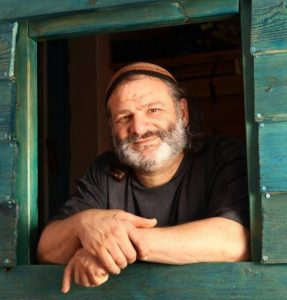
Israell365’s Rabbi Elie Mischel, who is currently touring Texas to connect with pro-Israel Christians, has been watching both halves of this picture up close, and his own account captures the tension better than any statistic can. “There is a long history of Texas supporting the Jewish people and Israel,” Mischel said. “Unlike much of the rest of the country, millions of Texans are standing strong with Israel and the Jewish people, for which we are deeply thankful. There’s an old tradition in Texas of understanding that the Jews are God’s chosen people, and that Texans have a deep spiritual connection to the people of Israel.” He recalled meeting a man in his nineties who told him he had been praying for Israel since he was five years old, years before the modern state was founded in 1948.
That same conversation, in Mischel’s telling, carries a harder edge. “Jewish institutions in Dallas and other places around Texas have been building walls and security fences and upgrading their security, because Texas is not immune to the evil that is sweeping across the United States,” he said, pointing to what he described as dozens of new mosques established in the state over the past year alongside “a real growth in Jew hatred, primarily from the Muslim community, but from others as well.” Mischel framed the stakes in terms that go beyond any single incident. “I really see these next few years in Texas as critical for the future of the state and the future of the country,” he said. “I hope and pray that the good people of Texas will reclaim their state and make sure that it doesn’t continue to slowly drift away from the Bible and towards hatred of the Jewish people.”
The tension between these two facts, a state with arguably the deepest institutional and religious commitment to Israel of any in the country, and a Jewish community facing hate crimes at nearly six times its demographic share, is not actually a contradiction once the numbers are read carefully rather than as competing headlines.
Part of the answer is simply arithmetic. Jews make up less than one percent of Texas’s population, the smallest denominator of any group tracked in the state’s hate crime data, which means even a modest, low double-digit count of incidents produces an outsized percentage when measured against population share. The same overrepresentation shows up nationally and has shown up in New York City and the United Kingdom in recent reporting, suggesting this is a structural feature of how antisemitic violence distributes itself relative to Jewish population size everywhere, not a uniquely Texan failure. The other part of the answer is that the people committing these acts, the individual vandals, the Goyim Defense League affiliates, the would-be Houston synagogue attackers, represent a small, often extremist fringe operating in direct opposition to, not in step with, the broader currents of Texas public and political life. A megachurch pastor in San Antonio filling arenas with pro-Israel sermons and a state legislature passing an anti-BDS law do not cancel out a swastika painted on a synagogue wall in Austin, and they were never going to. Texas’s Jewish community is living, at the same time, inside one of the most demonstrably pro-Israel political and religious cultures in the country and inside the same national wave of antisemitic violence that has touched nearly every American Jewish community since October 7. Both are true. Neither explains away the other.