



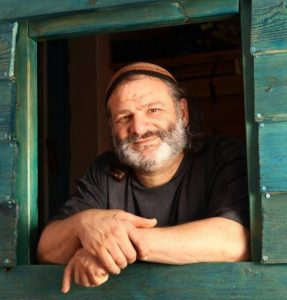

A new Catholic initiative is attempting something that has never been organized quite this way before: a coordinated theological appeal, signed by Catholic clergy and laity, explicitly in support of the Jewish state. Father Antoine Lévy, a Dominican theologian based in Jerusalem, and Dr. André Villeneuve, a Catholic biblical scholar and founder of Catholics for Israel, laid out the thinking behind “For Zion’s Sake: A Catholic Appeal in Support of Israel” in a lengthy conversation on the Genesis 123 Foundation’s Inspiration from Zion podcast, hosted by Jonathan Feldstein.
Villeneuve traced the initiative’s roots to years of watching a gap open between Catholic doctrine and Catholic practice. “There was a dichotomy between the teachings of scripture and the official teachings, or magisterial teaching, of the Catholic Church, and her rapport between the church and Israel in theory, which did not always play out in practice,” he said, explaining why he founded Catholics for Israel in 2007.
The immediate catalyst for the new document, both men said, was the wave of Catholic commentary that followed a January statement from regional church patriarchs, amplified by figures like Carrie Prejean Boller, asserting that anti-Zionism is settled Catholic teaching. “I became very frustrated by that,” Villeneuve said. “You want to be a Catholic anti-Zionist, bevakasha, please go ahead, but please do not claim to speak for the entire Catholic Church. This is your private opinion. The Catholic Church does not have an official teaching on Zionism, which means it’s absolutely legitimate to discuss it as a legitimate theological option.”
Lévy framed the timing in starker terms. “It’s no secret that the dialogue between the Catholic Church and the Jewish world has reached a new low after October 7th,” he said, describing a pattern of “influencers and thinkers and journalists” claiming to represent the Vatican’s actual position on Israel while introducing “elements of antisemitism that we hadn’t seen for a long time.”
A Document Built Like a Chiasm
Villeneuve, speaking as the document’s biblical scholar, revealed a structural detail easy to miss on a first read: the whole appeal is built as a chiasm, the literary structure common throughout the Bible in which a text’s themes mirror each other around a central turning point. It opens with “Catholics Against Israel: A Disturbing Trend,” moves through “Understanding Israel” and “Catholic Zionism: The Pivotal Question” at the center, then out through “Standing with Israel” and closes with “Catholic Voices for Israel: Our Appeal.” The center section defines Zionism narrowly and deliberately, Villeneuve said, as simply “the belief that the Jews have the right to self-determination in their own lands,” a definition meant to strip away what he called the caricatures built up around the word: “colonialist ideology,” “apartheid,” “ethnic cleansing,” “eschatological craze.”
The document’s theological core rests on Romans 11, which Lévy and Villeneuve cite directly against any framing of the Jewish people as spiritually superseded: For the gifts and the calling of God are irrevocable. (Romans 11:29) Villeneuve called the tension this creates unavoidable for serious Catholic theology. “If the church has said now for 60, 70 years that God’s gifts and calling to the people of Israel are irrevocable, well, how can you say that and in the same breath say that the return of the Jews to the land of Israel has absolutely no significance because we are the true Israel?” he said. “To me, it’s completely theologically inconsistent.”
One exchange in the conversation reached what Lévy called “the deepest theological core of this whole issue”: the old Catholic argument that the Jewish people’s historic exile itself proved they had been set aside by God. Lévy pointed out that this framing carries its own unraveling built in. “How can you say that there’s no legitimacy of the Jewish people in the land or state of Israel in the land from which we were exiled and which God gave us?” Feldstein asked. Villeneuve answered by citing an Israeli analyst’s phrase for the pattern: “a type of clinging to theology at the expense of reality,” rooted in a doctrine of perpetual exile dating to the second century that the return of the Jewish people to their land has now at least partially overturned, forcing a reckoning that opponents of Israel, in Villeneuve’s telling, avoid by simply not engaging with the Hebrew Bible’s own prophets. “Deuteronomy warns of an exile if Israel is not faithful to the covenant,” he said, “but unconditionally it also promises that God will return the people back to their land. And this is echoed by all the prophets.”
Where the Relationship Has Actually Broken Down
The conversation’s account of a “new low” since October 7 is not an exaggeration of the record. Pope Francis repeatedly raised the question of whether Israel’s campaign in Gaza met the legal definition of genocide, telling reporters that “according to some experts, what is happening in Gaza has the characteristics of a genocide” in a book published for the Church’s jubilee year, and calling conditions in Gaza “very serious and shameful” in a formal address to the diplomatic corps. Cardinal Pietro Parolin, the Vatican’s secretary of state, went further still in October 2025, telling Vatican media that Israel was carrying out an “ongoing massacre” in Gaza, even while calling Hamas’s October 7 attacks “inhuman and indefensible” in the same interview. Vatican communications have also avoided recognizing Jerusalem as Israel’s capital in ways that read as pointed: Vatican editorial director Andrea Tornielli has referred to the Israel Defense Forces as “the army of Tel Aviv,” an inaccurate label that nonetheless signals where the Vatican’s formal recognition still stands. In May 2024, the Vatican gave its own platform to Nobel laureate Tawakkol Karman, who used the appearance to accuse Israel of “massacres of ethnic cleansing and genocide.”
The pattern Lévy and Villeneuve describe, of theology reinforcing politics, also has real academic representation. Palestinian Christian theologians writing in this tradition, scholarship on the subject has noted, have explicitly framed Christian-Muslim dialogue as a joint platform against Israel rather than a venue for mutual understanding on its own terms, casting the “occupation” as “the ultimate source of evil” that obliges the church to “step in” alongside Muslim allies. That framing, closely related to the liberation theology model that reads Christian solidarity primarily through the lens of a colonized or oppressed people opposing a state power, is precisely what Villeneuve and Lévy are working against. Their document does not deny Palestinian suffering. It rejects the theological leap from acknowledging that suffering to concluding that Israel’s existence itself is illegitimate.
The Second Vatican Council’s Unfinished Business
Both men repeatedly anchored their argument in the Second Vatican Council of 1962 to 1965, whose declaration Nostra Aetate marked the Church’s decisive turn away from centuries of teaching that treated Jewish suffering and exile as divine punishment. “The magisterium has become much more friendly towards Judaism and towards Israel” since the council, Villeneuve said, arguing that the appeal represents “not a rupture, not an overturning of Catholic tradition, but a return back to authentic Catholic tradition.”
Not every Catholic accepted that turn, and the cost of rejecting it has just been made unusually visible. In July 2026, the Vatican excommunicated the bishops and formally declared in schism the priests and lay followers of the Society of Saint Pius X, the traditionalist group founded in 1970 specifically in opposition to Vatican II’s reforms, including its teachings on religious freedom and its openness to interreligious dialogue and ecumenism. The SSPX, which claims several hundred thousand adherents worldwide, had ordained four new bishops without papal approval despite direct appeals from Pope Leo XIV to stop, prompting the Vatican’s doctrinal office to declare the group in schism outright, a penalty broader than the excommunications the same group faced and had lifted in the 1980s and 2000s. The episode is a useful marker for how seriously Rome now treats rejection of the council’s reforms, the same reforms Lévy and Villeneuve invoke as the doctrinal foundation for taking Catholic Zionism seriously as a live theological question rather than a fringe position.
An Appeal That Ends in Confession
The document’s final section, mirroring its opening indictment of “Catholics Against Israel,” closes instead with what Villeneuve called “a call to repentance and a call to action.” He noted the Hebrew word for the same idea: “Teshuva in Hebrew is both to repent and to turn and to return.” The appeal calls on Catholics to bless Israel, without that blessing meaning uncritical endorsement of any specific policy, and closes with what Villeneuve described as “a word of confession, and I suppose of apology, towards our Jewish friends for those times when we did not stand together with the Jewish people, especially on October 7th and the hard years that have followed.”
Close to 150 Catholics, including theologians and priests, had signed the appeal as of the recording, alongside a “Friends of” category open to non-Catholic supporters. Neither Lévy nor Villeneuve expects senior Church leadership to sign on anytime soon, and both said that absence was expected rather than discouraging. As Lévy put it, doctrinal development in the Catholic Church has always moved through exactly this kind of open contest, “through crisis,” with theologians “quarreling, discussing, writing theological treatises to defend their positions,” a process that has, in his words, “both torn the church apart throughout the centuries but also made this reflection possible” and produced, over time, the Church’s genuine theological riches.


