




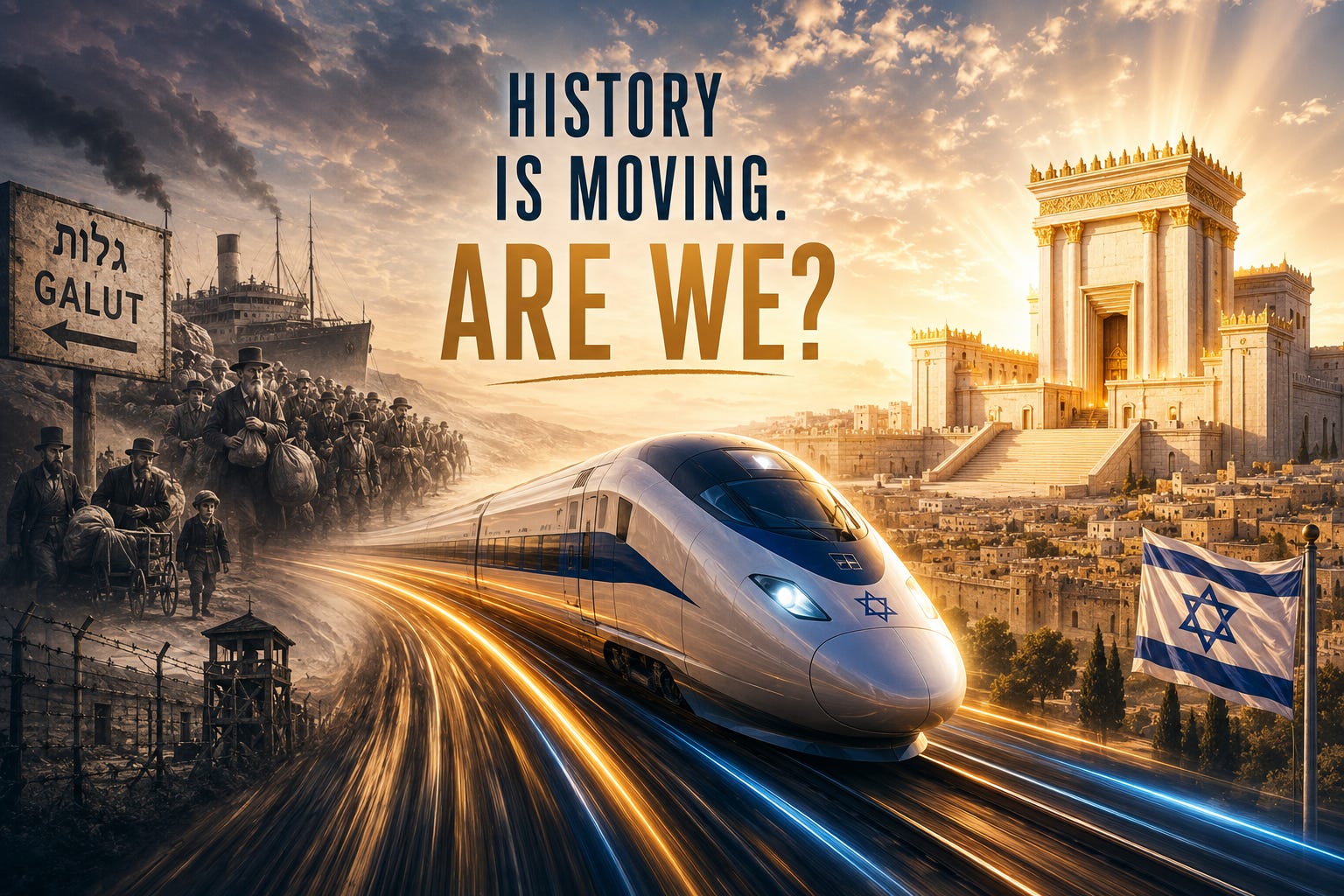
Every generation lives through history. Every generation experiences wars, political upheaval, scientific discoveries, and social change. So what makes our generation any different? The answer is not simply the pace of events. It is their direction.
For nearly two thousand years, Jewish history often appeared to move in circles. Our ancestors wandered from ghetto to ghetto, shtetl to shtetl, and country to country. One ruler replaced another. One decree gave way to the next. One expulsion was followed by another. One pogrom replaced the last. As portrayed so poignantly in Fiddler on the Roof, Jewish communities learned to build their lives with one eye always fixed on the door, never knowing when they would once again be forced to leave everything behind. Entire generations lived and died praying for redemption, yet from their perspective very little seemed to change. Then, almost unbelievably, everything did.
Imagine standing at the gates of Auschwitz in 1945. The Jewish world lay in ruins. Six million had been murdered. Ancient communities that had flourished for centuries had disappeared forever. Which Jew, standing amid such unimaginable destruction, could possibly have believed that within only three years a sovereign Jewish state would once again exist in the Land of Israel? Which Jew could have imagined that within a single lifetime millions of Jews would return from the four corners of the earth, that Hebrew would once again become the spoken language of a nation, that Jerusalem would become the capital of a Jewish state, that the Jewish people would possess one of the strongest militaries in the world, or that the Temple Mount itself would once again return to Jewish hands? No wonder the Psalmist describes the return to Zion by saying, “היינו כחולמים”—“We were like dreamers.” Even today, one sometimes has to stop and ask, Can this really be happening to us?
The Rambam’s understanding of redemption is remarkably practical. He teaches that the world continues according to its normal course. Redemption is not simply an escape into a magical or supernatural reality. One of its defining characteristics is the end of “שיעבוד מלכויות”—subjugation to foreign kingdoms. For the first time in nearly two thousand years, the Jewish people are no longer dependent upon the goodwill of kings, emperors, or foreign governments simply to exist. We govern ourselves in our ancestral homeland. We defend ourselves with our own army. We largely determine our own national destiny. For countless generations, this alone would have been considered the very definition of redemption.
From the Torah’s perspective, history is not an endless cycle. It is a journey with a destination. The prophets describe the ingathering of the exiles, the restoration of the House of David, the rebuilding of the Beit HaMikdash, and a world filled with the knowledge of Hashem. These are not poetic aspirations. They are divine promises. Every positive prophecy recorded in the Torah and the Prophets must ultimately come to fruition.
According to the traditional Jewish calculation, we are about to enter the year 5787. If history indeed moves toward the seventh millennium, then, in historical terms, remarkably little time remains. Many prophetic milestones still await fulfillment. Perhaps we should not be surprised that history itself appears to be accelerating before our very eyes.
Chazal describe redemption as unfolding “קמעא קמעא”—in stages. They also compare the period preceding redemption to “חבלי משיח”—the birth pangs of Mashiach. Anyone who has witnessed childbirth understands the pattern. Labor begins slowly. The contractions are mild and widely spaced. Time passes with little apparent progress. But as the birth draws nearer, everything changes. The contractions become stronger, closer together, and increasingly intense until, almost suddenly, new life enters the world. The process never ceases to be gradual, yet it accelerates dramatically as it approaches its culmination. Perhaps history follows the very same pattern.
For centuries, change appeared almost imperceptible. Then came the Industrial Revolution. Electricity, aviation, automobiles, computers, the internet, and now artificial intelligence compressed centuries of progress into only a few generations. AI now accomplishes in seconds what once required weeks or months. Information circles the globe instantly. Technologies become obsolete almost as quickly as they are invented. Human civilization itself seems to be moving faster than ever before.
The Jewish world has accelerated alongside it. Jews have returned home from over one hundred countries. Hebrew has become a living language once again. Jerusalem has been rebuilt and reunited. The land, once described as desolate has become one of the most innovative and productive countries on earth. Open preparations for the Beit HaMikdash, once dismissed as fantasy, are now discussed, studied, and pursued in broad daylight. Look only at the past few years. A global pandemic brought virtually every nation on earth to a standstill. Russia invaded Ukraine. Iran emerged into direct confrontation with Israel. Regional alliances shifted dramatically. October 7 shattered assumptions that had existed for decades and transformed Israeli society almost overnight. Artificial intelligence is reshaping nearly every profession. Developments that once would have defined an entire generation now seem to unfold within a matter of months.
Perhaps part of the problem is that our own lives have accelerated alongside history itself. We race from one notification to the next, from one breaking news alert to another, from one crisis to the next. Information overload has become our normal state of existence. It is like sitting on a train that has gradually gathered extraordinary speed. At first, every tree, every building, and every hill outside the window are perfectly clear. But as the train accelerates, the scenery becomes a blur. That does not mean nothing is happening. It means so much is happening that our eyes can no longer process it all. Perhaps history itself has reached that point. We are moving so quickly that we scarcely have time to appreciate the magnitude of the changes unfolding around us.
Maybe this is what the Talmud means when it teaches, “אין בעל הנס מכיר בניסו”—“The beneficiary of a miracle does not recognize his own miracle.” The miracles have not stopped. If anything, they have become so frequent that we scarcely notice them. We scroll past headlines that previous generations would have regarded as the fulfillment of ancient dreams, only to be distracted by the next historic headline a few hours later.
Perhaps this also sheds light on another familiar expression: “ישועת ה’ כהרף עין”—“Hashem’s salvation comes in the blink of an eye.” The preparation may unfold over generations. The stages may develop one after another. Yet once all the necessary pieces are in place, the decisive turning point can arrive with astonishing speed. Standing at the gates of Auschwitz in 1945, who could have imagined that only three years later the Jewish people would once again possess a sovereign homeland? Two thousand years of exile gave way to an entirely new reality almost overnight. History has a remarkable way of making the impossible seem inevitable in hindsight.
Is it really such a stretch to imagine that, at the pace history now seems to be moving, we may one day witness the rebuilding of the Beit HaMikdash? What once seemed like a dream a million miles away no longer feels quite so distant. Nearly every milestone of modern Jewish history would once have been dismissed as impossible. Yet one after another, those impossible dreams became reality. Perhaps the rebuilding of the Beit HaMikdash no longer belongs in the category of an unimaginable fantasy, but rather the next stage in a process that has already been unfolding before our eyes.
Future generations may well look back on our era as the generation in which thousands of years of biblical prophecy visibly converged. They may wonder what it was like to live through such extraordinary times. I hope our answer will be that we recognized the privilege while we were living it. We did not allow the speed of modern life to blind us to the miracles unfolding around us. We understood that we were not merely reading Jewish history. By recognizing the moment, embracing our responsibility and doing our part to move it forward, we became active participants in writing it.

