




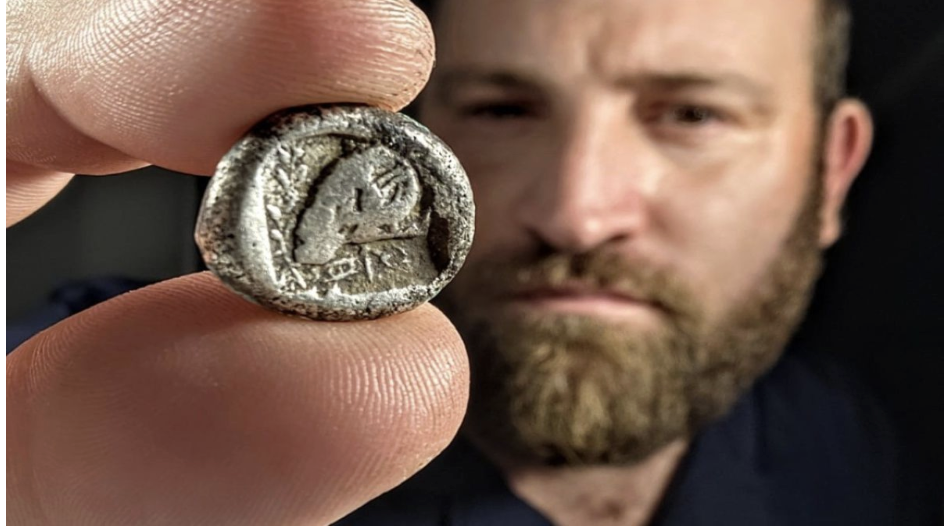
Avi Chaprak spends his days helping beachgoers in Ashdod recover rings, keys, and phones lost in the sand. About a month ago, while searching the shore for someone’s lost belongings, the deputy director of the city’s Beaches Department turned up something considerably older: a silver-plated coin that archaeologists say is the first of its kind ever discovered in Israel.
Chaprak, who had seen similar coins before and recognized its significance, turned the find over to the Israel Antiquities Authority, as required by law. Researchers there identified it as a siglos, a standard denomination minted in the ancient city of Salamis on Cyprus’s eastern coast in the mid-fifth century BCE, when the island lay under Persian rule. The coin weighs about 11 grams and appears at first glance to be solid silver, though a closer look showed it was actually base metal plated with silver, a technique known from Cypriot coinage of the period, driven by a shortage of silver on the island. One face depicts a reclining ram, and the other shows a ram’s head set within a sunken square frame, alongside a laurel branch and three symbols believed to belong to the ancient Cypriot syllabic script.
Yanniv David Levy, a researcher and curator in the Antiquities Authority’s Coin Department, said large silver coins from the Persian period rarely survive whole. Coins of this size and value were typically cut into pieces for use as local currency, and most known examples of that practice come from inland sites rather than the Mediterranean coast, making a complete, well-documented coastal find unusual by any measure.
The discovery drew interest beyond Israel’s borders. Evangeline Markou, a specialist in ancient Cypriot coinage at the National Hellenic Research Foundation in Athens, noted that while Salamis coins circulated widely across the eastern Mediterranean during this era, examples with a clear origin are far less common, giving this coin real value as evidence of trade and movement between Cyprus and the Land of Israel some 2,500 years ago. Levy agreed, saying the circumstances of the find and Chaprak’s accurate reporting allow researchers to treat the coin as a reliable window into the maritime and commercial ties that once linked the region to Cyprus.
Israel’s Minister of Heritage, Rabbi Amihai Eliyahu, called the coin tangible evidence of those ancient ties and praised Chaprak for handing it over rather than keeping it, noting that public cooperation in reporting antiquities preserves heritage that belongs to everyone and lets such finds be studied for generations to come.
The Israel Antiquities Authority presented Chaprak with a certificate of appreciation for the discovery. “For me, it was clear that the coin belonged to our collective heritage, so I immediately delivered it to the Israel Antiquities Authority,” he said. “If through this act I contributed another small piece toward the research and history of the Land of Israel, then that is a great honor for me.”
