



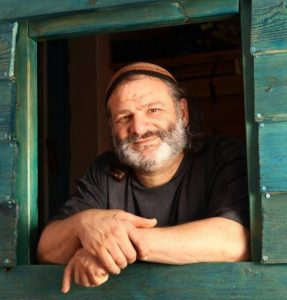
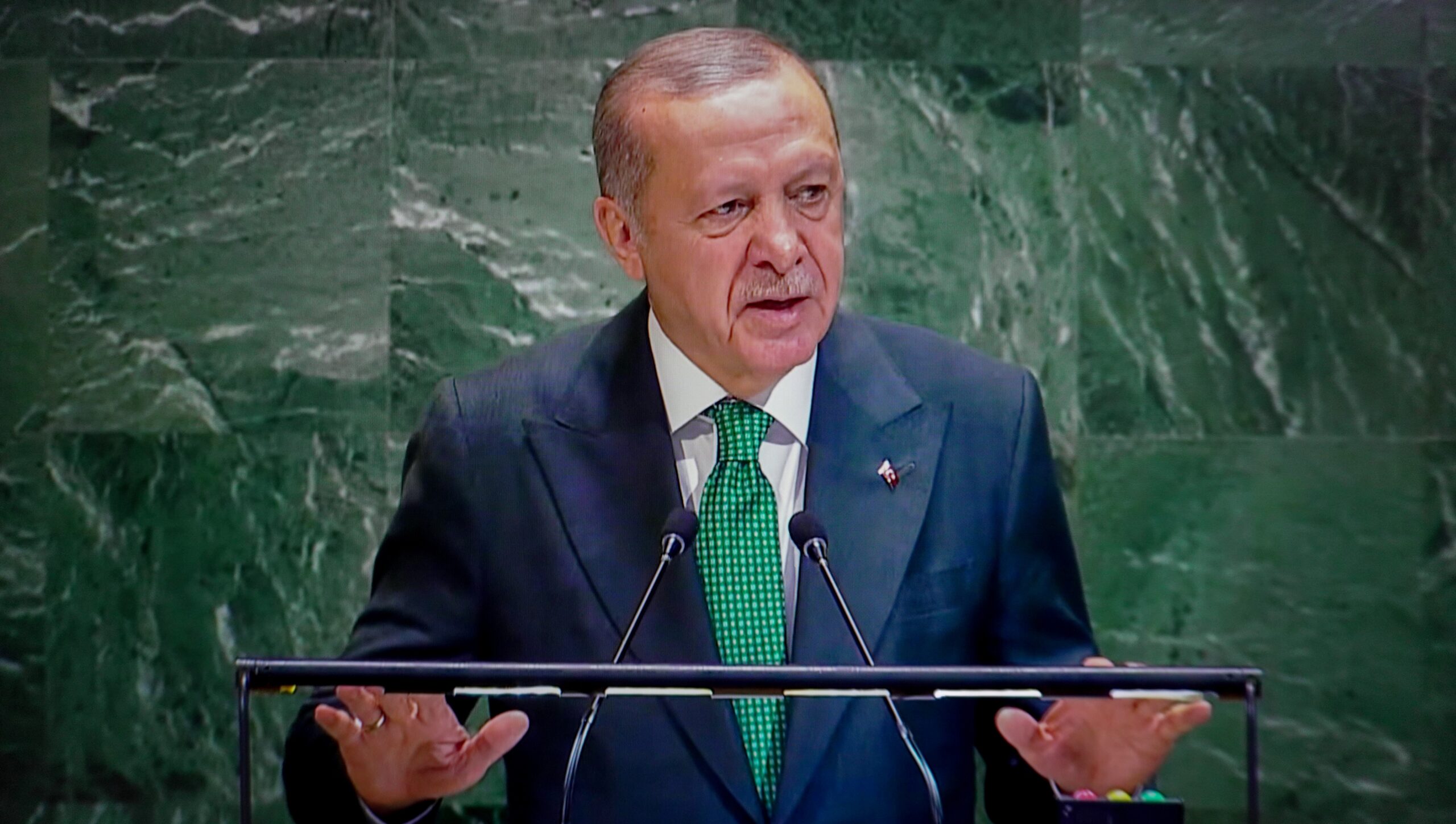
Maj. Gen. (res.) Gershon Hacohen has issued a stark warning about Turkish President Recep Tayyip Erdogan’s ambitions to revive the Ottoman Empire’s regional dominance, including a claim on Jerusalem itself. In an in-depth strategic analysis with the TOV Hebrew media network, Hacohen laid out a pattern of Turkish behavior, cross-border military expansion, sweeping maritime claims, and highly symbolic religious reversals, that he says amounts to a systematic project to project Turkish power far beyond its borders, reviving a 400-year Ottoman legacy (1516-1917) that once ruled almost the entire Middle East and stretched deep into Christian Europe. That history is exactly why the project should alarm Christians as much as it alarms Israel. Wherever Ottoman rule once expanded, Christian populations that had lived in those lands for centuries went into steep, often catastrophic decline, a pattern already repeating itself today in the very countries Erdogan invokes.
Hacohen points to Turkey’s “Blue Homeland” doctrine, a maritime strategy claiming vast stretches of the Mediterranean and its economic resources as Turkish territory, backed by an increasingly assertive Turkish navy. The doctrine’s clearest expression on land is Turkey’s continued military occupation of northern Cyprus. Erdogan has been direct about the scope of his ambition. “Turkey is larger than Turkey,” he has said, adding, “The borders of our hearts are elsewhere,” a reference to former Ottoman territory including Mosul and Kirkuk in modern Iraq. Turkey now operates military bases directly inside former Ottoman domains in Syria, Libya, and Somalia, a footprint Arab News has also documented, marking a sharp break from the deliberately isolationist foreign policy the Turkish republic’s founders established a century ago.
“The Harbinger of the Liberation of Jerusalem”
Nowhere has Erdogan tied this ambition to religion more explicitly than in his government’s decision to convert Istanbul’s Hagia Sophia, for nearly a thousand years the largest cathedral in Christendom and the spiritual center of Eastern Christianity, back into a mosque in July 2020. Erdogan invoked the legacy of Ottoman Sultan Mehmed II directly in announcing the move, framing it as a restoration of the sultan’s 1453 conquest rather than a religious or cultural decision made by his own government. But Erdogan did not stop at restoring history. In his own address announcing the conversion, he declared, “The resurrection of Hagia Sophia is the harbinger of the liberation of Masjid al-Aqsa in Jerusalem.” He was explicit that Hagia Sophia was only the first step, and that Jerusalem was the intended destination.
Erdogan has repeatedly and directly challenged the legitimacy of Israeli sovereignty over its own capital, using the same Ottoman-era religious framing. He told the Turkish Parliament flatly, “Jerusalem is our city, a city from us,” invoking the Ottoman Empire’s tearful retreat from the city during World War I and pointing to surviving Ottoman architecture, including Jerusalem’s Old City walls, as evidence of an enduring Turkish claim. In a public dispute with Israeli Prime Minister Benjamin Netanyahu over ancient relics, Erdogan said, “Turkey will not give even a single pebble belonging to Jerusalem to Israel,” describing the city as a sacred trust belonging to all humanity rather than to the Jewish state whose eternal capital it has been for three thousand years. After the United States recognized Jerusalem as Israel’s capital in 2017, Erdogan convened an extraordinary summit of the Organization of Islamic Cooperation and declared the American decision “against ethics, history, and consciousness, and completely null and void.”
A Bid to Lead the Entire Muslim World
Erdogan’s Jerusalem rhetoric is not an isolated obsession. It is one piece of a broader campaign to position himself as the leader of the global Muslim ummah, a role the Ottoman sultans themselves once claimed through the historic Caliphate, abolished by Mustafa Kemal Ataturk in 1924. Analysts have noted that Erdogan calculated the Hagia Sophia decision would resonate with Muslim audiences “from Los Angeles to Jakarta, from Pakistan to South Africa,” reinforcing his image as defender of the faith even as it damaged Turkey’s relations with the West. Erdogan has absorbed thousands of Muslim Brotherhood activists fleeing Egypt and granted them refuge in Turkey, sought to expand Turkish influence in Sudan, and worked to position himself as a rival to Saudi Arabia’s custodianship of Islam’s two holiest cities, Mecca and Medina, all while presenting himself internationally as the foremost defender of the Palestinian cause and of Al-Aqsa specifically.
The contradictions in that self-image are glaring. Erdogan condemns Israeli control of Judea and Samaria while his own forces occupy northern Cyprus, parts of Syria, and have deployed into Libya. He casts himself as champion of Muslims worldwide while conducting military campaigns against the Kurds, who are themselves overwhelmingly Muslim. He postures as the Muslim world’s conscience on human rights while imprisoning journalists by the hundreds at home.
A NATO Ally With a Russian Missile System and the Second-Largest Army in the Alliance
Turkey’s neo-Ottoman ambitions sit uneasily alongside its formal status as a NATO member, and its own recent conduct inside the alliance has done as much as anything to raise doubts about where its real loyalties lie. Turkey fields the second-largest standing military in NATO after the United States, a force Erdogan has increasingly used to pursue independent regional objectives rather than alliance priorities, from Cyprus to Syria to Libya. In 2019, Turkey took delivery of Russia’s S-400 air defense system after years of explicit American objections that operating a Russian system built to detect stealth aircraft alongside the F-35, the West’s most sensitive stealth fighter, would hand Moscow a live intelligence window into NATO’s own technology. Within days, Washington expelled Turkey from the multinational F-35 program and halted delivery of jets toward which Ankara had already paid roughly $1.4 billion. In December 2020, Washington also imposed CAATSA sanctions on Turkey’s defense procurement agency, making Turkey the first NATO ally sanctioned under the law. Erdogan, for his part, threatened to shut down two critical NATO installations on Turkish soil, Incirlik air base and the Kurecik radar station, “if necessary,” prompting the US defense secretary at the time to publicly question Turkey’s commitment to the alliance itself.
That standoff has resurfaced this year. President Donald Trump signaled openness to selling F-35 jets to Turkey during a NATO summit meeting with Erdogan in July, saying, “We’re going to be taking the sanctions off. We don’t want to sanction friends.” But the State Department subsequently clarified that Ankara still does not meet the legal requirements to rejoin the F-35 program so long as its S-400 systems remain on Turkish soil, regardless of the warmer tone between the two presidents. Turkey has reportedly never activated the S-400 despite paying for it, and Turkish officials say they now believe a resolution is closer than at any point in the six-year dispute. Whether or not that resolution materializes, the episode illustrates the same underlying pattern Hacohen describes: a Turkey formally inside the Western alliance system while acting, in practice, according to its own independent and often contrary strategic logic.
What Actually Happened Everywhere the Ottomans Ruled
A quick review of the Ottoman role in history should raise alarm among Christians about Erdogan’s revivalist project, even more so since it isn’t hypothetical. History already ran this experiment once, across the exact territories Erdogan invokes, and the results were the near-total disappearance of Christian communities that had existed since the apostolic era. Anatolia itself, the heartland of the modern Turkish republic, was overwhelmingly Christian for a thousand years before the Ottoman conquest, home to some of Christianity’s oldest churches, the very churches addressed in the New Testament’s Book of Revelation. Centuries of Ottoman rule, followed by the Turkish republic’s own campaigns of violence and forced assimilation, reduced that population to a rounding error. Christians made up an estimated 20 to 25% of the population of Anatolia in 1914. By 1927, following the Armenian genocide of 1.5 million Christians during World War I and the expulsion of Greek Orthodox communities in a population exchange, that figure had collapsed to roughly 2%. Today, in a country of over 80 million people, Christians make up an estimated 0.2 to 0.5% of the population, among the lowest of any country in the world with a historic Christian community.
Has Christianity Flourished or Withered Under Erdogan? The Record Is Clear
Christian communities in Turkey had hoped Erdogan’s Justice and Development Party would improve their circumstances when it first took power in 2002. Those hopes have been disappointed. The US State Department’s most recent religious freedom report on Turkey found that Turkish authorities “continue to undermine religious freedom by deliberately attempting to stifle the spread of Christianity,” and documented the systematic mistreatment underlying the community’s collapse from 20% of the population a century ago to roughly 0.2% today. Church buildings in Turkey face height restrictions that mosques do not, historic Armenian, Greek Orthodox and Assyrian churches are still officially treated as “foreign” institutions subject to constant government monitoring, and foreign pastors and missionaries have been deported and barred from re-entry for the “offense” of publicly evangelizing. Converts from Islam face harassment, family rejection, and threats of violence, and are frequently compelled to hide their faith entirely. A single new Syriac Orthodox church opened in 2023, the first since the founding of the Turkish Republic a century earlier, a rare exception that only underscores how sweeping the underlying suppression has been. Whatever else can be said about Erdogan’s Turkey, Christianity has not flourished there. It has continued a century-long decline toward extinction, with the government’s own policies repeatedly cited as a driving factor.
The Same Story, Repeating Across the Region Today
The pattern Erdogan’s Ottoman nostalgia recalls is not confined to Turkey’s own history. It is playing out in real time across the modern nations that once sat inside Ottoman and broader Islamic imperial control. Lebanon, once a Christian-majority country and still home to the largest proportion of Christians anywhere in the Arab Middle East, has seen its Christian population fall from a clear majority in the early 20th century to roughly 38% today, driven by lower birth rates, sustained emigration during Lebanon’s civil war years, and the community’s steadily diminishing influence over national affairs. Syria’s Christian population, roughly 10% of the country and numbering 1.5 to 2 million before its civil war began in 2011, has collapsed to somewhere between 300,000 and 600,000 today, gutted by war, ISIS’s campaign of massacre and enslavement against religious minorities, and mass emigration that shows no sign of reversing. Egypt still holds the largest Christian population in the Middle East, some 9 to 10 million Copts, but that community, once the majority faith of Egypt for centuries after the birth of Christianity, has been reduced over 1,400 years of Islamic rule to roughly a tenth of the population, and continues to face sectarian violence, discriminatory church-building laws, and periodic mass-casualty attacks by Islamist terrorists.
Taken individually, each of these declines has its own immediate causes: war in Syria, economic pressure in Lebanon, terrorism in Egypt. Taken together, across every territory that has ever fallen under the kind of Ottoman or broader Islamic imperial control Erdogan now says he wants to revive, they describe a single, unbroken historical pattern: Christian-majority or substantially Christian societies entering that system, and emerging from it centuries later as small, embattled minorities, or vanishing altogether. Hacohen’s warning is about geopolitics and Israeli security. But the history he is describing is, just as much, a warning about what happens to Christian communities every time this particular project has been tried before.

