
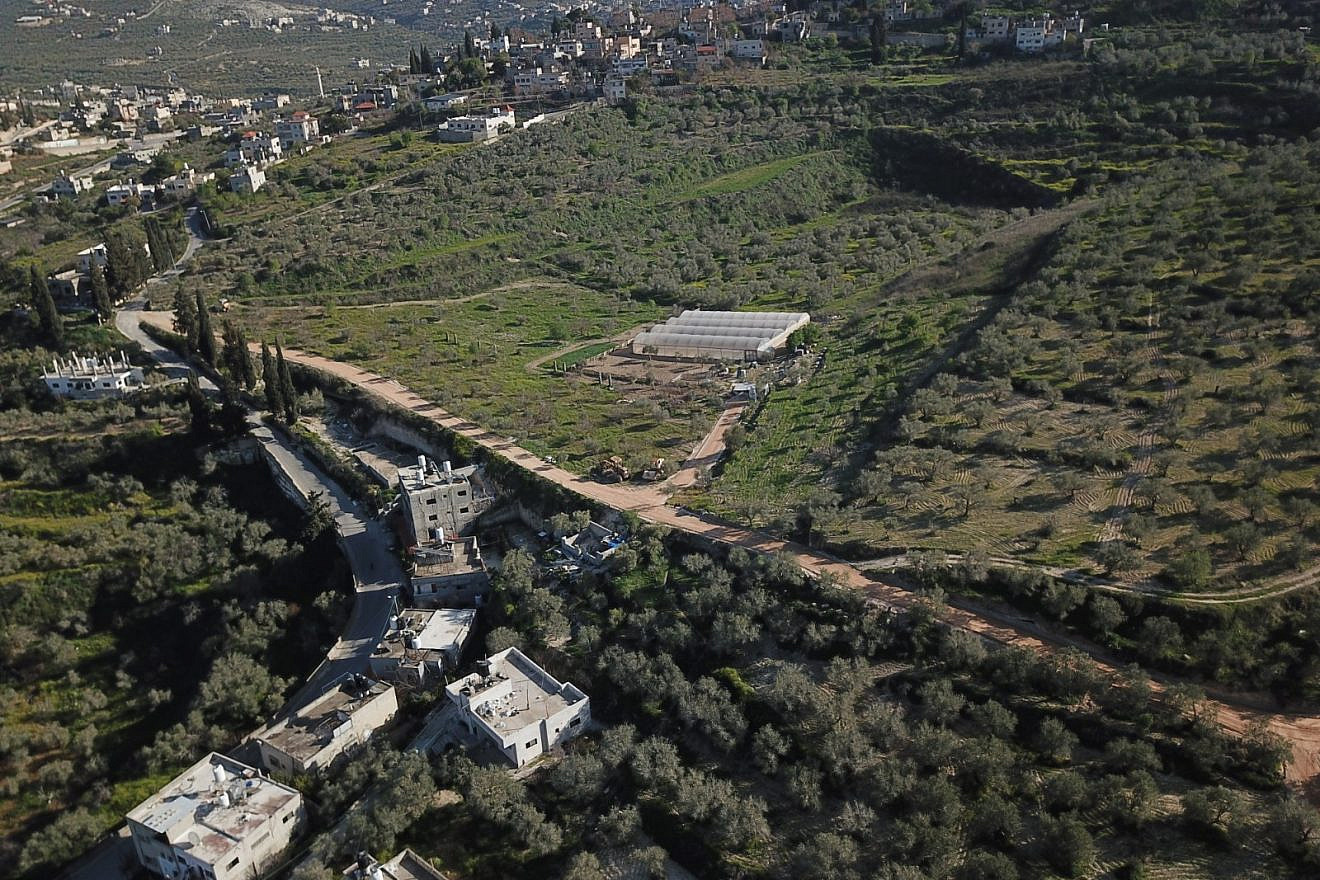
UNESCO’s World Heritage Committee voted Friday to recognize Sebastia, the ancient Samaria town traditionally venerated by Christians as the burial place of John the Baptist and identified by scholars as the capital of the biblical Kingdom of Israel, as an endangered “Palestinian World Heritage Site.” The vote, taken at the committee’s session in Busan, South Korea, accepted a Palestinian bid first submitted in 2012 on the grounds that the site faces serious threats requiring international protection. What the decision leaves out is that the most immediate threat to Sebastia’s archaeology has come from the Palestinian Authority itself, which has already paved a road directly through the site, destroying a Herodian-period wall and exposing Second Temple-era burial caves that were subsequently found filled with pig carcasses, an apparent act of deliberate desecration meant to defile the tombs and drive off the Israeli archaeologists working there.
Sebastia sits about 10 kilometers northwest of Nablus and carries a continuous history dating to the 9th century B.C.E., when it was known by its Hebrew name, Shomron, and served as the capital of the Israelite kingdom, before passing through Hellenistic, Roman, Byzantine, Islamic, Crusader, and Ottoman hands. Christian tradition dating to the fourth century holds that Sebastia is the burial site of John the Baptist, whose traditional tomb sits inside what is now the Nabi Yahya Mosque, a structure that began as a Byzantine church, was rebuilt as a Crusader cathedral in 1160, and was later converted into a mosque. The same tradition holds that the tombs of the prophets Elisha and Obadiah rest there as well. In 2022, separate from the road construction, Palestinians set fire to large parts of the heritage site, damaging antiquities and defacing other sections with graffiti.
Ambassador Nina Ben-Ami, deputy director general for UN and International Organizations at Israel’s Foreign Ministry, rejected the designation outright. “In line with Israel’s longstanding position, Palestinian membership of UNESCO has no legal effect under international law. Accordingly, Israel does not recognize nominations submitted by the Palestinian delegation,” she said, describing the listing as part of a wider campaign covering a dozen additional tentative Palestinian bids, including the ancient Jerusalem water system, the fortress of Herodium, and the Hasmonean Palaces. “Try though it may, neither the Palestinians nor this committee can erase the people of Israel’s ancient roots in our ancestral homeland.” Israel’s Foreign Ministry separately accused the Palestinian delegation of a “hostile and one-sided campaign” that falsely portrayed the site as facing an emergency in order “to erase Sebastia’s deep and well-documented Jewish and Christian history.” Foreign Minister Gideon Sa’ar was blunt: “No vote in an international organization can change history.”
A Site Christians Have Venerated for 1,700 Years, Rebranded Without a Word About It
Lost entirely in UNESCO’s framing is what Sebastia means to Christians around the world, not just to Jews. John the Baptist is among the most revered figures in Christianity across every major tradition, Catholic, Orthodox and Protestant alike, honored as the last of the prophets and the one who baptized in the Jordan River. Christian veneration of Sebastia as his burial place dates back roughly 1,700 years, to the fourth century, when a church was first built over the traditional tomb site. Byzantine pilgrims traveled there to pray beside his relics alongside those of the prophets Elisha and Obadiah, believed buried in the same spot. Crusaders later built a full cathedral over the tomb in 1160, a structure so significant to Christendom that it remains standing today, converted into the Nabi Yahya Mosque but still recognizable as the Crusader-era church it once was. For nearly two millennia, in other words, Sebastia has been a site of continuous Christian pilgrimage and prayer, predating any Palestinian national claim to the land by more than a thousand years.
None of that history appears anywhere in UNESCO’s decision or in the Palestinian Authority’s framing of the site as a “national achievement” belonging exclusively to Palestinian heritage. The designation folds John the Baptist’s tomb into a strictly Palestinian national narrative without acknowledgment that Christians worldwide, including the millions of evangelical and Catholic pilgrims who visit Israel each year specifically to walk in the footsteps of John the Baptist and Jesus, regard the site as sacred ground belonging to no single modern nationality. Erasing Sebastia’s Jewish history erases the biblical Kingdom of Israel that gave the site its name and its story. Erasing its Christian history erases the burial place of the man Christian tradition holds prepared the way for the Messiah. UNESCO’s vote did both at once, and did so silently, without any acknowledgment that a rebranding was even occurring.
The Bulldozers Were Already There
What makes UNESCO’s “endangered” designation so jarring, Israeli researchers say, is that it inverts who is actually doing the endangering. At Sebastia itself, Palestinian Authority workers brought in heavy machinery and paved a road straight through the archaeological zone, destroying a Herodian-period wall and exposing Second Temple burial caves in the process; someone then threw pig carcasses into the exposed tombs, a calculated act meant to defile Jewish graves and force Israeli archaeologists off the site. UNESCO’s own decision cited threats from “the Israeli occupation” and land expropriation plans as the emergency justifying the listing. It said nothing about the pavement, the wall, or the pigs.
🚨 INSANITY: A 2,000-year-old religious heritage site is being erased before our eyes.
— Regavim (@RegavimEng) June 2, 2026
At Khirbet Farsin, an ancient Second Temple/Talmudic-era village in northern Samaria, illegal PA-backed agricultural takeover is destroying antiquities, flattening state land, and burying… pic.twitter.com/QkmY7bqhXo
Sebastia is not an isolated case. At Khirbet Farsin, a Second Temple-era site in northern Samaria containing a mikveh, burial caves and underground passages, and preserving both its biblical name, Peresh, from the descendants of Menashe, and its Talmudic name, Kfar Parshai, four adjacent plots have been plowed, fenced off, and converted into Palestinian agricultural land, less than a kilometer from the Jewish community of Hermesh. The Israeli NGO Regavim has sent an urgent letter to enforcement authorities demanding action, after aerial photographs showed clearing and road construction that began in 2021 and has sharply accelerated over the past two years. Yossi Dagan, chairman of the Samaria Regional Council, called Khirbet Farsin “a site of extraordinary historical and archaeological importance,” warning, “An open history book is being erased. The authorities must overturn the table.” Roi Drucker, Regavim’s Judea and Samaria district manager, said the case fits a broader trend. “We are witnessing a widespread and destructive phenomenon of wild trampling over historical heritage sites in Judea and Samaria. Enforcement authorities must act immediately,” he said.
The damage extends well beyond these two sites. At Mount Ebal, where the Bible records that Joshua built an altar to God upon entering the land, “Then Joshua built an altar unto the Lord God of Israel in mount Ebal” (Joshua 8:30), Palestinian road construction destroyed sections of a 3,200-year-old defensive wall, at the same site where archaeologist Scott Stripling recently uncovered what researchers believe is the oldest Hebrew inscription ever found in the Land of Israel. At Beit Fajar, a Palestinian Authority quarrying operation dug a 1,500-dunam pit directly through a section of Solomon’s Pools aqueduct in 2022, destroying roughly 2,000 meters of the ancient water system, with no intervention from the Israeli government.
Regavim’s data identifies approximately 6,000 archaeological and historical sites in Judea and Samaria recognized by the scientific community, of which only around 2,300 have been formally declared protected, leaving roughly 3,700 with no legal protection at all. A comprehensive survey found that 80% of the significant archaeological sites across the region have already been damaged, with half of those in immediate danger of total eradication. A separate 2024 survey conducted by Palestinian archaeologists themselves found evidence of looting at 309 of 440 sites examined. Regavim’s data attributes 90% of the destruction to Palestinian Authority development activity.
The Knesset Moves to Respond
The pattern has pushed the Knesset toward emergency legislative action. On May 12, the Knesset passed the Judea and Samaria Heritage Authority Bill in its first reading, sponsored by Likud MK Amit Halevi, which would strip archaeological oversight from the Defense Ministry’s Archaeology Unit under COGAT and hand it to a new civilian Israeli body reporting directly to the Heritage Ministry. With Knesset dissolution proceedings looming, the Education, Culture and Sports Committee convened three consecutive days to try to push the bill through its second and third readings before the window closes. Critics call the bill a form of de facto annexation, since it would be the first time the Knesset exercised direct civilian authority, including land expropriation powers, in areas currently under military administration. Halevi has not disputed the stakes. “The fact that we approach this as if Israel was occupying its own land, and the whole application of international treaties, as if they are relevant to the Jewish people in Sebastia or the Cave of the Patriarchs, is unacceptable,” he said.
A Pattern Nearly a Decade in the Making
Sebastia is only the newest entry in a UNESCO record Israeli officials describe as a sustained campaign to strip Jewish, and now Christian, heritage from sites central to both traditions. In 2016, UNESCO passed resolutions describing the Temple Mount and the Western Wall Plaza, Judaism’s holiest site, strictly in Islamic terms, referring to the plaza by its Arabic name, Al-Buraq Plaza, and to Israel throughout as “the occupying power.” In 2017, the committee registered the Old City of Hebron and the Cave of the Patriarchs, the traditional burial place of Abraham, Isaac, Jacob, Sarah, Rebecca and Leah, as an endangered “Palestinian World Heritage Site.” In 2018, it declared both the Cave of the Patriarchs and Rachel’s Tomb near Bethlehem “an integral part of the Occupied Palestinian territory.” In September 2023, the agency listed ancient Jericho as a Palestinian World Heritage site, again over objections that it ignored the city’s ancient Jewish ties. That pattern drove the United States out of UNESCO twice: the first Trump administration withdrew in 2017 over the agency’s anti-Israel bias, Israel followed in 2019, the Biden administration rejoined in July 2023, and the second Trump administration announced a second American withdrawal in July 2025, again citing pervasive bias against Israel.
A One-Way Standard on Holy Sites
The deeper problem, Israeli officials argue, is not only what UNESCO calls these sites but what the Palestinian Authority does with the ones already in its hands. Joseph’s Tomb, the traditional burial site of the patriarch Joseph in Nablus, sits in Area A under full Palestinian civil and security control, and the PA is explicitly bound by the 1995 Oslo Interim Agreement to protect it. In practice, the site has been destroyed repeatedly: during rioting in 2000, Israeli border policeman Madhat Yusuf bled to death there after the PA denied entry to Israeli medical personnel for hours; Palestinian rioters burned the tomb again in 2015 and once more in April 2022, when dozens smashed the gravestone and returned the following night to finish the job. Jewish access today is possible only under IDF escort. The Temple Mount tells the same story from the opposite direction: Jewish and Christian prayer there is barred outright, not by Israeli law, which guarantees access to holy sites for every faith, but by a policing arrangement that leaves the compound’s daily management to the Islamic Waqf and treats non-Muslim prayer as forbidden, with Christian visitors barred from bringing in Bibles.
Taken together, what UNESCO extended to Sebastia on Friday is not a decision about protecting endangered heritage. It is a designation handed to the one party whose own record, at Khirbet Farsin, at Mount Ebal, at Beit Fajar, at Joseph’s Tomb, and now at Sebastia itself, is the actual source of the danger UNESCO says it is trying to prevent.
UNESCO’s World Heritage Committee voted Friday to recognize the ancient Samaria town of Sebastia, traditionally venerated by Christians as the burial place of John the Baptist and identified by scholars as the site of ancient Samaria, capital of the biblical Kingdom of Israel, as an endangered “Palestinian World Heritage Site.” The decision, adopted at the committee’s session in Busan, South Korea, accepted a bid the Palestinian Authority first submitted in 2012, and did so, Israeli officials said, while erasing both the town’s Jewish origins and its standing in Christian tradition.
Sebastia sits about 10 kilometers northwest of Shechem (Nablus) and carries layers of history dating to the 9th century B.C.E., when it was known by its Hebrew name, Shomron, and served as the capital of the Israelite kingdom, before passing through Hellenistic, Roman, Byzantine, Islamic, Crusader and Ottoman hands. The Hebrew name, derived from the word for “watchman,” gave its name to the entire region of Samaria surrounding ancient Shechem. Christian tradition, dating to the fourth century, holds that Sebastia is the burial site of John the Baptist, whose traditional tomb sits inside what is now the Nabi Yahya Mosque, a structure that began as a Byzantine church, was rebuilt as a Crusader cathedral in 1160, and was converted into a mosque under Saladin. The same tradition holds that the tombs of the prophets Elisha and Obadiah rest there as well.
None of that layered history, Israeli officials said, made it into UNESCO’s decision. Ambassador Nina Ben-Ami, deputy director general for UN and International Organizations at Israel’s Foreign Ministry, rejected the designation outright. “In line with Israel’s longstanding position, Palestinian membership of UNESCO has no legal effect under international law. Accordingly, Israel does not recognize nominations submitted by the Palestinian delegation,” she said. She described the listing as part of a wider campaign. “The decision to submit a dozen tentative sites for UNESCO World Heritage status, including the ancient Jerusalem water system, the fortress of Herodium, and the Hasmonean Palaces, represents another Palestinian attempt to rewrite Jewish history in the Land of Israel. Try though it may, neither the Palestinians nor this committee can erase the people of Israel’s ancient roots in our ancestral homeland.”
Israel’s Foreign Ministry separately accused the Palestinian delegation of running a “hostile and one-sided campaign” at UNESCO that falsely portrayed the site as facing an emergency, in order “to erase Sebastia’s deep and well-documented Jewish and Christian history.” A member of Israel’s delegation, which participates in UNESCO proceedings only as an observer, called the outcome a disgrace. “It is shameful that politicization has destroyed UNESCO and turned history into a mockery,” the representative said. Foreign Minister Gideon Sa’ar was blunter still. “No vote in an international organization can change history,” he said.
The listing arrives despite Sebastia’s own recent history at Palestinian hands. In 2022, Palestinians set fire to large parts of the heritage site, damaging antiquities and archaeological remains, and defaced other sections with graffiti. Palestinian officials have pointed to a separate Israeli land plan, announced in late 2025 to develop roughly 1,800 dunams around the site, as the emergency justifying UNESCO’s intervention; Israeli officials describe that framing as a pretext.
Part of a Pattern Going Back Nearly a Decade
Sebastia is only the latest addition to a UNESCO record Israeli officials describe as a sustained campaign to strip Jewish, and now Christian, heritage from sites central to both traditions. In 2016, UNESCO passed resolutions describing the Temple Mount and the Western Wall Plaza in Jerusalem, Judaism’s holiest site, strictly in Islamic terms, referring to the plaza by its Arabic name, Al-Buraq Plaza, and to Israel throughout as “the occupying power,” while omitting any reference to the site’s centrality to Jewish worship and history. In 2017, the committee voted to register the Old City of Hebron and the Cave of the Patriarchs, the traditional burial place of Abraham, Isaac, Jacob, Sarah, Rebecca and Leah, as an endangered “Palestinian World Heritage Site.” In 2018, it went further, declaring both the Cave of the Patriarchs and Rachel’s Tomb near Bethlehem, one of Judaism’s most visited pilgrimage sites, to be “an integral part of the Occupied Palestinian territory.” In September 2023, the agency listed ancient Jericho as a Palestinian World Heritage site, again over objections from legal experts and Israeli diplomats who said it ignored the city’s ancient Jewish ties.
That pattern is what drove the United States out of UNESCO twice. The first Trump administration withdrew in 2017, citing the agency’s anti-Israel bias; Israel followed the same year, formalizing its exit in 2019. The Biden administration rejoined UNESCO in July 2023, only for the second Trump administration to announce a second American withdrawal in July 2025, again citing what it called pervasive political bias against Israel.
Friday’s session also added five fortresses in Lebanon’s Jabal Amel region, including Beaufort Castle, currently held by the IDF as part of counterterrorism operations against Hezbollah, to the endangered list, a decision Israel likewise opposed.
A One-Way Standard on Holy Sites
Israeli officials argue the deeper problem is not just what UNESCO calls these sites, but what the Palestinian Authority actually does with the ones already under its control. The PA’s own record on protecting holy sites sacred to other faiths runs directly against the “steadfastness” and “protection” language Palestinian officials invoked in celebrating the Sebastia decision.
Joseph’s Tomb, the traditional burial site of the biblical patriarch Joseph in Nablus, sits in Area A, under full Palestinian civil and security control, and under the 1995 Oslo Interim Agreement the Palestinian Authority is explicitly bound to protect it: the agreement’s Annex I states that “the protection of [Jewish holy sites], as well as of persons visiting them, will be under the responsibility of the Palestinian Police.” In practice, the site has been repeatedly destroyed. During rioting in 2000, Israeli border policeman Madhat Yusuf bled to death at the site after the Palestinian Authority denied entry to Israeli medical personnel for hours. Palestinian rioters set fire to the tomb again in 2015, and once more in April 2022, when dozens of rioters smashed the gravestone, destroyed lighting and electrical equipment, burned prayer books, and returned the following night to finish destroying what they had missed. Jewish access to the site today is possible only under IDF escort, arranged in advance with Palestinian security coordination, rather than through any open policy of Palestinian protection.
The Temple Mount tells a similar story from the other direction: rather than facing PA-sanctioned violence, Jewish and Christian worship there is simply barred outright, not by Israeli law, which guarantees freedom of access to holy sites for all faiths, but by a decades-old policing arrangement that leaves day-to-day management of the compound to the Islamic Waqf and treats organized non-Muslim prayer as forbidden. Jewish visitors may enter only through a single gate during fixed hours and are barred from praying aloud or bringing ritual items; Christian visitors face the same restrictions on prayer and are barred from bringing in Bibles or prayer books, which have at times been confiscated at the security checkpoint. Nothing about that arrangement matches the “exclusively Muslim” framing UNESCO adopted for the site in 2016.
Taken together, Israeli officials argue, the pattern UNESCO has now extended to Sebastia is not a story about protecting endangered heritage. It is a story about an international body that repeatedly grants the Palestinian Authority exclusive custodianship over sites holy to Jews and Christians alike, even as the PA’s actual record, at Joseph’s Tomb, at the Temple Mount, and now potentially at the traditional burial place of John the Baptist himself, is one of restricted access, recurring desecration, and a refusal to recognize any faith’s claim to these places but its own.