



An illegal recreational compound funded by the European Union has been discovered sitting partly on Israeli state land in Area C of northern Samaria, the Israeli NGO Regavim announced, calling it a stark example of European hypocrisy that comes just weeks after the EU sanctioned the group itself.
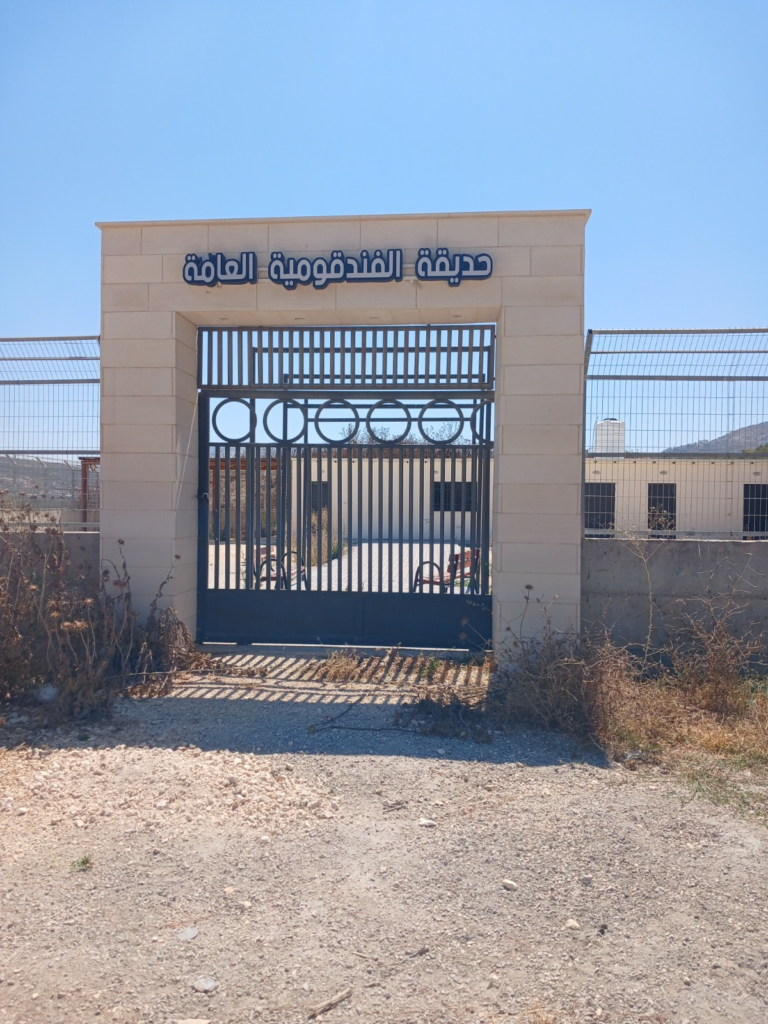
Regavim’s field coordinator found the compound during a routine inspection of state land as Israel moves to restore and expand Jewish communities in northern Samaria. Built in 2025 on the outskirts of the Palestinian village of Silat ad-Dhahr, the site includes an entrance gate, a broad access road, benches, a pergola, playground equipment and a light-construction utility structure. Official signage at the site credits the European Union with funding both the compound and its access road.
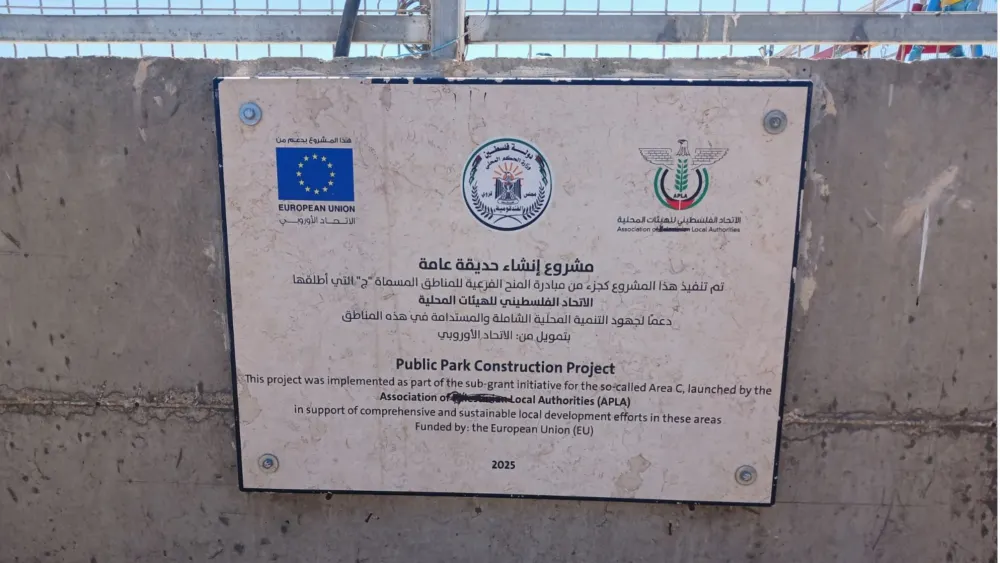
A sign showing the European Union sponsored the new illegal Palestinian compound in Area C. (Credit: Regavim. David Isaac)
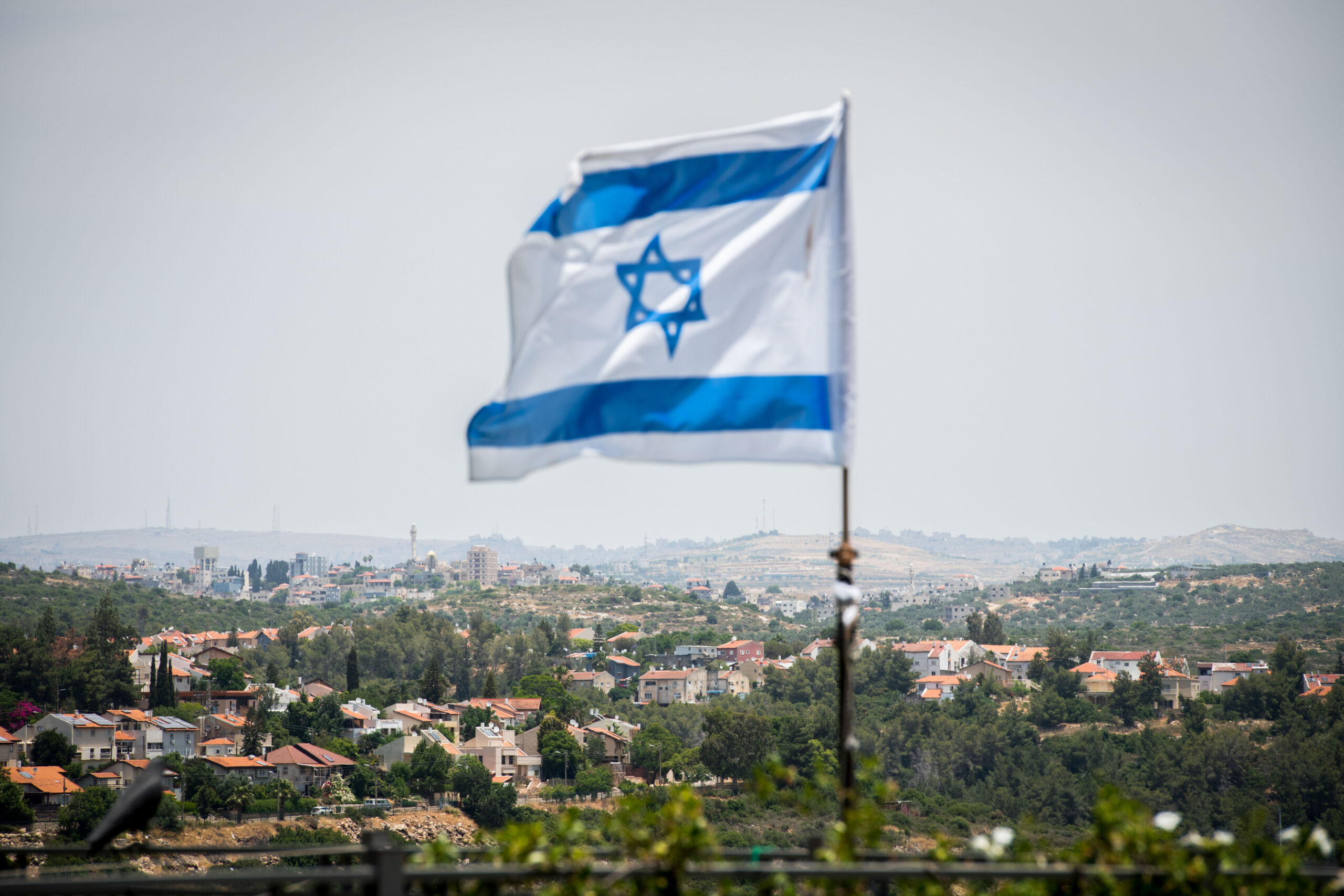
Part of the site spills over from Area B into Area C, onto Israeli state land near Sa-Nur, one of four Samaria communities evacuated during Israel’s 2005 Gaza disengagement and now being resettled.
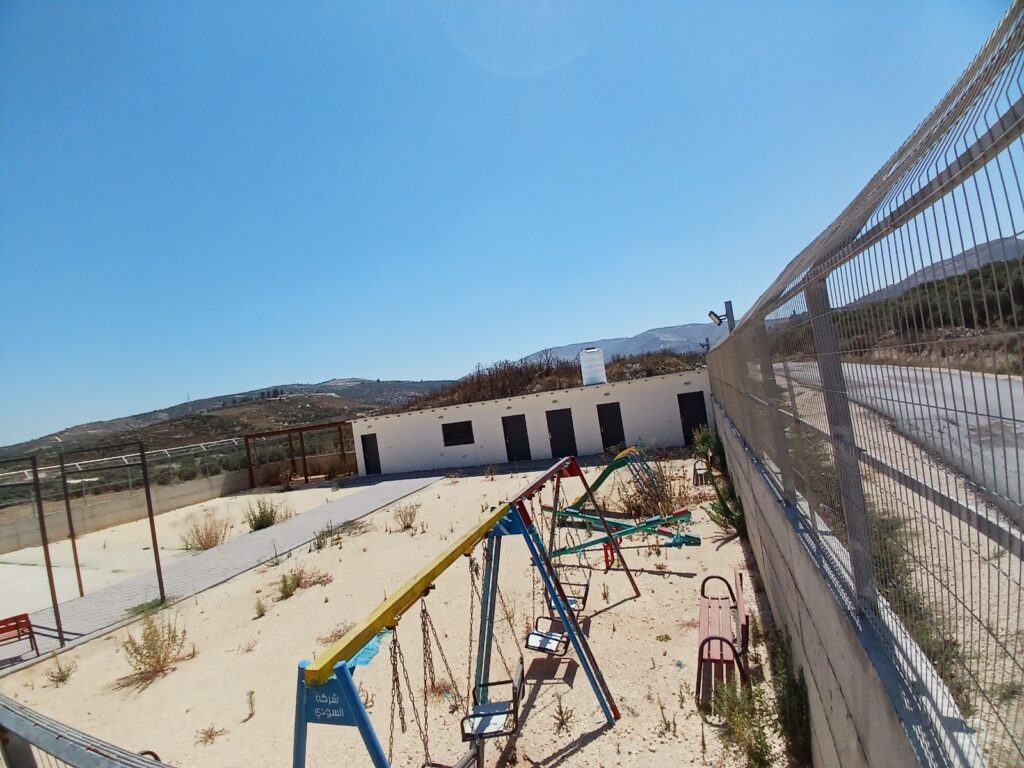
Naomi Kahn, director of Regavim’s International Division, said the discovery came from routine monitoring work tied to that resettlement effort. “Our field coordinator did a standard sweep to update our data on the areas being repopulated by Jewish communities in northern Samaria. He discovered a recently built recreational compound with European Union sponsorship signage and Palestinian Authority credits. But the compound, which ‘spilled over’ from Area B, is sitting on Israeli state land in Area C,” she said.
Kahn drew a direct line between the discovery and the EU’s own sanctions against Regavim, imposed weeks earlier. “The whole thing is illegal and awesome at precisely the same time the EU has sanctioned law-abiding Israeli civil society organizations, including Regavim, without even the pretense that they are guilty of doing anything illegal,” she said.
Sanctions Over a Demolished School
The European Council adopted restrictive measures against Regavim and its director, Meir Deutsch, on May 28, accusing the group of petitioning Israeli courts to demolish “Palestinian property with the aim to expand the control of Israel to the whole West Bank and institute legal proceedings to that end.” The EU’s announcement specifically cited Regavim’s role in the demolition of an EU-funded Palestinian primary school in the village of Jabbet al-Dhib, near Bethlehem, which the Jerusalem District Court had ruled a serious safety hazard before it was torn down.
Kahn said the sanctions were retaliation for that case, and warned they were unlikely to be the EU’s last move against Israeli civil society groups or the courts that rule in cases they bring. “Their aim is to curb the independence of Israeli courts and then the Israeli government,” she said. She argued the sanctions were designed to deter judges from enforcing the law at all. “Knowing that Regavim has been sanctioned for bringing suit, a reasonable judge will ask him or herself whether it’s worth having their assets frozen, their travel restricted, their reputation dragged through the mud for the sake of enforcing the law against a rinky-dink structure that the E.U. will simply pay to rebuild.”
“The Facts on the Ground Do Not Lie”
Roi Druker, Regavim’s Judea and Samaria regional director, who discovered the compound, framed it as part of a much larger pattern playing out anywhere Israel has stepped back from an area. “The facts on the ground do not lie. Wherever there is no Israeli presence and no settlement, a vacuum is created that leads to rampant encroachment and an enormous loss of state land,” Druker said. “This is an unprecedented act of audacity by the European Union, which imposes sanctions with one hand while, with the other, violates international law and Israeli jurisdiction in Area C.”
Druker called on Israeli authorities to act on the discovery immediately. “It is time to stop looking the other way. It is time to look the problem in the eye, and to demand that both the Palestinian Authority and its European benefactors live up to their obligations and obey the law,” he said. “We demand that the enforcement authorities and the Civil Administration act immediately to demolish the illegal compound and restore governance and order to the northern Samaria region.”
Regavim described the compound as one example of a broader pattern of construction on open land in areas Israel effectively vacated for two decades in pursuit of a negotiated resolution with the Palestinians, land the group says has since been steadily absorbed through unpermitted Palestinian and EU-backed building. The government’s renewed push to resettle communities like Sa-Nur is aimed, in part, at reclaiming what officials describe as a strategically vital area that has become, in Kahn’s words, “a hotbed of terrorism.”
The Money Follows Israeli Jurisdiction, Not Palestinian Need
The geography of EU funding gives away its purpose: money flows specifically to Area C, where Israel holds jurisdiction and where every new EU-backed structure chips away at Israeli control, while Area A, home to the large majority of the Palestinian population and already under full Palestinian Authority civil and security control, receives no comparable EU construction program at all. If the goal were simply to raise Palestinian living standards, the money would go where the most Palestinians already live. Instead, it is aimed precisely at the strip of land still under Israeli control, which is the tell: this is a campaign to shift territorial facts on the ground, not a humanitarian program.
The EU funds its own, publicly acknowledged “Area C Development Programme,” now in its seventh phase and totaling €23.2 million across 73 infrastructure projects in 59 Palestinian localities, according to the EU’s own delegation to the region. The program’s stated rationale is that Palestinians living in Area C, the roughly 60% of Judea and Samaria under full Israeli civil and security control, face “serious limitations” on development that Palestinians elsewhere do not, since building in Area A requires no Israeli permit and no outside funding push to begin with. The EU does not run a comparable donor-funded construction program in Area A, because none is needed there. The entire premise of the Area C program, by the EU’s own account, is that Israeli jurisdiction is the obstacle its funding is designed to work around, which is a description of a land campaign, not a description of poverty relief.
Regavim and allied researchers have tied that funding directly to the “Fayyad Plan,” a strategy laid out by former PA prime minister Salam Fayyad starting in 2009 to establish facts on the ground, schools, roads, homes and public buildings, specifically in Area C, in order to make an eventual Palestinian claim to the territory harder to reverse regardless of the outcome of any negotiations. Regavim’s most recent comprehensive survey counted 87,610 illegal Arab structures in Area C as of 2022, up 80% in a single year, with another nearly 10,000 added by May 2024, bringing the total past 97,000. The group has documented more than 600 kilometers of illegally built access roads and over 112,000 meters of retaining walls and terracing supporting that construction, much of it funded by EU member states and channeled through Palestinian development bodies such as the Municipal Development and Lending Fund. None of that infrastructure serves Palestinians in Area A, where it isn’t needed; all of it serves the singular goal of establishing an irreversible Palestinian footprint on land still under Israeli sovereignty.
The History Behind “West Bank” and “Judea and Samaria”
This article uses “Judea and Samaria,” the name by which this region has been known throughout Jewish history, reflecting the biblical kingdoms of Judah and Israel that stood there for over a thousand years and gave the world Hebron, Shiloh, Shechem, and Bethel. The name was in continuous use, including by the British Mandate administration, until Jordan invaded and occupied the territory during Israel’s 1948 War of Independence. Jordan formally annexed it in 1950, an annexation recognized at the time by only two governments in the world, Britain and Pakistan, and rebranded it “the West Bank,” a reference to its location west of the Jordan River, matching Jordan’s own territory on the river’s east bank. The renaming served a specific political purpose: folding the territory into the Hashemite Kingdom’s own geography and severing its Jewish and biblical identity in the process. Israel’s government reversed that rebranding immediately after retaking the territory in the 1967 Six-Day War. As early as July 22, 1968, Israel’s official committee on names ruled that the territory should be called Judea and Samaria, and in 1977 the Israeli government mandated the name’s use in all official state documents, including military orders, a policy still in force today.
The term “West Bank” has nonetheless persisted internationally, but that is beginning to change. Arkansas became the first American state to sign into law a requirement that state documents use “Judea and Samaria” rather than “West Bank,” in 2025, and Florida’s House of Representatives passed a similar bill in February 2026 barring the term from public schools and state agencies. Legislators in Georgia and Oklahoma have advanced comparable measures. At the federal level, Rep. Claudia Tenney and Sen. Tom Cotton have each introduced the “RECOGNIZING Judea and Samaria Act,” which would bar federal materials from using “West Bank” at all, and Tenney has launched a “Friends of Judea and Samaria Caucus” in Congress to build support for the shift. Oklahoma state Sen. Julie Daniels, introducing her own state’s version of the bill, said the goal was “to correct the record and affirm the historic and biblical connection of the Jewish people to Judea and Samaria,” arguing that a term “created in 1948 for political reasons should not be allowed to erase the true name of the biblical heartland of the Jewish people.” The EU’s continued insistence on “West Bank,” even as that tide turns elsewhere, keeps the bloc anchored to a Jordanian-invented label built to erase the very history its own development programs are, in practice, working to overwrite on the ground.
