

On July 29, right after Tu B’Av, more than 10,000 Jewish singles from around the world will log on for what organizers are calling the largest Jewish speed-dating event ever held, each matched by questionnaire and sent through up to seven dates in a single evening. It is, in one sense, the newest possible version of a very old idea. Long before Zoom, before questionnaires, before matching algorithms, unmarried women in ancient Israel went out to the vineyards on this exact date and did the same basic thing: put themselves in front of eligible men and hoped for the best.
A Holiday Rooted in Scripture
Tu B’Av, the 15th of the Hebrew month of Av, has no explicit biblical commandment attached to it, but its roots run through several distinct episodes in the Torah and the Prophets that the Sages later tied to the date. The Mishnah in Tractate Ta’anit calls it one of the two happiest days of the Jewish year, alongside Yom Kippur, and describes unmarried women going out in borrowed white garments, so that a poor woman would never be embarrassed next to a wealthy one, to dance in the vineyards and call out to the young men watching: look carefully at what you choose for a wife.
The Talmud in Ta’anit records several reasons the Sages gave for the date’s significance. It marks the day the tribes of Israel were permitted to intermarry with one another, following the resolution of the inheritance dispute raised by the daughters of Zelophehad in the book of Numbers. It marks the day the tribe of Benjamin was formally readmitted into the congregation of Israel after the civil war described in the book of Judges, a war that itself began over a very similar custom of women dancing in the vineyards of Shiloh: “Behold, there is a feast of the Lord in Shiloh yearly, in a place which is on the north side of Beth-el, on the east side of the highway that goeth up from Beth-el to Shechem, and on the south of Lebonah… and the daughters of Shiloh come out to dance in dances” (Judges 21:19). Other reasons given by the Sages include the day the last members of the generation that left Egypt, condemned to die in the wilderness, stopped dying; the day King Hoshea ben Elah removed the guard posts that had blocked Israelites in the northern kingdom from making pilgrimage to Jerusalem; and the day the Romans finally permitted the burial of those killed defending Betar in the Bar Kochba revolt.
The custom of the vineyard dance faded for centuries, but the date never lost its association with matchmaking, and modern Israel has revived Tu B’Av in earnest as the closest thing Judaism has to Valentine’s Day: a day for proposals, for flowers, for greeting cards, and, increasingly, for events aimed squarely at getting single Jews in front of each other.
The Modern Version
This year’s event is being run jointly by Partners in Torah, Aish, and CoronaCrush, alongside more than 100 partner organizations across six continents, building on last year’s event, which matched 6,750 singles for 15,463 dates in a single hour and produced dozens of ongoing relationships, including at least three marriages. Participants fill out a detailed questionnaire in advance and are matched for up to seven dates over the course of the evening.
“Every year the response grows, and every year we hear new stories that remind us why this matters,” said Tehilla Friedland, COO of Partners in Torah and one of the event’s lead organizers. “We are not just running an event. We are building a community, one date at a time.” Michaela Tobias, community manager at CoronaCrush, said this year’s matching technology was refined directly from participant feedback. “Singles told us what worked and what didn’t, and we listened,” Tobias said. “This year’s questionnaire and matching are smarter, and we are ready to help even more people find each other.”

The Couples It Has Already Made
Gila, originally from London, had just decided to make aliyah when a friend showed her last year’s event listing on Instagram. “I was sitting in the call with my friend, and we saw it,” she recalled. “I was like, why not? To think that I met my husband is really crazy.” She was matched with Neriya, an American who had moved to Israel to study in yeshiva and was specifically hoping to meet someone who had already made aliyah. “There are only benefits to this,” Neriya said. “Either you spend an hour of your evening and nothing happens, or you spend an hour of your evening and find, in seven minutes, the person you’re going to marry.” The two spoke by phone for two hours the night they matched, stayed in touch daily for weeks, and were engaged within three months; Neriya proposed in Jerusalem with fairy lights and a picnic a friend helped arrange. They married in February, less than a year after their first seven-minute call. “Give it a try,” Gila said. “You really just never know where your husband is going to pop up from.”
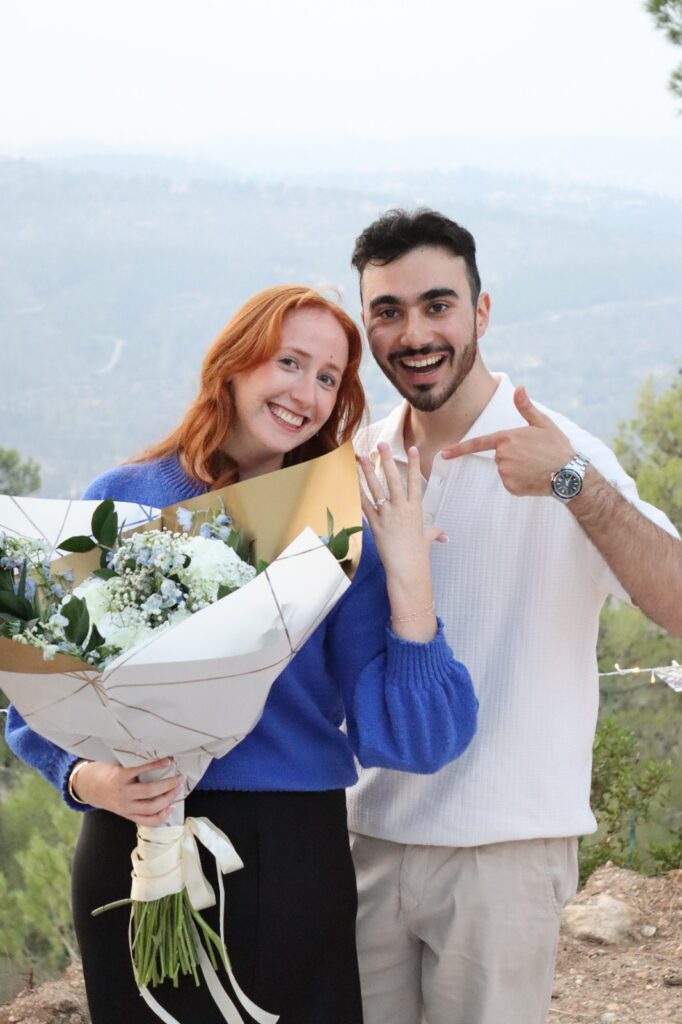
Goldie had already been through seven speed-dating events over three years with no lasting match, and nearly skipped last year’s as well. “I believe in putting myself out there as much as I can,” she said. “If Hashem wants me to find someone, then I have to allow for the opportunity.” She logged on from a quiet room a friend found for her at an in-person gathering, and was matched with Barak, a psychologist from Los Angeles whose parents are both Israeli. Their seven-minute slot ran out just as they were starting to connect, but Barak called her afterward, and they spoke for two hours. “He didn’t play games or beat around the bush, and I really appreciated that,” Goldie said. Barak flew out to meet her in person soon after; they dated six months, got engaged in Israel this past February, and married in June. They plan to make aliyah in the coming weeks. “You never know,” Goldie said. “You could meet your spouse as I did. Or, at the very least, you’re just meeting another Jewish neshama searching.”
Past participants have logged in from South Africa, the United Kingdom, the United States, Brazil, France, Sweden, Israel and beyond, matched by preference and, where relevant, by location. “The Jewish response to building the future has always been through relationships and family,” said Rabbi Steven Burg, CEO of Aish. “Every year this event brings together singles who might never have crossed paths otherwise, and every year we hear that it changed someone’s life. Tu B’Av has always been a day associated with matchmaking in Jewish tradition, and it feels fitting that this event now carries that spirit forward for a new generation.”
Registration for the July 29 event is open now through participating organizations’ websites and social media channels.