
Just a month and a half after the National Red Heifer Institute announced the birth of a red heifer around the reading of Parshat Chukat, the Institute is announcing the birth of a second red heifer, this time in the Golan Heights, on the eve of Tisha B’Av. The same week, two red heifers were inseminated in Ancient Shiloh, part of what the Institute describes as a broader effort to raise a full herd of red heifers and restore the laws of purity to Israel after 2,000 years of exile.
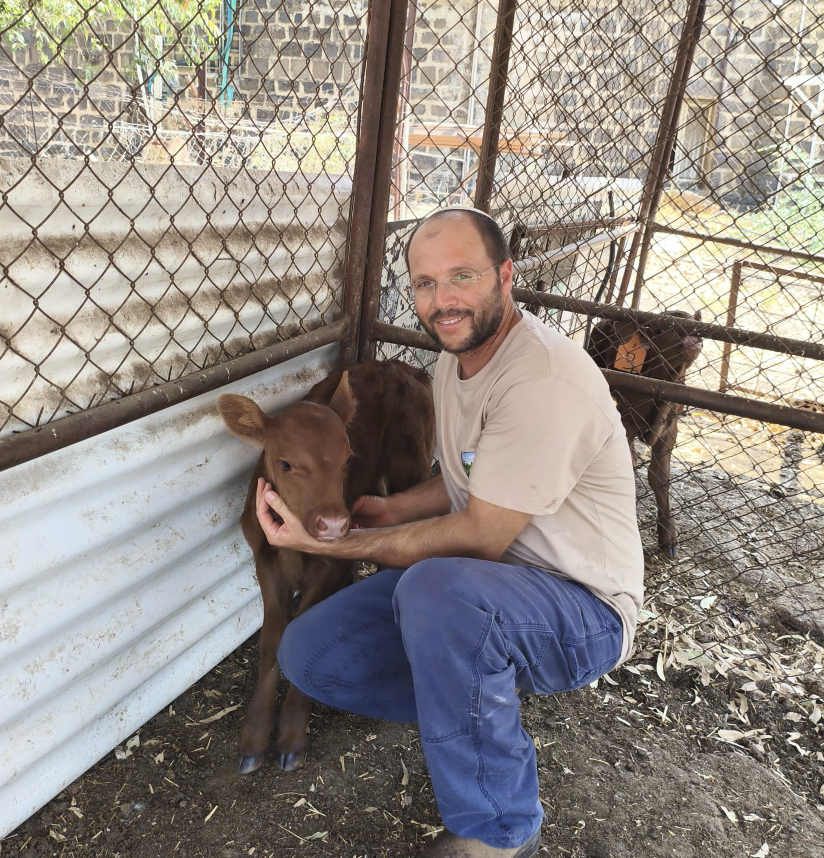
The new heifer was born in the herd of Shai Givon, a farmer with the National Red Heifer Institute, with strict care taken from birth to preserve her unblemished status: no ear tag was placed, since the puncture itself would constitute the kind of blemish that disqualifies a heifer from the ritual. Givon is the same breeder who first identified the previous heifer, discovered in one of the dairy barns where he was working.
Asked how two red heifers could be born so close together, Givon said he sees the timing as more than coincidence. “I feel that we are living in a historic era,” he said. “Since the last heifer was born, I have received inquiries and questions from every part of the Jewish spectrum, in Israel and abroad; Hasidim, Litvaks, secular Jews and religious Jews alike. The Jewish people are more attuned than ever to the Temple and to restoring purity to Israel, and God is opening doors and opportunities that have not existed in 2,000 years.”
“We are on our way to raising a full herd of red heifers,” Givon said. “The team at the Institute expected potential heifers to be born this season, but her birth so close to Tisha B’Av gives the strong sense that God is pressing us to accelerate the path toward building the Temple. The real question is whether we want to.”
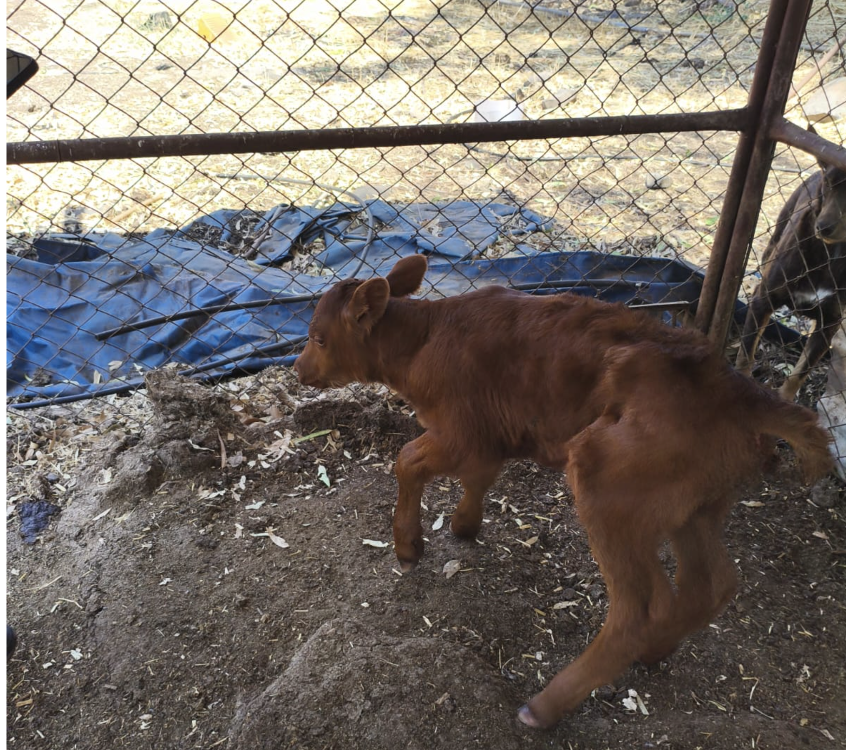
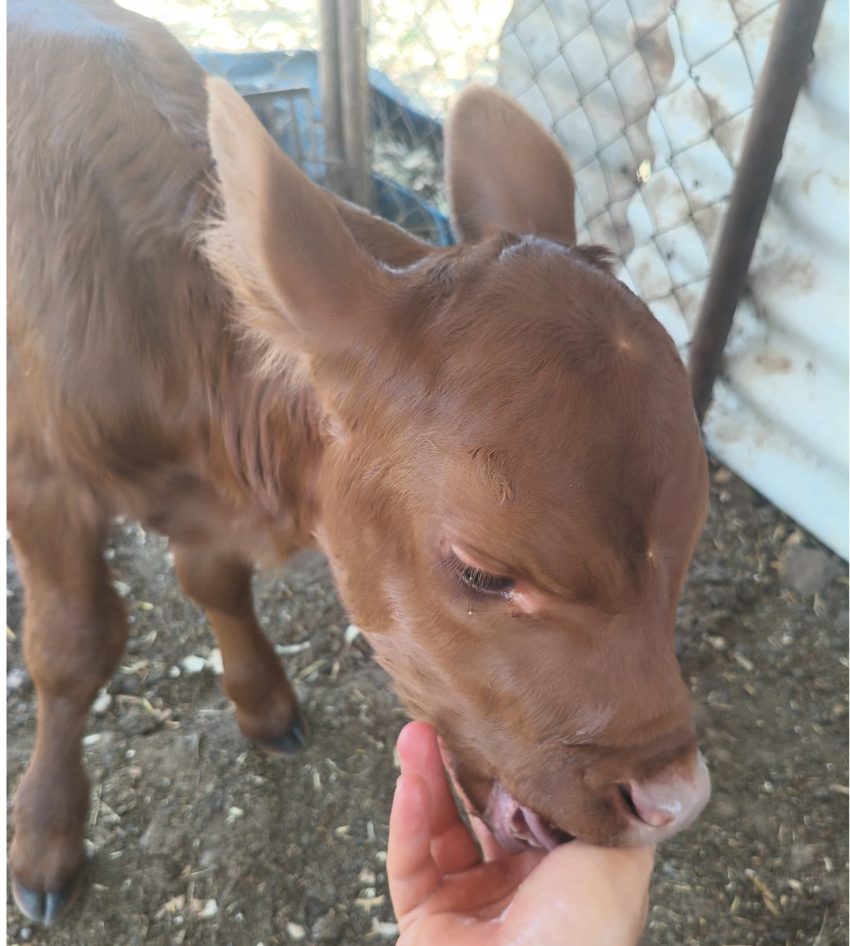
Because she was born directly in Givon’s herd, the new heifer carries no ear tag. But her health has opened a halachic question the Sages never had to confront. She was born a twin to a male calf, and cattle are unique among animals in that twin fetuses can share a connected blood supply between their placentas. In the small share of these cases — Givon’s Institute puts the figure at roughly 98 percent — this cross-circulation mixes the hormones needed for reproductive development between the male and female twins, and the male’s testosterone can permanently damage the female’s uterus. The English veterinary term for the resulting female twin is a freemartin: an animal born with an intact uterus that cannot properly develop, leaving her what halachah terms an aylonit — a female incapable of ever conceiving.
The question now sits with the Beit Midrash, the roughly twenty rabbis who provide halachic guidance to the Institute. The Beit Midrash only recently finished ruling on the previous heifer’s kashrut, after the puncture from her ear tag healed to the point that barely any trace remained of the blemish inflicted shortly after her birth. Now it must decide whether a uterine defect present from birth, but invisible on the outside, disqualifies the new heifer from the mitzvah of the red heifer altogether.
“There is a real question as to whether a birth defect that is not external and visible on the cow’s body disqualifies her unblemished status, both for sacrifices generally and for the red heifer specifically,” said Rabbi Azariah Ariel, head of the Beit Midrash at the National Red Heifer Institute. “Since our goal is to establish a national halachic standard, we will not rule on this alone. The Beit Midrash will need to deliberate together and bring its conclusions to the leading halachic authorities of the generation for their endorsement. With God’s help, we hope within about a year to publish our conclusions on the central questions in this field, and afterward to publish four comprehensive volumes of Parah Adumah Kehilchatah [The Red Heifer According to Halachah], summarizing a decade of halachic research for the rabbinic community in Israel.”
The Institute is inviting rabbis from across Israel to a gathering on Thursday, August 6, at a farm in the north, to deliberate together on the halachic questions the project keeps raising. Rabbis interested in attending can register through the Institute’s website or by emailing menachem@redheiferinstitute.com.
The heifer’s birth comes as public engagement with the Temple keeps climbing ahead of Tisha B’Av. Yehuda Ben Tzvi, one of the Institute’s leaders, sees the shift firsthand through his educational work at the Mikdash Educational Center. “During the Three Weeks we don’t only mourn the Temple, we work without pause, running educational programs across the country on the subject,” Ben Tzvi said. “Over the past month we’ve met close to 10,000 people across roughly 60 communities, from Acre in the north to Bnei Netzarim on the Egyptian border. Just this week of the Nine Days, we reached 1,000 children a day at a massive educational event in Ancient Shiloh, connecting 5,000 children from the Binyamin Regional Council to the subject of the Temple ahead of Tisha B’Av.”
“Over the past year we’ve felt a tremendous public awakening around the Temple,” Ben Tzvi said, “and to keep up with the demand, we’ve launched a mass fundraising campaign in recent days to expand our educational work on the subject.”
“Perhaps on Tisha B’Av two years from now, we will merit purifying the people of Israel for the first time in 2,000 years, through a historic national event that fulfills the words of the prophet — that the days of mourning the destruction will become days of joy for the building of the Temple,” Ben Tzvi said. “As it is written: ‘Thus said the Lord of Hosts: The fast of the fourth month, the fast of the fifth, the fast of the seventh, and the fast of the tenth shall become occasions for joy and gladness, happy festivals for the house of Judah — but you must love truth and peace’ (Zechariah 8:19).”
The question now, Ben Tzvi said, is whether the Jewish people want the Temple built, and what each person is doing to advance that process speedily in our days.