




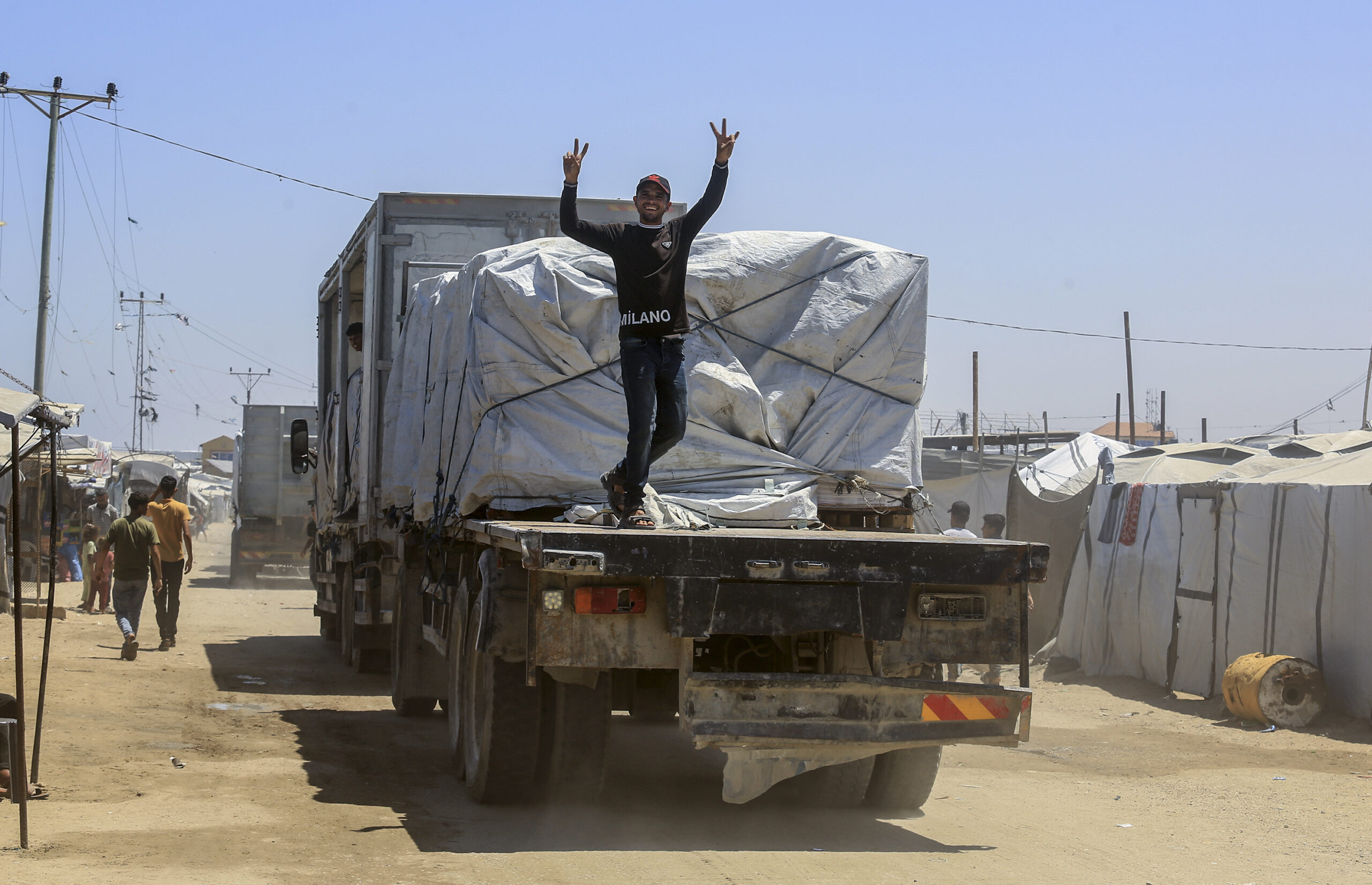
Armed Hamas terrorists forced their way into a World Food Programme warehouse and food distribution site in northern Gaza on Saturday, assaulting two truck drivers and halting aid deliveries to thousands of families who depend on the site daily. The raid, confirmed by the United Nations’ own humanitarian coordinator for the region, exposes yet again the reality that Israel has documented since the war began: the terrorist organization ruling Gaza treats humanitarian aid as a resource to be seized, not a lifeline to be protected.
The Jabaliya raid, in depth
Dr. Ramiz Alakbarov, the UN’s Deputy Special Coordinator for the Middle East Peace Process and Humanitarian Coordinator, said in a statement Sunday night that armed personnel affiliated with Hamas authorities forcibly entered the Abu Rashid food distribution point in Jabaliya, in northern Gaza, on Saturday. Humanitarian workers were forced to suspend distributions as a result. Alakbarov said the same forces entered a WFP warehouse and assaulted two truck drivers who were delivering supplies.
Alakbarov called the incident part of a broader and worsening pattern, describing an “increasingly dangerous pattern of intimidation, violence and obstruction” that includes smuggling attempts and the targeting of humanitarian staff. He said the continuity of aid operations is now in jeopardy and called for an immediate end to all interference, along with respect for the independence and neutrality of humanitarian work.
An official from Hamas’s interior ministry rejected the accusation, telling reporters the operation was law enforcement responding to reports of smuggled cigarettes and phone components hidden inside aid parcels, and denying that it amounted to a raid or an attack.
COGAT, the Israeli defense body responsible for coordinating humanitarian access into Gaza, said the incident was further proof of what Israel has argued throughout the war. “This constitutes further clear evidence that Hamas cynically exploits the humanitarian space and the aid intended for the residents of the Gaza Strip for its own purposes,” the agency said, adding plainly that Hamas is the party undermining distribution mechanisms and seizing aid meant for civilians.
According to a UN report, on Saturday (11 July), Hamas terrorists forcibly entered a food distribution site operated by the World Food Programme (WFP) in the Jabalia area, forcing the suspension of food distributions that had been providing daily assistance to thousands of…
— COGAT (@cogatonline) July 13, 2026
A documented pattern, not an isolated event
Saturday’s raid fits a record Israel has been building since the earliest months of the war. On November 16, 2024, roughly 90 percent of a single day’s UN food convoy, 98 of 109 trucks, was hijacked inside Gaza shortly after crossing at Kerem Shalom. Between May and July 2025, independent tracking found that between 88 and 94 percent of aid trucks were intercepted before ever reaching the civilians they were meant to feed. Israeli forces have recovered weapons inside UN facilities throughout the war, and footage from the area around Shifa Hospital showed fuel siphoning and tunnel shafts near storage sites, funneling supplies meant for patients into Hamas’s war effort instead.
Hamas has taxed, diverted, and resold humanitarian goods to finance its own operations long before this war, using the civilian population’s hunger as leverage in negotiations with Israel and the international community.
GHF proved there was another way
The clearest rebuttal to the claim that aid diversion is unavoidable came from the Gaza Humanitarian Foundation. Backed by the United States and Israel and launched in May 2025, GHF built secure distribution sites, screened aid recipients, and delivered food directly to individual Gazans rather than through the bulk-warehouse model that had handed Hamas its opportunities to steal. By the time it wound down its operations in November 2025, GHF had distributed more than 187 million meals, reaching up to a million Gazans, without the mass diversion that had plagued the UN-led system. A State Department spokesman later credited the model with helping bring Hamas to the negotiating table, since it stripped away the group’s ability to profit from stolen aid. When GHF closed its operations, the organization said plainly that it had proven there is a better way to get food to Gazans than through the system Hamas had learned to exploit.
UNRWA’s own payroll tells the story
If Hamas’s grip on aid running through UN channels needs a single illustration, it is the United Nations Relief and Works Agency’s own employee rolls. Israeli intelligence has estimated that roughly 10 percent of UNRWA’s Gaza workforce, more than a thousand people, carries ties to Hamas or Palestinian Islamic Jihad. A federal US investigation through the USAID Inspector General’s office has expanded to examine at least 1,500 current or former UNRWA staffers suspected of terror ties, and the agency has already fired 70 employees over Hamas connections following that inquiry. UN Watch’s Hillel Neuer called those firings “a drop in the ocean,” estimating that roughly 1,500 Hamas members remain on the UN payroll, drawing salaries funded in large part by American and other Western donors. UNRWA leadership has previously acknowledged that Hamas members are on staff and has stated it does not regard that as a violation. President Trump signed an executive order ending US funding to UNRWA in February 2025, and the 2026 defense budget he signed permanently bars the United States from funding the agency going forward.
Israel has provided far more aid than critics acknowledge
The accusation that Israel restricts humanitarian relief collapses against the agency’s own figures. By mid-August 2025, COGAT reported that nearly two million tons of aid, roughly 80 percent of it food, had crossed into Gaza across almost 100,000 trucks. In the first week of August 2025 alone, more than 1,200 trucks delivered 23,000 tons of supplies. Israel operates multiple crossings into Gaza, screens every truck for weapons and dual-use materials before allowing entry, and has continued facilitating aid deliveries even as fighting has resumed. The obstacle to getting that aid to civilians has never been Israeli policy; it has been Hamas’s determination to control the goods once they cross the border.
A ceasefire Hamas has not honored
President Trump’s peace framework, accepted by both Israel and Hamas after the October 2025 ceasefire, requires Hamas to disarm and hand over administration of Gaza, giving its members the choice to lay down their weapons and remain or leave the strip through safe passage. The Board of Peace’s implementation plan lays out an eight-month schedule for Hamas to surrender its heavy weapons and allow the destruction of its tunnel network and military infrastructure. Armed men storming a food warehouse and beating aid workers is not the behavior of a group disarming under that framework. It is the behavior of an organization that still governs Gaza by force and still treats humanitarian aid as a tool of that governance, months after it agreed to give both up.
Hamas was supposed to be laying down its weapons and stepping aside from power by now. Instead, its gunmen are still storming warehouses meant to feed Gaza’s children, still beating the men who drive the trucks, and still treating starvation as a weapon it alone controls. Ezekiel had a word for shepherds like that thousands of years ago, and it was not a kind one.

