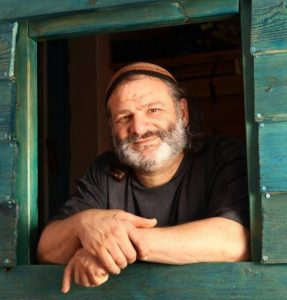

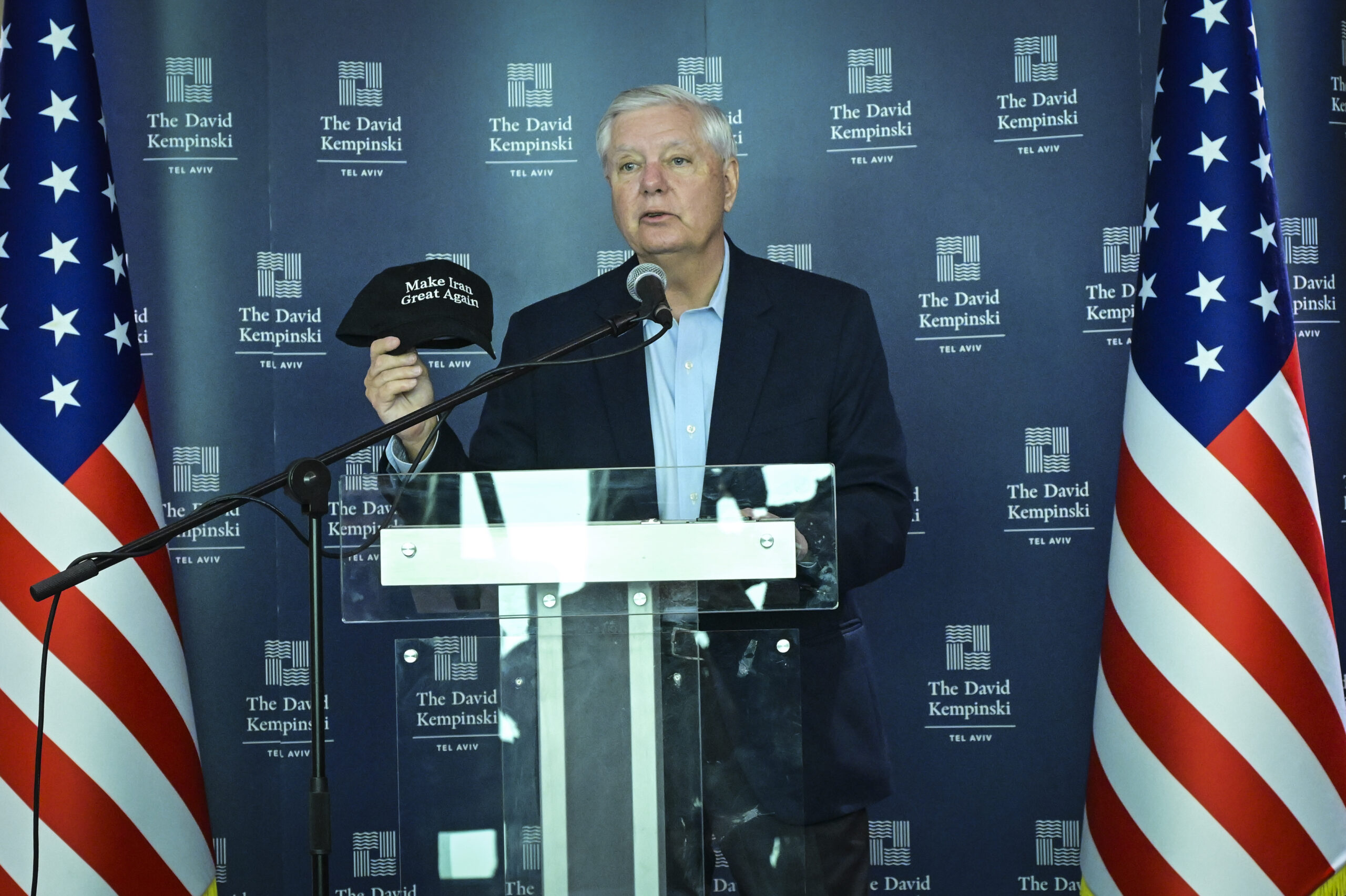
On Saturday night, Channel 14 host Yinon Magal stopped his program, “HaPatriotim,” “The Patriots,” for a powerful display of gratitude for the recently passed friend of Israel, Lindsey Graham. Magal paused the panel discussion, turned to the camera, and told his audience he wanted to do something that he had never done on air before: recite the Mourner’s Kaddish, a prayer set aside in Jewish law for the closest relatives of the Jewish dead. It was even more surprising that this deeply religious Jewish prayer was being said to honor a man who was a devout Christian.
Magal told viewers that before making the decision, he had called Rabbi Yitzchak Zilberstein, widely regarded in Haredi circles as the posek hador, the leading halachic authority of the generation, to ask whether Jewish law permits reciting Kaddish for a gentile. “I consulted with Rabbi Yitzchak Zilberstein about whether it’s peremissible to say Kaddish for a non-Jew,” Magal said on air. “He said we can learn Mishnah, Mishnah, Mishnah, and afterward we will say Kaddish for the elevation of the soul of Lindsey.” The panel then studied Mishnah together in the studio, a traditional act undertaken specifically to merit the soul of the deceased, before Magal led the full text of the Kaddish, from its opening words, Yitgadal veyitkadash sh’mei raba, to its closing line, oseh shalom bimromav, dedicating it to the soul of “Lindsey Olin ben Florence James Graham,” using the Hebrew convention of naming the deceased alongside his parents. When he finished, Magal thanked the panel and added, “yehi zichro baruch,” may his memory be a blessing.
בשידור חי: ינון מגל וחברי הפטריוטים נפרדים מלינדזי גרהאם באמירת קדיש לעילוי נשמתו #הפטריוטים@YinonMagal pic.twitter.com/OjUbGbtc3r
— C14 (@C14_news) July 12, 2026
Graham, a Republican senator from South Carolina since 2003 and chairman of the Senate Judiciary Committee from 2019 to 2021, died suddenly on Saturday evening at the age of 71, following a brief illness. The news stunned Israeli officials across the political spectrum. Prime Minister Benjamin Netanyahu and his wife, Sara, said they were mourning “our dear friend, Senator Lindsey Graham,” recalling that he had told Netanyahu directly, “we have no better friend than Lindsey.” President Isaac Herzog called Graham “a beacon of moral clarity and a true leader of the US-Israel partnership.” National Security Minister Itamar Ben-Gvir wrote that Graham “stood with Israel not because it was easy, but because he believed it was right.” Foreign Minister Gideon Sa’ar called him simply “the best senator and the best friend.” Shas party leader Arye Deri went further than any of them, calling Graham “one of the greatest friends of the State of Israel and Righteous Among the Nations of our generation,” using the traditional term reserved for non-Jews who acted to protect and defend the Jewish people.
The gratitude behind Magal’s gesture was earned across two decades of specific, documented advocacy. Graham was among the loudest voices in Congress backing security assistance to Israel, including funding for the Iron Dome missile defense system that has shot down thousands of rockets fired at Israeli civilians. After the October 7 massacre, he called for giving Israel every tool necessary to defeat Hamas and told interviewers that the war should end only in the kind of unconditional surrender Japan and Germany gave at the end of the Second World War. He traveled to Israel repeatedly during the war, standing publicly alongside Israeli leaders and troops at some of the darkest moments of the conflict. He was one of the chief architects in Congress pushing to expand the Abraham Accords, working for years to help broker normalization between Israel and Saudi Arabia as a strategic counterweight to Iran. On Iran itself, Graham was consistently the most hawkish voice in the Senate, calling for regime change in Tehran and describing the country’s leaders as “Nazis.” At a time when many in Washington had grown cold toward Israel, the idea of ending U.S. military aid was floating around. Graham publicly condemned the proposal as “a serious mistake.” In an interview shortly before his death, he stated his position plainly: “I’ll stand with Israel until the day I die. It is our greatest ally.”
The Kaddish, familiar from Jewish funerals and remembrance services, is technically called Kaddish Yatom, the Orphan’s Kaddish, a prayer that, notably, never once mentions death. Its entire text is a declaration of God’s greatness, written mostly in Aramaic so that its meaning would be immediately understood by ordinary people rather than reserved for scholars: “May His great name be exalted and sanctified in the world that He created according to His will” (from the opening line of the Kaddish). Its purpose is to publicly sanctify God’s name through the merit of a mourner’s continued devotion, which is why Jewish law reserves it specifically for close relatives mourning a Jewish parent, sibling, spouse, or child. A non-Jew, whatever his merits, does not fit inside that specific halachic category, and no responsible posek would simply substitute one name for another in that prayer.
What Rabbi Zilberstein appears to have authorized was Kaddish DeRabbanan, the Rabbis’ Kaddish, recited not by mourners specifically but by anyone, following any session of Torah study, as an expression of gratitude for the privilege of having studied. Because Kaddish DeRabbanan is tied to the act of Torah study itself rather than to the specific mitzvah of mourning a Jewish relative, it can be dedicated to the memory of anyone whose life the community wishes to honor, Jewish or not, provided the study session comes first. This is precisely the sequence Magal described. The letters of the word Mishnah are themselves a classical rearrangement of the letters of neshamah, soul, and studying Mishnah in someone’s memory is a long-established Jewish custom for elevating a soul, regardless of that person’s faith. Learning first and reciting Kaddish DeRabbanan second is not an improvisation. It is the correct halachic vehicle for exactly the situation Magal faced: gratitude toward a righteous gentile that Jewish law takes seriously enough to have built a specific mechanism for expressing it.
The Bible itself anticipates that non-Jews can sanctify God’s name through their own actions, independent of the covenant given at Sinai. The prophet Malachi declared: “For from the rising of the sun to its setting, My name is great among the nations, and in every place incense is offered to My name, and a pure offering, for My name is great among the nations, says the LORD of Hosts” (Malachi 1:11). A Gentile senator from South Carolina who spent two decades defending the Jewish state in the corridors of American power, at real political cost, sanctified that name as surely as anyone standing in a synagogue. Yinon Magal understood that on Saturday night, and rather than let the moment pass as sentiment, he did what observant Jews do when something demands more than a headline: he asked a rabbi, he learned, and only then did he pray. Lindsey Graham earned that. Few friends of Israel ever have.