
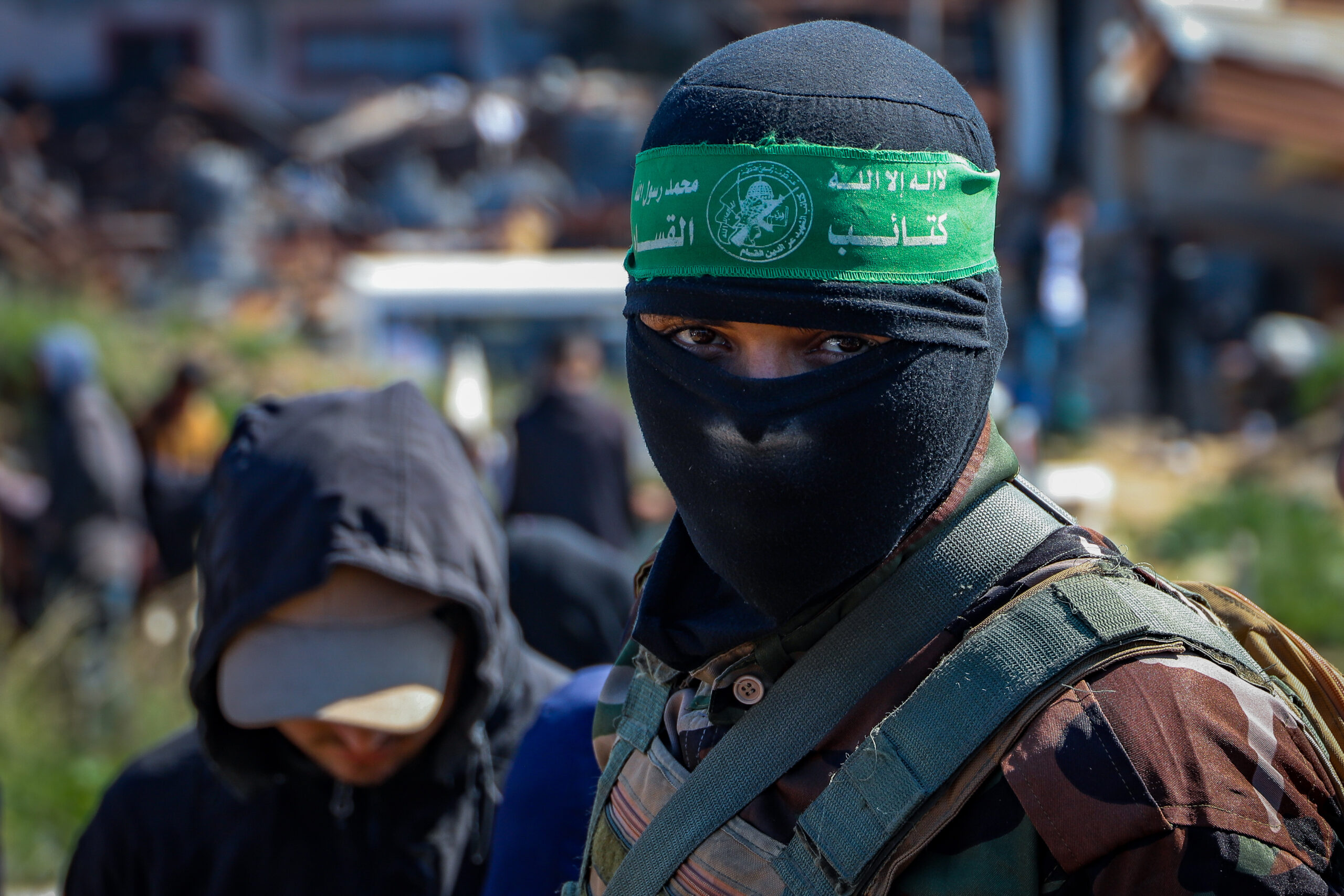
Hamas announced Monday the resignation of its Gaza “Emergency Committee,” the Hamas-run administrative body governing the Strip, in what the terror group described as a step toward transferring authority to the technocratic National Committee for the Administration of Gaza (NCAG). The announcement addresses one of the central conditions of the ceasefire brokered by President Trump in October 2025, yet mounting evidence shows Hamas has no intention of relinquishing actual control over Gaza.
Ismail al-Thawabta, head of Hamas’s government media office, told AFP that Mohammed al-Farra, head of the government’s emergency committee, “has officially submitted his resignation.” Hamas’s government said in its announcement that civil servants would continue working as usual, describing them as “public employees who are ready to work under the responsibility of the National Committee for the Administration of Gaza.”
The NCAG is headed by Palestinian technocrat Ali Shaath and was created by the Board of Peace, the body Trump established during his mediation of the Gaza ceasefire. Under Trump’s 20-point plan for Gaza, the NCAG was designed to administer the Strip in place of Hamas while the terror group disarmed and Israeli forces gradually withdrew. Hamas’s resignation announcement comes as the group continues to stall on disarmament, the central unresolved requirement of the ceasefire’s second phase.
The Board of Peace responded with pointed skepticism. “Ultimately, our assessment will be guided by actions, not promises, to meet the critical needs of the people of Gaza,” the Board wrote on X. The Board said any genuine transfer of power requires “the consolidation of all weapons under the control of the NCAG,” as mandated by the Comprehensive Gaza Peace Plan and UN Security Council Resolution 2803, and stressed that the NCAG must be able to “exercise its mandate independently.”
An Israeli official dismissed the move outright, telling the Kan public broadcaster it was “spin without any meaning.” The official said Hamas fears being declared in violation of the ceasefire agreement and is stalling through theatrics.
A Palestinian source familiar with the negotiations told The Times of Israel that Hamas is attempting to convert its existing governing apparatus into a caretaker structure while pressuring the Board of Peace and Israel to allow the NCAG to physically enter Gaza. Diplomats from Egypt, Qatar, and Turkey told The Times of Israel last month that Hamas has deliberately dragged out disarmament negotiations.
A senior Palestinian official in Ramallah told The Jerusalem Post that Hamas’s announcement changes nothing on the ground. “Hamas hasn’t declared an end to its rule in the Gaza Strip,” the official said. “What they have done is announce the dissolution of what they call the emergency committee. But at the same time, they immediately declared that another temporary governing body would run the Strip and appointed someone to head it.” The official said Hamas is using the Cairo talks to appear cooperative while working to preserve both its arsenal and its governing authority. “They want to buy more time, hoping that future circumstances may work to their advantage,” he said, pointing to potential shifts in Iran-US relations as a factor Hamas is banking on.
Hamas is reportedly demanding that its own police and security personnel be absorbed into the NCAG’s new police force. “Hamas wants its members to be allowed to carry weapons in a way that appears legal under the framework of the new technocratic committee, while in reality, it would continue to guide their actions,” the official said. Another Palestinian source told the Post bluntly: “The resignation of one or two heads of Hamas’s governmental committee does not mean the collapse of Hamas’s rule in Gaza.” That source said Hamas’s actual goal is to secure international funding and legitimacy it cannot otherwise obtain, then use its embedded civil servants as intelligence assets inside the new administration. “Hamas’s employees could be the eyes of the organization inside the new administrative body,” he said. “Hamas cannot give them up, because through them it can continue to operate and play a role.”
Hamas Cops Cause for Grave Concern
The concern over Hamas members being incorporated as security personnel is cause for grave concern. Under the Palestinian Authority’s “Pay-for-Slay” program, terrorists convicted of attacks against Israelis receive monthly salaries that rise according to the length of their prison sentence, meaning the deadliest attacks yield the highest pay. Those who have served more than 10 years in prison are entitled to a position in the PA, with the seniority of that position, like the salary, determined by time served. Lt. Col. (res.) Maurice Hirsch, writing on the structure, noted that this system has produced security forces staffed by convicted terrorists holding senior government and security positions and drawing ongoing pay even without active service.
The pattern has repeated for years in Judea and Samaria. In May 2022, Daoud Zubeidi, an officer in the PA security forces, killed Israeli police officer Noam Raz. In September 2022, Ahmed Abed, an intelligence officer in the PA security services, opened fire alongside another gunman on Israeli troops, killing Bar Falah, deputy commander of Israel’s elite Nahal reconnaissance unit. In March 2024, a member of the PA security forces killed two Israelis at a gas station. Palestinian Media Watch documented that Fatah published a poster honoring 30 “Martyrs of the Palestinian Security Forces,” of whom 23 died while carrying out attacks on Israelis. One of the most recent cases involved 1st Lt. al Mansour Billah Jalal al-Jabbar of the PA’s National Security Forces, who opened fire on IDF troops at a checkpoint near Nablus.
Released terrorists have spoken openly about the rewards. Osama Al-Silawi, convicted of murdering an Israeli and torturing and murdering three Palestinians accused of collaborating with Israel, thanked PA Chairman Mahmoud Abbas on official PA television for the military rank and salary he received upon release. A Palestinian Media Watch report released this year alleges the practice runs deeper still: the PA has been concealing pay-for-slay payments since 2021 by classifying more than 23,000 recipients as civil servants, security force personnel, and pensioners, funneling an estimated $315 million annually through channels Western donors believed were terror-free. Itamar Marcus, the group’s director, called the prospect of these forces governing Gaza “inconceivable,” telling the State Department that “the PA and its security forces are a fundamental part of the problem.” It is against that record that any plan to seat Palestinian security personnel inside the NCAG’s new police structure, as Hamas is reportedly demanding for its own operatives, deserves scrutiny rather than assumption of good faith.
Executions and control since the ceasefire
While Hamas stages its administrative reshuffling for international audiences, the terror group has spent the months since the October 2025 ceasefire consolidating power inside Gaza through executions of rivals and suspected collaborators. In areas outside Israeli military control, Hamas remains the enclave’s de facto government, maintaining that grip, according to reporting, by executing opponents and anyone it views as a threat to its rule. The pattern is consistent with Hamas’s post-ceasefire strategy: present a diplomatic face to mediators in Cairo while enforcing absolute control through violence on the ground.
The Israel Defense Forces, meanwhile, have continued expanding the territory under its control inside Gaza, now holding roughly 60 percent of the Strip, up from the approximately 53 percent it held after its initial pullback on the first day of the truce. Prime Minister Netanyahu ordered the military last month to retake additional ground, with a target of controlling 70 percent of the enclave. On Monday, the army confirmed an airstrike over the weekend killed Hudhayfah Hussein Abdullah al-Hawajr, a Nukhba Force operative in Hamas’s East Jabalia Battalion, along with four other Hamas operatives who were attempting to rebuild a terror tunnel on the western side of the Yellow Line, inside Hamas-run territory.
Israel’s Foreign Ministry added a financial dimension to the picture Tuesday, accusing Hamas of diverting billions of dollars raised for Gaza’s population. The ministry cited June 4 remarks by Mahmoud al-Habbash, religious affairs adviser to Palestinian Authority chief Mahmoud Abbas, who said funds channeled through Hamas and its affiliated networks “disappeared” and “evaporated” because they passed through partisan and factional hands rather than legitimate institutions. “Billions raised for Gaza. Billions pocketed by Hamas. Even the Palestinian Authority admits it,” the Foreign Ministry wrote. Israel’s Shin Bet has previously estimated that Hamas siphons off at least 60 percent of goods entering Gaza.
Nearly two decades of violent rule
Hamas seized control of Gaza by force in 2007, violently expelling the rival Fatah movement in a bloody internal Palestinian civil war that included executions and assassinations of Fatah officials. From that point forward, Hamas ruled Gaza as an undisputed one-party terror state, using the territory as a launching pad for a sustained campaign against Israeli civilians that included thousands of rocket attacks, cross-border tunnel infiltrations, and repeated wars.
That campaign culminated on October 7, 2023, when Hamas terrorists invaded southern Israel, murdering approximately 1,200 people and abducting 251 hostages into Gaza in the single deadliest massacre of Jews since the Holocaust. The invasion triggered the war that has now stretched into a ceasefire whose second phase remains unresolved, specifically because Hamas continues resisting disarmament.
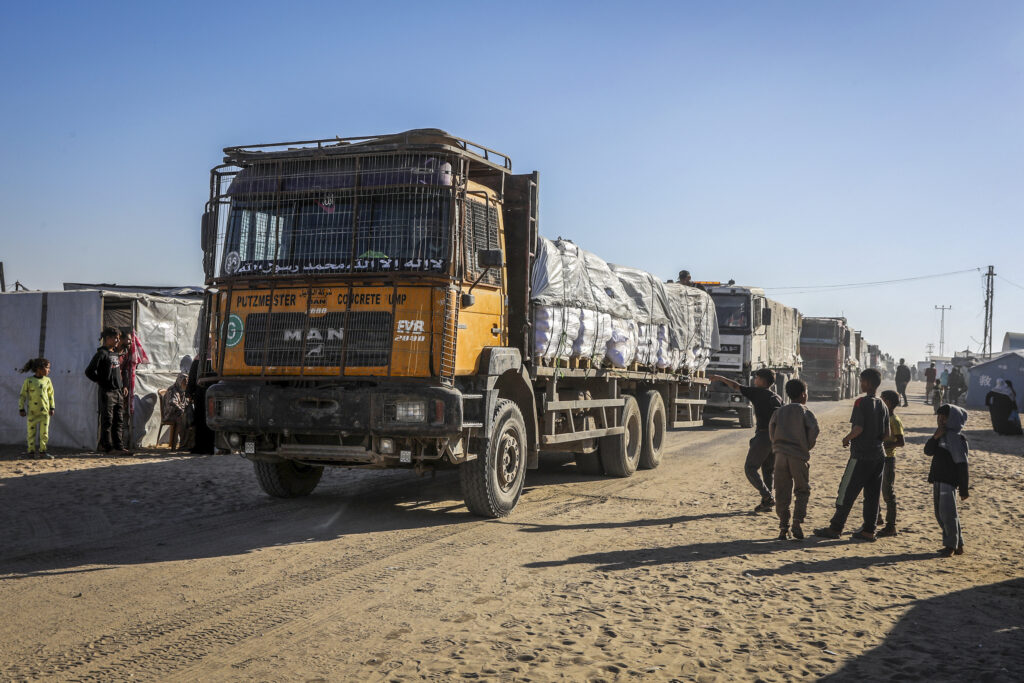
For years prior to October 7, and throughout the war that followed, Hamas systematically diverted humanitarian aid intended for Gaza’s civilian population into its military infrastructure. Cement, steel, and construction materials sent into Gaza under the label of civilian reconstruction were routed instead into a vast underground tunnel network, portions of which were built directly beneath hospitals, schools, and civilian residential buildings, using the protected status of those facilities as cover for military operations and human shields for its fighters. Hamas has also recruited children into its ranks, training them for combat roles and using them in propaganda, a practice documented extensively by Israeli and international monitors. Food and humanitarian aid shipments intended for ordinary Gazans have been repeatedly hijacked by Hamas, which has used control over aid distribution as both a revenue source and a mechanism of social control, rewarding loyalists and punishing dissenters through access to food and supplies.
That record forms the backdrop against which Monday’s resignation announcement must be read. A single committee’s dissolution does not undo an eighteen-year record of armed rule, and every Palestinian and Israeli source close to the negotiations describes the move as choreography rather than surrender. Hamas is signaling cooperation to the mediators in Cairo while working, by its own officials’ design, to keep its weapons, its personnel, and its authority intact under new letterhead.