


Israel’s Knesset voted Wednesday to advance a Basic Law declaring Torah study a foundational constitutional value of the Jewish state, a measure legal experts warn could permanently entrench draft exemptions for tens of thousands of yeshiva students while the Israel Defense Forces fights a manpower shortage on multiple fronts.
The bill, sponsored by United Torah Judaism lawmakers Moshe Gafni and Yaakov Asher along with Yitzhak Pindrus, passed its first reading by a vote of 63-53. Prime Minister Benjamin Netanyahu attended the debate and voted in favor. Four coalition members broke ranks: Likud’s Dan Illouz and Yuli Edelstein, Deputy Foreign Minister Sharren Haskel, and Religious Zionism’s Moshe Solomon.
Because Israel has no formal constitution, Basic Laws carry the highest legal status in the country, meaning this measure, if it clears its remaining two readings, would sit above ordinary legislation and could override future High Court rulings requiring Haredi enlistment.
Gafni told the Knesset that recent years have brought “a degradation in the honor of the Torah,” and said he acted “under the instruction of the leading Torah sages” to restore it. Yitzhak Pindrus went further, declaring Torah study the highest value in the State of Israel, above military service itself. Opposition leaders responded with fury. Naftali Bennett called it the “Basic Law of Torah Humiliation” and vowed to repeal it the moment he forms a government. Gadi Eisenkot called it “a direct blow to our national backbone.”
Eight decades of exemption
The exemption this bill seeks to protect emerged from a political deal. In October 1948, during Israel’s War of Independence, Prime Minister David Ben-Gurion agreed to exempt 400 yeshiva students from military service at the request of Haredi leader Yitzhak-Meir Levin. Ben-Gurion reportedly believed the exemption would remain small and insignificant. He later regretted this exemption. By the 1950s, he was already asking why one mother’s son should die defending the homeland while another mother’s son sits safely in his room and studies. The number of exempted men grew from 400 to tens of thousands, and by 2024, an estimated 80,000 Haredi men aged 18 to 24 were eligible for service but had not enlisted.
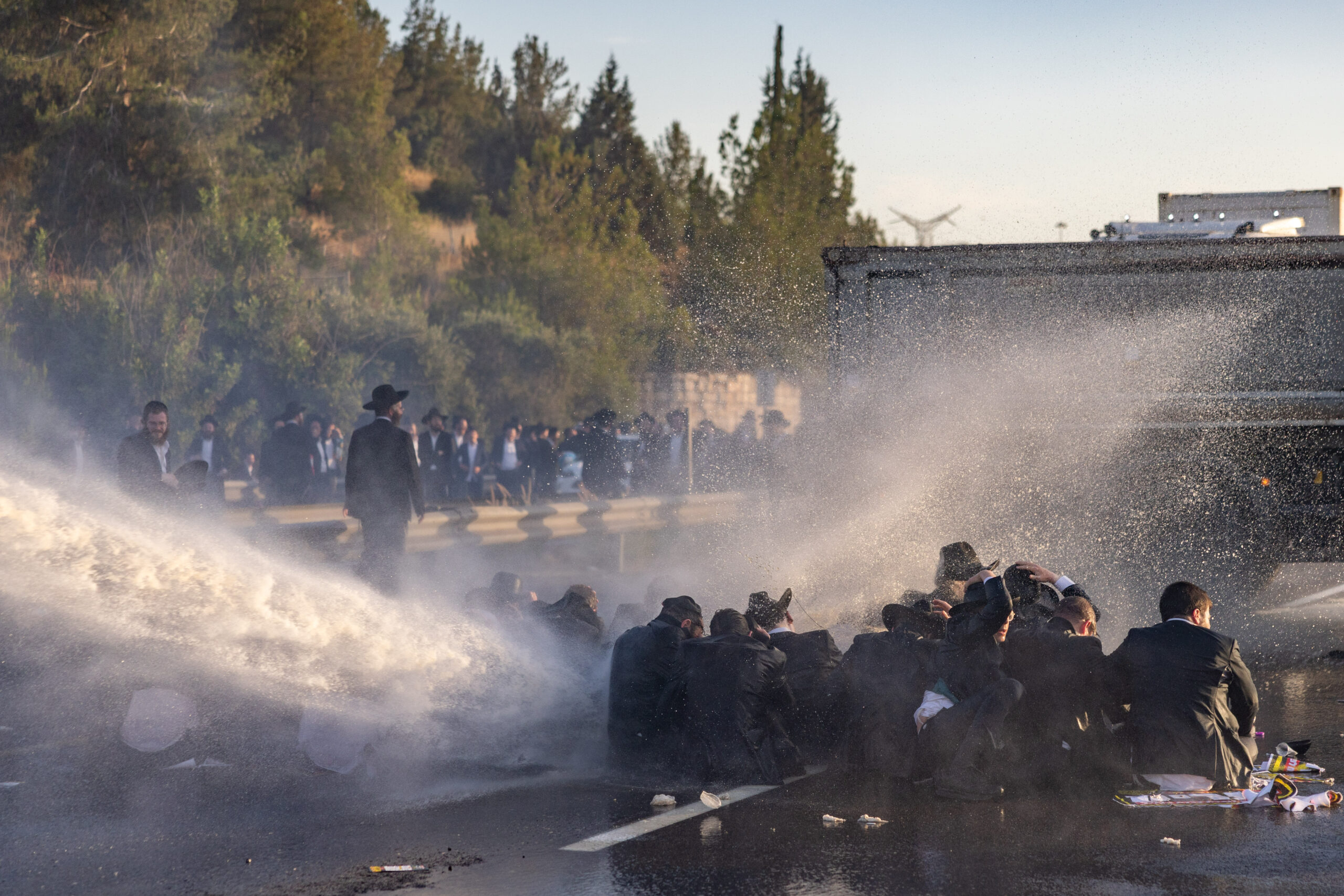
The legal architecture built to manage this grew increasingly elaborate and increasingly unstable. The 2002 Tal Law formalized deferrals under the principle of torato umanuto, “his Torah is his occupation.” The High Court struck it down in 2012 for failing to distribute the burden of service fairly. A replacement law followed in 2014. In June 2024, the Supreme Court ruled unanimously that no legal basis remained for exempting Haredi men from the draft at all, and ordered the state to begin conscription. The Basic Law now moving through the Knesset represents the Haredi parties’ latest attempt to override that ruling by constitutional means rather than statute, precisely because a Basic Law would be far harder for future courts to strike down.
While hundreds of thousands of Israelis serve years of active duty and additional decades of reserve service, Haredi households continue to receive substantial state support. Yeshiva stipends, child allowances tied to large family sizes, subsidized housing programs, and exemptions from broader taxation obligations flow to a community whose men have largely opted out of the service obligation that funds and defends the state providing those benefits. The High Court froze some of this funding in April 2024, directly linking yeshiva budgets to compliance with enlistment orders, only for the government to continue funneling money through other channels.
Enlistment numbers remain small
The IDF has built dedicated frameworks to draw Haredi men into service without requiring them to abandon their religious lifestyle. The Netzach Yehuda Battalion, established in 1999, maintains strict kosher standards and gender-segregated conditions. The Hasmonean Brigade, the IDF’s first all-Haredi combat brigade, opened in January 2025 with ambitions to eventually field thousands of soldiers. The Hetz Company serves Haredi paratroopers.
The results remain modest against the scale of the shortfall. The IDF reported close to 3,000 new Haredi enlistees in a recent year, up from roughly 1,800 previously, but still far short of the interim goal of 4,800 annual recruits, itself a fraction of what full participation would look like. In one enlistment cycle, more than 10,000 draft orders went out, and only 177 men reported for service. IDF Chief of Staff Eyal Zamir has said the army will “collapse in on itself” without additional manpower, and has called expanding Haredi enlistment “an essential operational necessity.”

What the Bible actually commands
The Bible draws a sharp distinction that the Basic Law’s supporters ignore. Deuteronomy 20 lists categories of men exempt from battle: the man who built a new house and has not dedicated it, the man who planted a vineyard and has not harvested it, the man betrothed but not yet married. “What man is fearful and fainthearted? Let him go and return to his house, lest his brethren’s heart melt as well as his heart” (Deuteronomy 20:8). These exemptions apply specifically to milchemet reshut, a discretionary war of choice. They never applied to milchemet mitzvah, a commanded, obligatory war fought in defense of the Jewish people and the Land of Israel.
The Mishnah in Sotah states the law without ambiguity: in a milchemet mitzvah, everyone goes out to fight, even a bridegroom from his wedding chamber and a bride from beneath her wedding canopy. Rambam codifies this ruling in Hilchot Melachim, and no exemption for Torah scholars appears anywhere in his account of who must fight when Israel’s survival is at stake. A war launched by Hamas terrorists and Hezbollah rocket crews against Jewish civilians is not a war of political discretion. It is the exact war category the Bible commands every Israelite, without exception, to join.
By claiming this exemption, the Haredim are explicitly violating Torah commandments.
The sin the Basic Law repeats
The Bible already told this story once, and it did not end well for the generation that lived it. When the twelve spies returned from scouting the land of Canaan, ten of them urged the nation to stay in the wilderness rather than enter and fight for the inheritance God had promised. Some among that generation preferred the wilderness precisely because it let them study God’s word and receive their food from Heaven without risk, without labor, and without battle. God’s response came without hedging. He decreed that the entire generation of adults who had accepted that argument would die in the wilderness rather than enter the land. “Say to them: As I live, says the LORD, just as you have spoken in My hearing, so I will do to you” (Numbers 14:28). Forty years of wandering followed, one year for each day the spies had scouted the land and doubted.
A nation that prefers spiritual comfort to the physical defense of its inheritance has already been judged for that choice once. The Knesset just voted to make the same flawed argument the basis of constitutional law.