

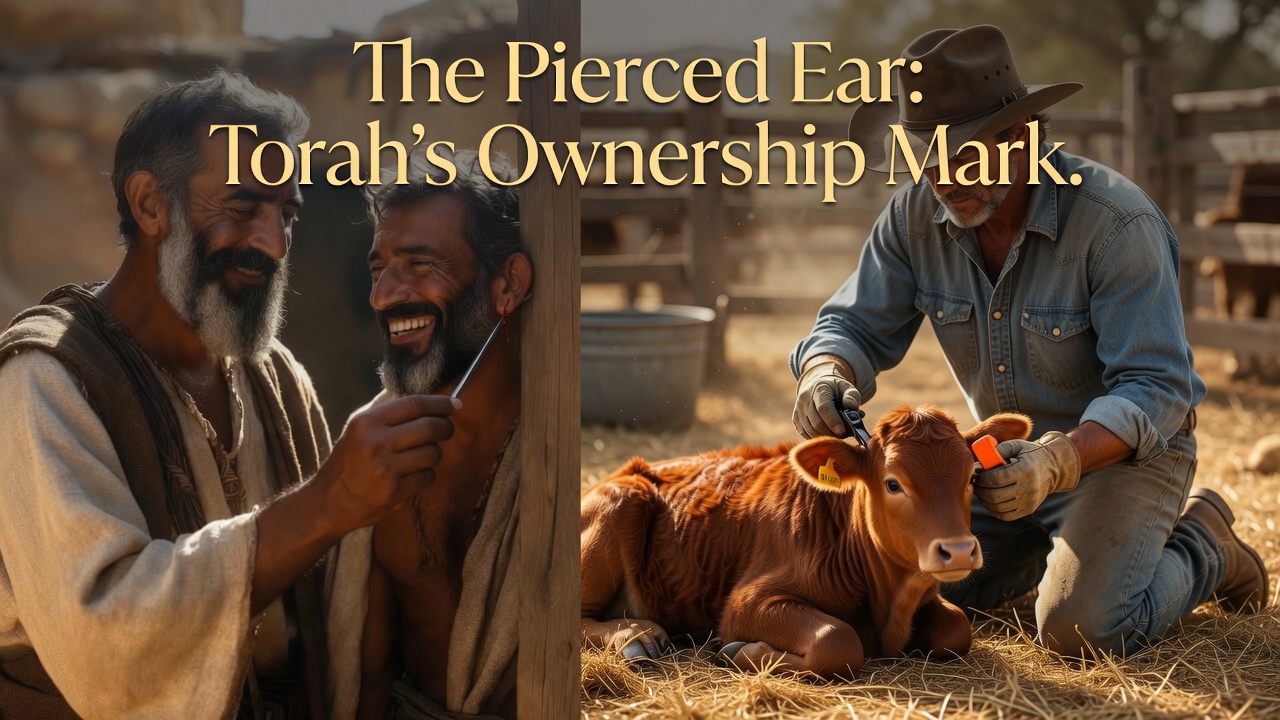
The image tells two stories side by side. On the left, a Hebrew servant stands willingly at the doorpost. His master pierces his ear with an awl. The servant smiles with joy and devotion, choosing permanent service out of love. On the right, a modern rancher kneels beside a red calf. He applies an ear tag, marking the animal as owned livestock. Both scenes depict the same ancient act: piercing the ear to assert ownership and integrate the subject into the human economic system. This visual connects directly to the Torah’s requirement for the parah adumah (red heifer). An early ear tag on the calf named Temimah (perfect) disqualifies her under the Torah’s own standards. The disqualification is not a later rabbinic addition. It flows from the lexical, biological, and anthropological definitions in the Written Torah itself.
The birth of Temimah on a Galilee dairy farm has drawn attention to the requirements for the red heifer. Reports noted her pure red coat and rapid healing from the tag. This development arrives amid broader momentum. The Sanhedrin advances its work. Training programs for kohanim (priests) and Levites expand. Tens of thousands of young people commit to study and readiness for service in the House of Hashem. These steps mark real progress toward the day when the nation returns fully to the biblical system of purity and offerings. Temimah joins this wave as a symbol of hope. Many pray she becomes the first of many qualified candidates and a mother to future red heifers that meet every requirement.
Yet a central question arises from the plain text of the Bible and the detailed rulings of the Sages. Does the ear tag applied at birth already disqualify this calf from ever serving as the parah adumah (red heifer)?
The Biblical Standard for Perfection
The Bible states the requirement without ambiguity. “This is the statute of the law that the Lord has commanded, saying: Speak to the children of Israel, that they bring you a red heifer temimah (perfect), in which there is no mum (blemish), and upon which a yoke has never come.” (Numbers 19:2)
The Sages understood temimah to demand absolute wholeness. They applied the detailed laws of mum developed for other offerings to the parah adumah. These standards come directly from the everyday agricultural world of the Land of Israel. One key benchmark involves the karshinah seed from the bitter vetch plant. Multiple layers of potential disqualification now appear in the case of Temimah.
Lexical Definition from the Torah Text
The term mum denotes a physical defect that mars wholeness. Temimah requires the animal to be complete, entire, and sound. Charutz, from the root meaning to cut or incise, refers to mutilation by incision or slit. Applying an ear tag drives a pin through the auricular cartilage. This creates a deliberate puncture. In the lexicon of classical Hebrew, such an artificial hole in the flesh constitutes a definitive mum. The animal is no longer temimah. The piercing violates the baseline requirement of anatomical wholeness established in the Written Torah.
Biological Reality of the Piercing
From a physiological standpoint, piercing permanently alters the ear. Cartilage has limited blood supply and does not regenerate to fill a void. The procedure creates a permanent fistula and localized scar tissue. Even after tag removal, the structural matrix of the cartilage remains severed. The animal is biologically no longer in its original, sound state. This change aligns directly with the Torah’s demand for temimah integrity. The defect is not cosmetic. It is a lasting alteration to the flesh.
The Anthropological Conflict: Ownership versus Sanctity
The Torah requires the red heifer to remain entirely outside the profane sphere of human utility. She must exist as an untouched vessel of natural vitality, never subjected to the yoke or ordinary agricultural marking. In the ancient Near East, ear piercing served as a standard mark of ownership for livestock and slaves. The Torah itself references this practice in Shemot 21:6, where a servant’s ear is bored to signify permanent subjugation.
Tagging Temimah marks her as domesticated property for herd management and tracking. It integrates her into the human economic system. Once marked as owned agricultural stock, she ceases to be the pristine, set-apart animal the Torah demands. The act parallels the yoke prohibition. The intervention itself, not merely any resulting scar, violates the requirement that nothing ordinary has come upon her.
Clear Contrast with the Passover Lamb
The command for the Passover lamb in Shemot 12:3-5 assumes personal ownership. Each household takes a lamb from the flock or herd into the home for four days. The animal is explicitly part of the family’s property before slaughter. The red heifer command contains no such language. It demands an animal brought for the ritual that has never known the yoke or ordinary use. The distinction is deliberate. The Passover lamb functions within the household economy. The red heifer must remain ritually isolated from that economy.
The Parallel with First Fruits
The principle appears clearly in the laws of bikkurim (first fruits). The farmer marks the first ripened fruit while it is still attached to the tree with a reed-rope or similar marker and declares it for the Temple. This sets it apart before any personal use or harvest, preserving its sanctity. The marking happens in the field to signal ownership by Hashem rather than the farmer.
Applied to the red heifer, the same principle holds. The proper approach would have been to tag all other calves first with a clear visual signal that “this one is not yet claimed for ordinary use.” This preserves the temimah status by marking the profane herd while leaving the red heifer untouched until halachic experts confirm her suitability. It mirrors the bikkurim method of separation in situ and avoids the irreversible piercing that asserts ownership.
Multiple Layers of Disqualification
The Mishnah addresses each potential defect distinctly. The piercing itself larger than karshinah initiates one mum. The applicator often engages the cartilage, triggering the separate cartilage damage category. The dried out condition adds another layer if the tissue loses vitality or shows flaking after the breach. These stand as independent grounds under the temimah requirement.
The Sages in Bekhorot 6:1 applied these Torah categories with precision. The karshinah seed provided the everyday measure for the piercing clause because farmers knew its size from handling fodder in the mangers. The Mishnah clarifies what the Torah already requires, not adds to it.
The case of Temimah illustrates the challenge. The initial piercing exceeded the Torah’s standard for wholeness. Cartilage involvement and the permanent alteration of the ear structure compound the defect. Healing does not restore the original state. The animal has been removed from consideration under the criteria set in Bamidbar and Vayikra.
A Law to Protect Future Red Heifers
Israel must establish a clear statute for all red heifer candidates born in the land. Every such calf requires examination by qualified halachic experts prior to any ear tagging. The government should cover the full costs of this process. This measure supports the national interest in restoring the Temple service and enables every Jew to fulfill his or her avodah (service) to Hashem with greater purity.
Farmers already show willingness to cooperate with research institutes. A formal protocol prevents avoidable disqualifications while upholding the exacting standards the Sages derived from the feed trough itself. Implementation would cost little compared to the national benefit. It demonstrates practical commitment to the biblical commandments that prepare the people for the Third Temple on Mount Moriah. Reforming agricultural standards around these special births ensures that future candidates avoid ordinary interventions that compromise their status from the start.
The Practical Reality the Sages Assumed
The birth of Temimah coincides with genuine advances in Temple preparation. Reports from my sources confirm the Sanhedrin continues its work. Training initiatives multiply. Youth across the country dedicate themselves to readiness. These efforts deserve full support. At the same time, precision in halachic application must match the enthusiasm.
The Sages rooted their rulings in the soil and the daily life of Israel. They selected the karshinah seed from the very fodder fed to heifers as the measure of perfection. They listed cartilage damage, splitting, piercing, and drying as separate disqualifiers because they understood the vulnerabilities of living animals in the barn and field. Modern restoration efforts succeed only when they honor that same concrete reality.
The ear tag on Temimah serves as a reminder. Ordinary farm procedures that seemed routine now stand exposed against the ancient text. The initial piercing exceeded melo karshinah. It likely engaged the cartilage. Healing does not undo the act under the criteria the Sages established. With safeguards in place, the next red heifer can emerge fully temimah, ready to provide the ashes that purify the nation and advance the redemption.
The path forward lies in faithful adherence to the sources. The karshinah in the feed trough held the answer all along. Recognizing it now accelerates the day when Israel stands pure before Hashem in the rebuilt Temple.