


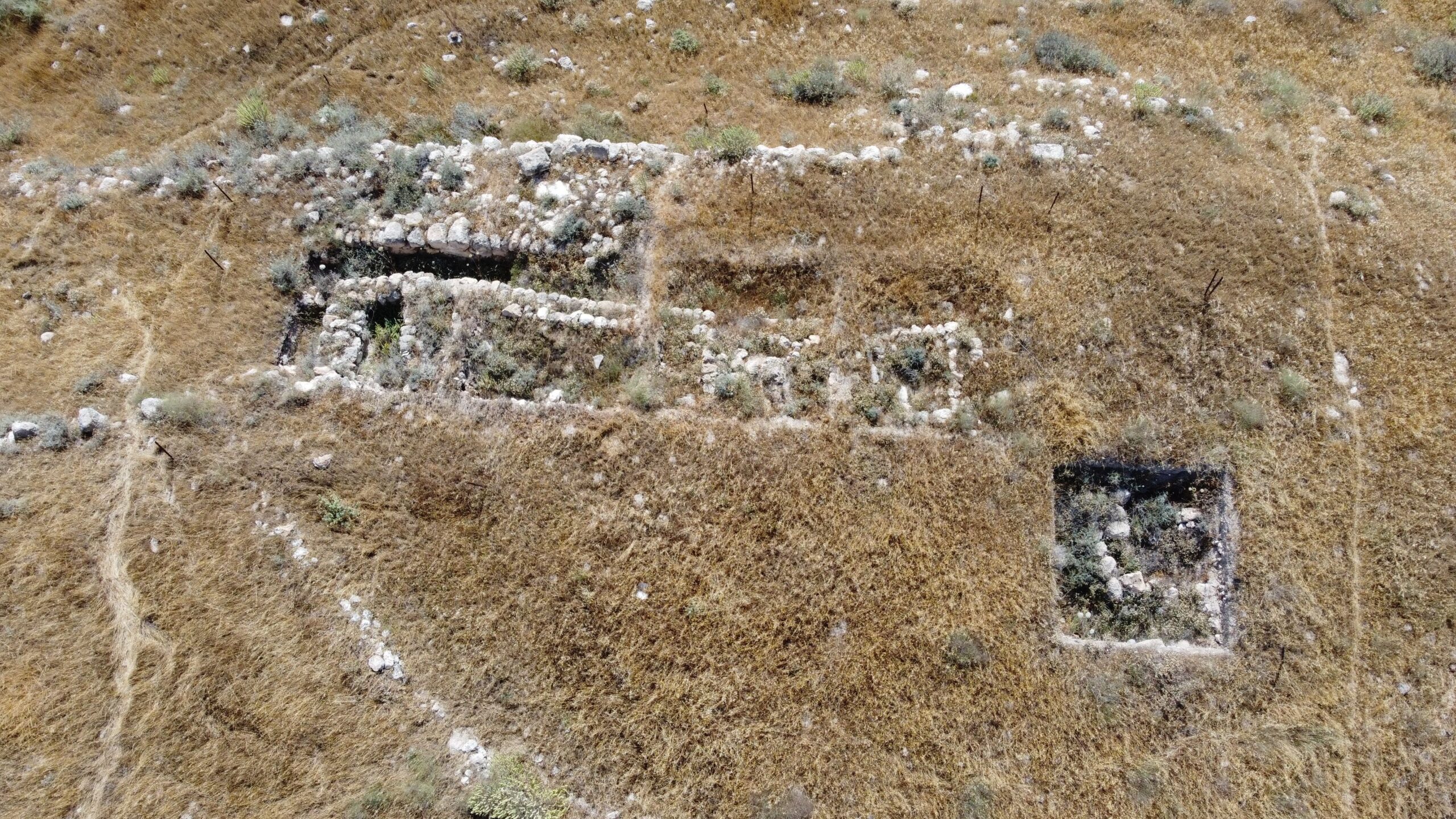
Archaeologists working at Tel ‘Eton in the Judean Shephelah did not realize, at first, what they had found. They thought the layer of stone was simply rubble from a collapsed wall. They began clearing it away, one stone at a time, until they reached something far too heavy to lift. Only after they considered breaking it apart and then changed their minds did the team realize they were looking at a massebah, a standing cult stone weighing roughly 750 kilograms and rising 1.4 meters. That discovery, now published in the Hebrew University’s peer-reviewed Jerusalem Journal of Archaeology, may be the strongest physical evidence yet for one of the most contested episodes in the Bible: King Hezekiah’s campaign to abolish idolatrous worship throughout Judah.
The study’s author, Prof. Avraham Faust of Bar-Ilan University’s Department of General History, excavated the stone from the largest room of a grand four-room residence at Tel ‘Eton, a site in the Judean lowlands roughly twenty miles southeast of Ashkelon. The building, identified by archaeologists as a governor’s residence, was constructed in the late eleventh or early tenth century BCE and stood for generations before the Assyrian army destroyed it during the campaign of 712 BCE.
The stone had originally been positioned directly opposite the home’s entrance, where it would have been visible to anyone standing in the courtyard outside. “The location of the stone suggests that it played an important role in the lives of the building’s occupants,” Faust said. Standing stones of this kind were common throughout the ancient Near East. “Their exact meaning is debated,” Faust noted, “but all scholars agree that they were used in religious contexts.”
What makes the Tel ‘Eton massebah remarkable is not that it existed, but how it ended. By the time Assyrian soldiers burned the house to the ground, the great stone was no longer standing upright in a place of honor. It had been laid on its side and built into a stone platform, where it was found with a cooking pot resting on top of it. Significantly, the stone was not smashed. It was not desecrated. It was simply removed from ritual use and respectfully covered over.
“Those responsible for changing religious practices may have wished to eliminate the stone’s ritual function, and perhaps wanted the old ritual objects desecrated, but the people who carried out the change seem to have treated it with respect,” Faust said. “They removed it from use without destroying it, effectively neutralizing its cultic significance while preserving the object itself.”
The timing is what places this discovery at the center of the Hezekiah debate. The decommissioning occurred sometime before the Assyrian destruction at the close of the eighth century BCE, the very period in which the Bible places Hezekiah’s reign and his religious reforms. Scholars who study this era generally weigh two candidates for sweeping cultic change in Judah: Hezekiah in the eighth century and Josiah roughly a century later. “Since Josiah’s reform is thought to have happened later in the seventh century, it is not really relevant,” Faust said, “but Hezekiah is believed to have reigned in the eighth century, so it could fit.”
The book of Second Kings describes Hezekiah’s actions in stark terms. “He did what was pleasing to God, just as his forefather David had done. He abolished the shrines and smashed the pillars and cut down the sacred post” (II Kings 18:3-4). The Hebrew word for those pillars is massebah, the very term archaeologists use to classify the Tel ‘Eton stone.
For decades, many biblical scholars have treated these verses with suspicion, arguing that the account of Hezekiah’s reform was inserted into the text long after the fact to serve a later theological agenda. Their skepticism has rested on a real gap in the archaeological record. Excavators have identified only a small number of public temples and shrines outside Jerusalem that went out of use during this window, at sites such as Arad, Lachish, and Beersheba, and even those finds remain disputed.
Faust’s study pushes the search for evidence into a place earlier scholarship had largely ignored: the private home. Public temples are rare, and their destruction layers are debated. Households are far more common and far more likely to preserve the quiet, careful, undramatic way that ordinary families abandoned forbidden worship rather than openly defying royal decree. A king’s officers could tear down a temple. A family removing its own household god from sight and burying it with the same reverence it once received tells a different and arguably more convincing story of genuine religious change reaching into daily life.
Faust was careful not to overstate his case. “Archaeology rarely provides a single discovery that settles a long-standing historical debate,” he said. “But every well-documented find adds another piece to the puzzle. The standing stone at Tel Eton offers a rare glimpse into how religious change may have been experienced in everyday life, and it strengthens the case that significant transformations were taking place throughout Judah during this period.”
What emerges from a Judean hillside is not a smashed idol thrown into a pit, but a family quietly laying their household god on its side and building a stone platform over it, choosing reverence for the object even as they abandoned its worship. Three thousand years later, that single buried stone speaks louder than the skeptics who dismissed Hezekiah’s reform as a later invention. The God of Israel does not need His victories announced. He buries idols in silence and lets the stones themselves bear witness long after the men who toppled them have turned to dust.
