


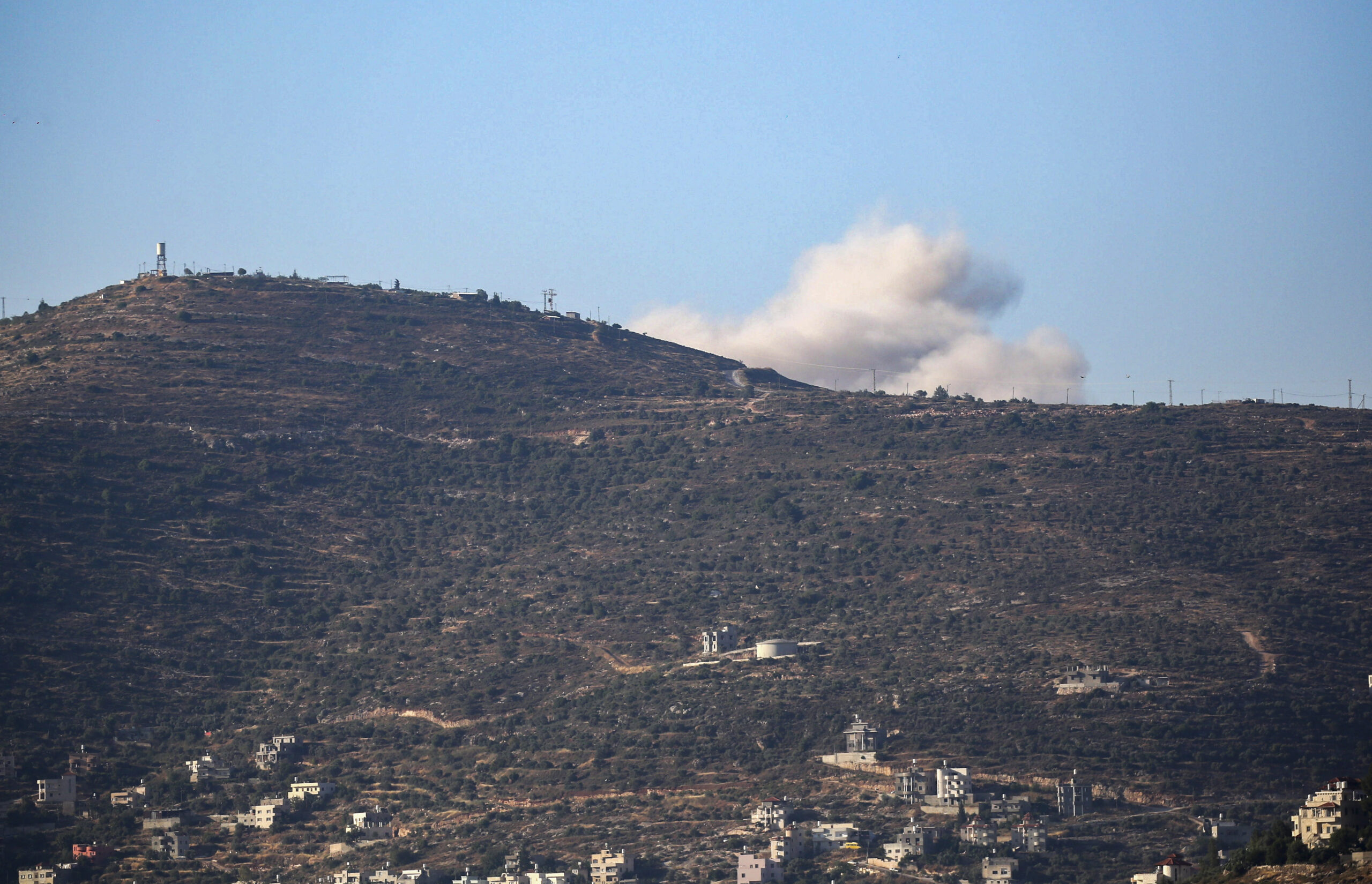
Rabbi Tovia Singer, founder of Outreach Judaism, delivered an urgent message on the Parsha Inspired podcast last week: the war now underway between Israel and Iran is not a future event awaiting fulfillment. It is the war described in Ezekiel chapters 38 and 39, and it is happening as Israelis read these very words.
“It’s not around the corner anymore. It’s actually here,” Singer said. “Iran, modern-day Iran, exactly geographically where it is, and the people who self-identify as Persians proudly. It’s called Milchemet Gog, the war of Gog. You call it whatever you want. It’s an end-time war. It’s in Ezekiel 38 and 39. Well, it’s happening right now, as we are speaking right now, in real time. Israel is battling Iran, and it’s happening right now. Right now.”
The recording itself was interrupted by the war it described. The host of the podcast opened the episode by describing being woken before dawn by sirens. “This morning at 5:58 a.m., my family was awoken, and the entire community was awoken, to the sound of air raid sirens of incoming hypersonic ballistic missiles from Iran,” he said. “These are dirty bombs with multiple random targets, meaning that although the entire missile can be focused at our community, the heads of these missiles will shoot out randomly. These are not used for military purposes. This is used for maximum civilian damage.”
Singer raised the possibility hanging over every Israeli sheltering from these barrages. “If any of these ballistic missiles are armed with a nuclear device, God forbid, and make it through all the slingshots and the anti-missile missile systems, that’s it,” he said. “The most dangerous country in the world is gaining access to the most dangerous weapon in the world.”
Why Persia, of All Nations
Singer’s central argument concerns identity. Among the nations named in Ezekiel’s prophecy of the war of Gog, he said, Persia is unique in having remained geographically and ethnically continuous into the present day. “A very significant number of the people who live in Iran, modern-day Iran today, identify as Persian, and their DNA tells [them] they’ve been there for a very long time,” Singer said. “In their collective consciousness, they consider themselves Persians and are proud of their ancient history.” He contrasted this with other nations named alongside Persia in Ezekiel’s prophecy, regions of North Africa and the upper Nile whose populations, he said, have since been absorbed and homogenized through successive conquests, leaving Persia as the clearest match between an ancient prophetic name and a present-day nation.
Singer then turned to what he called the most compelling part of the argument: Iran’s hostility toward Israel has no natural basis. “Let me explain to you why this is ridiculous and why this is so compelling,” he said. “Persia, the closest part of Persia to me, I’m in Jerusalem right now, is a thousand kilometers east. It means we share no border with them. Moreover, they’re not Arabs. If you want to insult someone living in Iran, call him an Arab, and he will correct you very, very quickly and say, ‘We’re not Arabs here.'” He noted that Israel’s actual territorial disputes lie with its Arab neighbors, over the Golan Heights with Syria and over Judea and Samaria, not with Persia.
He pressed the point further by invoking the historical relationship between Persia and the Jewish people. “Persia was an empire that was not only not hostile to us, they were very benevolent to us,” Singer said. “It was Cyrus the Great who said to the Jews, ‘Go back.'” The Persian king’s decree permitting the exiled Jews to return to Zion and rebuild the Temple, recorded in the books of Ezra and Chronicles, makes Iran’s role as Israel’s chief antagonist today, in Singer’s reading, not a continuation of ancient enmity but an inversion of it, which he takes as evidence that the current conflict is being driven by a script written long before either side’s modern grievances existed.
The Order of Events: Return, Then War
Singer laid out a specific sequence drawn from Jeremiah. The regathering of the Jewish people to their land comes first: “But this you must know, that Jeremiah 30:3, that the children of Israel return back to Israel after a very long exile.” The full verse reads: “For, lo, the days come, says the LORD, that I will turn again the captivity of My people Israel and Judah, says the LORD; and I will cause them to return to the land that I gave to their fathers, and they shall possess it” (Jeremiah 30:3).
The anguish that follows the return is described four verses later, in language Singer said matches nothing else in Jewish history until now: “And this happens after Jacob’s trouble. So that’s Jeremiah 30:7, which comes after Jeremiah 30:3.” The verse states: “Alas! for that day is great, so that none is like it; it is even the time of Jacob’s trouble; but he shall be saved out of it” (Jeremiah 30:7).
Singer pointed to Zechariah 12 as describing the same war over Jerusalem. “Nations will come up against Jerusalem, and Jerusalem will be a heavy, burdensome stone against all the nations who come up against it,” he said, citing Zechariah 12:3, which reads in full: “And it shall come to pass in that day, that I will make Jerusalem a stone of burden for all the peoples; all that burden themselves with it shall be sore wounded; and all the nations of the earth shall be gathered together against it” (Zechariah 12:3). He continued into the following verses, describing God’s protection of Jerusalem’s defenders: “God will make the Jewish people strong, mighty warriors. They will have the power of David, even of the angel, Lord of Hosts,” referencing Zechariah 12:8, which reads: “In that day shall the LORD defend round about Jerusalem; and he that is feeble among them at that day shall be as David; and the house of David shall be as God, as the angel of the LORD before them” (Zechariah 12:8).
A Text Written to Be Understood
Singer insisted that none of this is meant to require specialized interpretation. “It’s very in the end of days. This has to be clear,” he said. “Why? Because if these texts are not transparent, easy to understand, written in the simplest biblical Hebrew, then we won’t even know what we’re looking for. We’ll be lost.” He framed this clarity itself as a fulfillment of Isaiah’s description of a generation guided directly by God through events it could not otherwise navigate alone: “Who is blind, but My servant? Or deaf, as My messenger that I send?” (Isaiah 42:19).
He made the same point about timing later in the episode, arguing that the present generation occupies a unique vantage point that no rabbinic authority of the past possessed. “I assure you one thing, you don’t need a commentary to read this chapter,” Singer said of Ezekiel 39. “In fact, the classical medieval commentators would have envied you… [for] living in our time [and] to be able to witness this. Rashi would have loved to have witnessed this. He could not, as he lived a thousand years ago. Maimonides could not. He lived nine hundred years ago.”
The Stated Purpose of the War
Singer argued that the war’s outcome, as described by Ezekiel, is not primarily about Israel’s military performance. “The reason why this war happens, and why all the enemies of Israel are destroyed, is that the world will know that I am God,” he said, directing viewers to the closing verses of Ezekiel 39. The passage reads: “And I will set My glory among the nations, and all the nations shall see My judgment that I have executed, and My hand that I have laid upon them. So the house of Israel shall know that I am the LORD their God, from that day and forward” (Ezekiel 39:21-22). “That means we are supposed to look at this war with Iran, at the end of days, Persia at the end of days with its proxies all around us, and see their utter destruction, and derive from that that the LORD is God,” Singer said, calling this recognition an essential feature of the messianic age.
The Demographic Argument
Singer’s claim about the concentration of world Jewry in Israel is borne out by current population data. According to figures released by Israel’s Central Bureau of Statistics this year, the global Jewish population stands at approximately 15.8 million, with roughly 7.2 million, or about 45%, living in Israel, compared to roughly 6.3 million, about 40%, in the United States. The shift is stark when measured against the twentieth century. On the eve of World War II in 1939, the global Jewish population stood at 16.6 million, of whom only 449,000, about 3%, lived in the land of Israel. By 1948, when the State of Israel was established, the global Jewish population had fallen to 11.5 million following the Holocaust, with 650,000, about 6%, living in Israel. The proportion of world Jewry living in Israel has therefore grown roughly fifteenfold since the eve of statehood.
Singer placed this shift in much deeper historical context, arguing that a concentration of this scale has not existed since the era preceding the Assyrian exile of the Northern Kingdom in the eighth century BCE, during the lifetime of King Hezekiah of Judah. “At least half of the known Jews in the world live here in Israel. That has not been the case since the days of Hezekiah. Twenty-seven hundred years since the Neo-Assyrian Empire,” he said.
He connected this regathering to Hosea’s description of a long exile followed by a return marked by the restoration of covenantal kingship: “For the children of Israel shall abide many days without king, and without prince, and without sacrifice, and without pillar, and without ephod or teraphim; afterward shall the children of Israel return, and seek the LORD their God, and David their king, and shall come trembling unto the LORD and to His goodness in the end of days” (Hosea 3:4-5).
He paired this with Amos’s promise that the return, once it happens, would be permanent: “And I will turn the captivity of My people Israel, and they shall build the waste cities, and inhabit them; and they shall plant vineyards, and drink the wine thereof; they shall also make gardens, and eat the fruit of them. And I will plant them upon their land, and they shall no more be plucked up out of their land which I have given them, says the LORD your God” (Amos 9:14-15). “None of these books whitewash Jewish history,” Singer said. “Very clearly, at the end of Amos, chapter 9, look at verses 14 and 15. The children of Israel will be replanted in the Holy Land, and once they return, they will never be uprooted.”
From Kristallnacht to October 7
The episode drew an explicit comparison between the events of October 7, 2023, and Kristallnacht, the night of November 9-10, 1938, when Nazi paramilitary units and civilian mobs across Germany and Austria burned synagogues, smashed and looted thousands of Jewish-owned businesses and homes, and murdered dozens of Jews while thousands more were arrested and sent to concentration camps. Kristallnacht is widely regarded by historians as the moment Nazi persecution of Jews shifted from legal discrimination to open, organized violence, foreshadowing the Holocaust that followed. “To give the viewers a sense of scale, [on] Kristallnacht, which was the antecedent event of the Holocaust, on November 10th, 1938, ninety-two Jews were murdered,” the episode noted. “Here we’re speaking about a dark Sabbath day in which twelve hundred Jews were murdered, in a barbarism that none of us could have imagined, until October 7th. You and I thought that the Nazis was the worst, that was the worst possible level. And then we found out there were actually people who actually enjoyed it.” That massacre, the episode argued, set in motion the chain of escalation running through the war in Gaza to the current confrontation with Iran.
The Spies, the Calf, and the Cost of Rejecting the Land
The episode aired during the week of Parashat Shelach, the Torah portion recounting the mission of the twelve spies sent by Moses to scout the land of Israel, ten of whom returned with a report that demoralized the nation and triggered a rebellion against entering the land. Singer drew a direct line between that ancient failure and the present moment, arguing that the deeper sin was not the spies’ slander of the land but the nation’s own unwillingness to want it. “The real story of the spies is that the Jewish people cried and said we don’t want to come,” Singer said. “They were disgusted by God’s beautiful land.”
The severity of God’s response to that episode stands in sharp contrast to His response to the sin of the golden calf earlier in the Israelites’ journey. After the calf, an act of outright idolatry, Moses interceded, and God forgave the nation, allowing that same generation to continue toward the land, though judgment fell on those directly responsible. After the sin of the spies, by contrast, God decreed that the entire generation of adults who had left Egypt, having followed their leaders into despair rather than trust the divine promise, would die in the wilderness over the next forty years, with none but Joshua and Caleb permitted to enter the land. The Sages have long noted this asymmetry: idolatry, the gravest of sins, was met with forgiveness, while rejecting the land of Israel on the word of faithless leaders was not. The spies’ report was delivered, by tradition, on the ninth of Av, the same date later marked by the destruction of both Temples, a connection the Sages drew to teach that the seeds of future exile were planted the moment the generation wept over a land they should have desired.
Singer applied that lesson directly to the present. “Instead of sitting in exile and complaining about the situation in Israel, come join the heart of the people of Israel,” he said. “Why be a part of the community of Israel in exile when you could be part of Israel itself?” He closed with a call drawn from the same Torah portion’s surrounding narrative: “Be strong and courageous.”
The Closing Argument
Singer’s final point concerned where this war fits within the broader prophetic structure of Ezekiel. The chapters describing the war of Gog, 38 and 39, are immediately followed by chapters 40 through 48, which describe in architectural detail the construction of the Third Temple. “Ezekiel 40 till the end is Third Temple prophecy, and we’re almost there,” Singer said. “Forty through forty-eight is all Mashiach-incident. So that’s where we are. We don’t have to guess. The text very clearly says that God is going to keep dragging back the enemies of Israel, specifically Persia and its proxies, and as a result, God is going to destroy them completely. And then the Jewish people, already having been in the land, will be restored, their sins will be forgiven, and there will be a restoration of God’s glory. And that’s what we’re observing right now.”
