




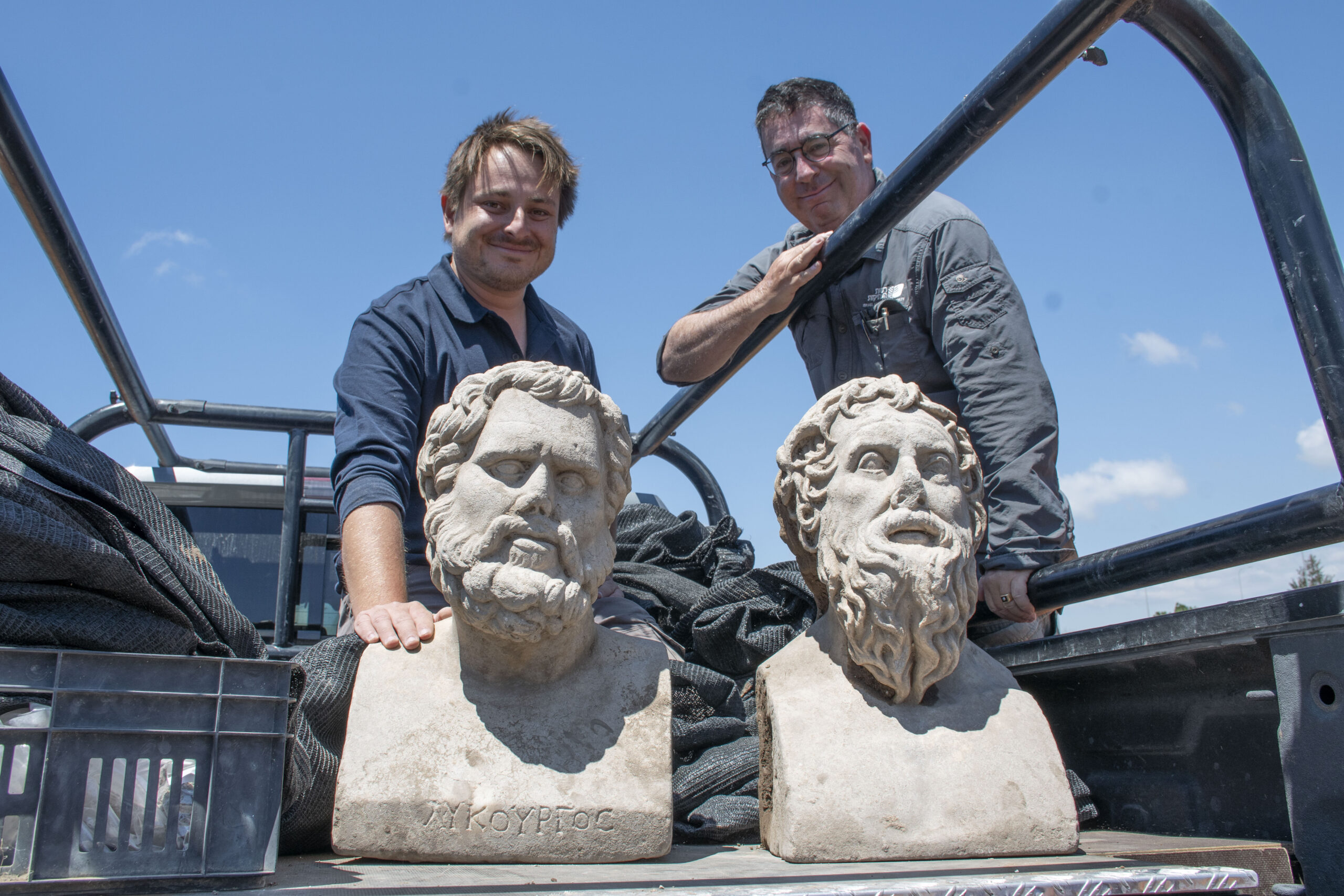
Workers laying the foundation for Israel’s new high-speed coastal railway near Binyamina did not expect to make history; they expected to move dirt. Instead, they uncovered it. Two magnificently preserved marble statues, approximately 1,700 years old, were unearthed during an Israel Antiquities Authority excavation conducted ahead of construction for the Ministry of Transportation and Israel Railways’ National Infrastructure Plan 65 — a project designed to cut travel time between Haifa and Tel Aviv to 30 minutes.
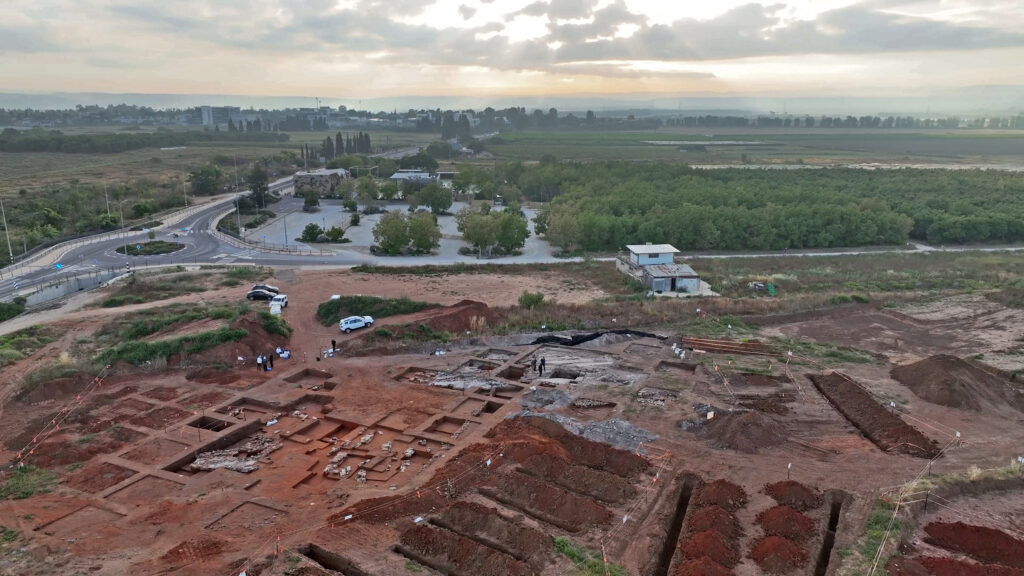
The Israel Antiquities Authority excavation at the entrance to Binyamina. Photo: Shatil Emmanuilov, Israel Antiquities Authority
What emerged from the ground was not rubble or scattered shards. They were protomot — sculpted human heads and upper torsos — depicting historical figures from the Greco-Roman world, buried face-down inside a Roman-Byzantine winepress pit, as though someone had deliberately laid them to rest.
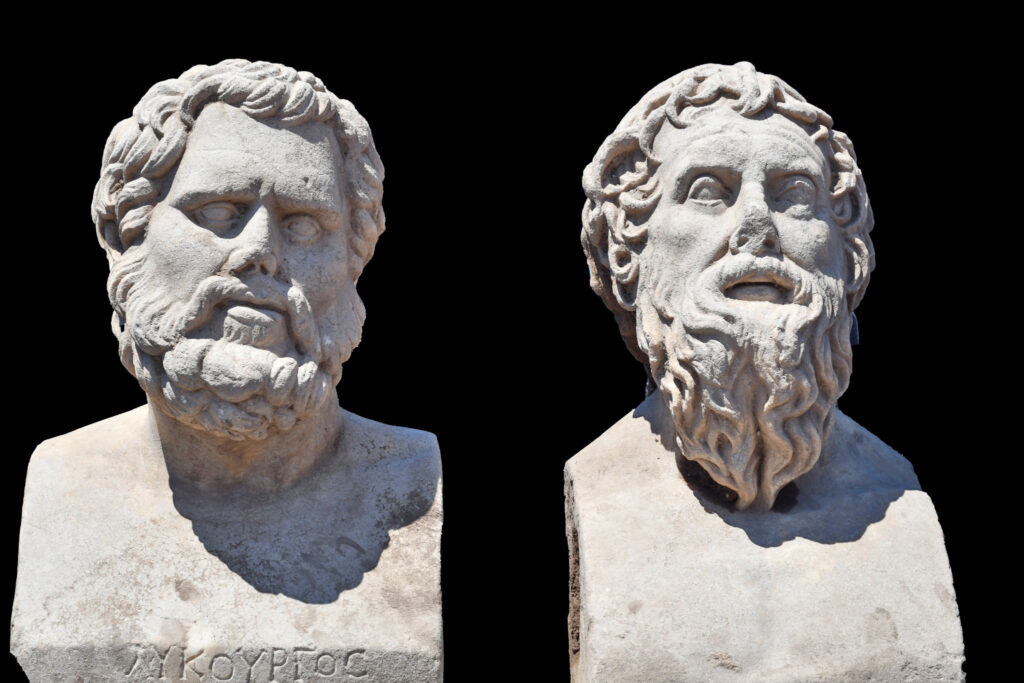
The Roman statues. They probably stood at the top of columns that decorated a building. Photo: Yoli Schwartz, Israel Antiquities Authority
“While digging the winepress, something was sticking out of the ground, and the workers called me,” said Michael Sorotskin, an archaeologist with the Israel Antiquities Authority. “There was a feeling that we were about to discover something that really shouldn’t be there. Suddenly, we saw that this was not the usual pottery — it was marble! Then, slowly, slowly, the two statues were revealed. I’m still struggling to find the right words. It is simply wondrous.”
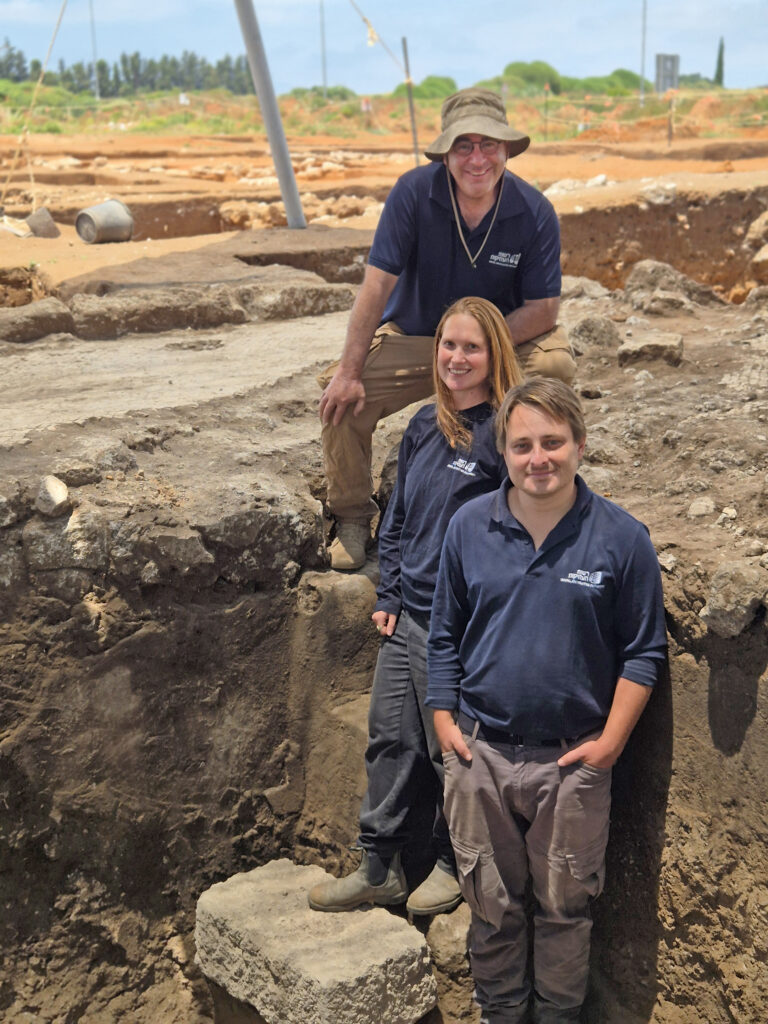
From top to bottom – archaeologists Eliran Oren, Avishag Reiss and Michael Sorotskin from the Israel Antiquities Authority. Photo: Nohar Shahar, Israel Antiquities Authority
One of the protomot bears a Greek inscription with the name “Lycurgus” — a name that carries considerable weight in the ancient world. Two prominent historical figures bore that name: Lycurgus of Sparta, the near-mythical lawgiver credited with forging Sparta’s legendary military culture, and Lycurgus of Athens, a celebrated 4th-century BCE statesman and orator. “Possibly this statue may prove to be of one of these two historical figures, but our research is just beginning,” said Dr. Peter Gendelman, a Caesarea region expert from the Israel Antiquities Authority.
The statues date to the Roman period, when the coastal region surrounding Caesarea — ancient Kesariya — was a thriving center of imperial power and elite culture. Herod the Great had built Caesarea into one of the most advanced port cities in the Roman world, and its legacy of wealth and cosmopolitan ambition continued for centuries. Statues of this type, called protomot in Hebrew, adorned public buildings and the private villas of the elite, serving as visual statements of cultural prestige and connection to the classical world. “During the Roman period, statues of this type were displayed both in public buildings and in the homes of the elite, who sought to connect themselves to the cultural and spiritual world of antiquity,” said Dr. Gendelman. “Not far from the discovery site, remains of a bathhouse were previously uncovered, and it is possible that the statues decorated a luxurious villa of a Caesarea resident.”
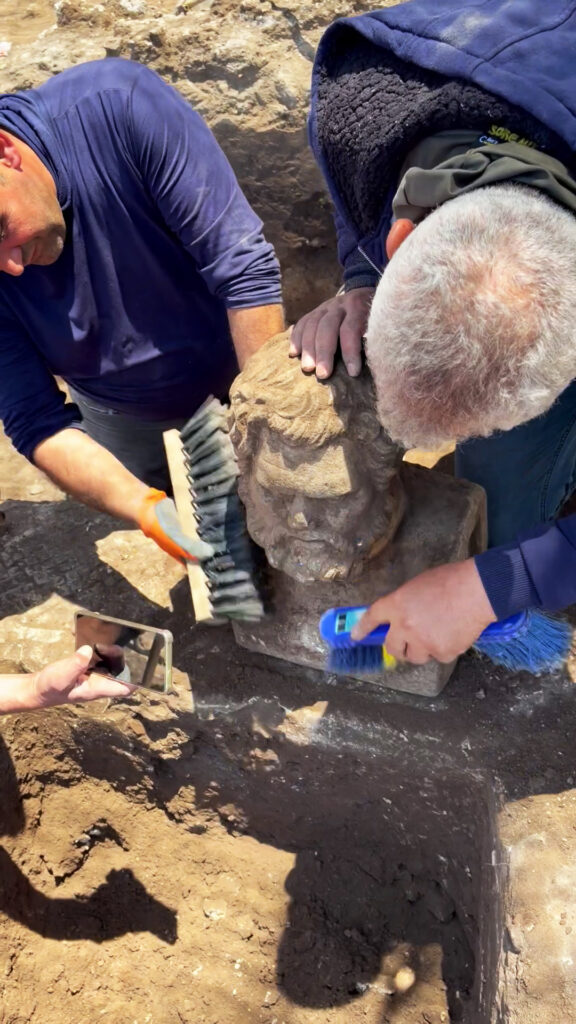
Cleaning a statue after its discovery. Photo: Eliran Oren, Israel Antiquities Authority
What makes the discovery stranger — and more dramatic — is where and how the statues were found. They were not discovered in the villa where they likely stood. They were buried, neatly, face-down, inside a wine-collection pit of a winepress that had fallen out of use. No one yet knows why. Excavation directors Eliran Oren and Avishag Reiss of the Israel Antiquities Authority described the mystery plainly: “It is not known why the statues were hidden here — perhaps to preserve them.” The last comparable portrait figure was discovered in the Caesarea area in the 1990s.
“This is a once-in-a-lifetime discovery,” said Oren and Reiss. “It was very unexpected, but somehow, the really big discoveries always turn up on the excavation’s very last day.”
The statues will make their public debut at the “Center VII – The Domestic House” archaeological conference on Thursday, June 18, at Tel Aviv’s MUZA – Eretz Israel Museum, organized in collaboration with the Israel Antiquities Authority, Tel Aviv University’s Sonia and Marco Nadler Institute of Archaeology, and Bar-Ilan University’s Martin (Szusz) Department of Land of Israel Studies and Archaeology. Attendance is free. Following the conference, the statues will remain on public display at the museum throughout the summer while scholars undertake cleaning, conservation, and the work of determining with certainty who these marble faces once honored — and why someone chose to hide them beneath the Israeli earth. Details here
