
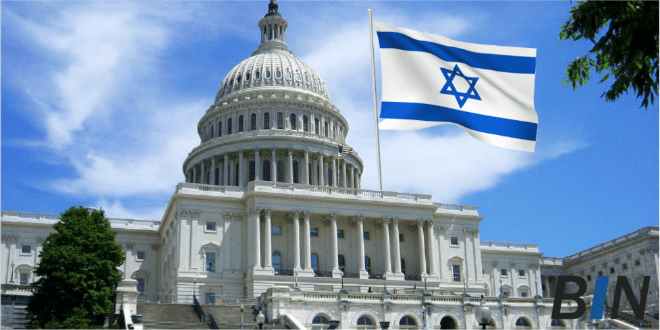
With Iranian-backed missiles still falling and Washington consumed by war decisions, dozens of members of Congress set aside partisan politics Wednesday to gather on Capitol Hill and celebrate Yom Yerushalayim — Jerusalem Day — the 59th anniversary of the city’s reunification under Israeli sovereignty. The message from the Cannon Caucus Room was unambiguous: Jerusalem is Israel’s eternal capital, and American support for the Jewish state is not contingent on election cycles or diplomatic convenience.
The Congressional Israel Allies Caucus hosted the annual event, co-chaired by Rep. Chris Smith (R-NJ), Rep. Brad Sherman (D-CA), Rep. Ronny Jackson (R-TX), and Rep. Brad Schneider (D-IL). Participants included members of Congress, Jewish and Christian leaders, and advocates of the US-Israel alliance. Senator Ted Cruz, White House Faith Office head Paula White, Special Envoy to Combat Anti-Semitism Leo Terrell, and Pastor Larry Huch addressed the gathering alongside a senior Israeli official.
“On Jerusalem Day, we join Israel in celebrating the 1967 restoration of its ancient capital city to Israeli sovereignty,” said Rep. Smith. “This was a great day for the Jewish people and for everyone who believes in the right of every nation to exercise its sovereignty within secure borders.”
The 1967 Six-Day War ended 19 years of Jordanian occupation of eastern Jerusalem, during which Jews were barred from the Western Wall and Jewish cemeteries were desecrated. Israel’s stunning military victory in six days — against Egypt, Syria, and Jordan simultaneously — restored Jewish access to the Old City and the Temple Mount for the first time since 1948. The reunification was not merely a military achievement; it was the fulfillment of millennia of Jewish longing.
The Bible makes the centrality of Jerusalem to the Jewish people impossible to mistake. “Im eshkachech Yerushalayim, tishkach yemini” — “If I forget you, O Jerusalem, let my right hand forget its skill.” (Psalms 137:5). The Sages teach that this verse was not written as poetry but as an oath — an unbreakable covenant between the Jewish people and their city that no foreign occupation, however long, could dissolve. Every generation that lost Jerusalem was commanded to remember it, and every generation that regained it was obligated to defend it.
The timing of this year’s celebration was impossible to ignore. With the war against Iran reignited and American military assets engaged across the region, Rep. August Pfluger (R-TX) told the gathering that he was praying for President Trump to resist pressure from what he called “a radical media” seeking to undermine the campaign. “This truly is a cause of righteousness,” Pfluger said, adding that history would judge Trump favorably for the decisions he has made.
Sen. Cruz was equally direct. Despite naysayers, he said, the president “has stood with resolve, and he has drawn red lines.” Cruz told attendees that when he and Trump spoke days earlier, he told the president plainly: “You are defending America. Understand America does not stand with Israel because we’re engaged in charity or because we’re helping out a neighbor who needs help. America stands with Israel because it is in the national security interest of the United States of America.”
Leo Terrell — a Baptist, a former liberal commentator, and now the chair of the Justice Department’s task force on Jew-hatred — delivered one of the event’s most striking testimonies. He traveled to Israel earlier this year to receive an award and met with Prime Minister Benjamin Netanyahu. “What left the deepest impression on me was not my meeting or a ceremony,” Terrell said. “It was Jerusalem itself.” Walking the streets and witnessing Jews, Christians, and Muslims praying freely at their respective holy sites, he said: “I witnessed people of different religions openly expressing their fundamental right to worship God according to their conscience. Jerusalem is not merely a political issue. It is a testament to what a free society looks like when it respects the rights of all believers.”
Rep. Randy Fine (R-FL) offered a pointed contrast. He described taking non-Jewish American Christians on a tour of Israel that included sites under Palestinian Authority control, including Bethlehem. “I thought they were going to tell me it was spiritually moving,” Fine said. “What all of them said is, ‘I wish Bethlehem was controlled by the Jews.’ They had been to so many places that were important for their own faith, for their own story, for their own religion, and they had seen how Israel had protected it for them. Then they went to a place just across a wall from Israel that used to be 90% Christian, and they did not feel safe.” Fine’s conclusion was direct: “It is not just our story. It’s not just our faith. It is the entire fate of Western civilization.”
The antisemitism spreading inside the United States cast a shadow over the celebration. Rep. David Schweikert (R-AZ) told attendees he has encountered more antisemitic harassment in the last six months than in his previous 16 years representing Scottsdale. He described being accosted at an event last weekend — his young children present — by a man “screaming at me, because apparently I’m a Jew-lover and I take money from Jews.” He said those incidents “are destroying our society,” and noted that Jewish groups in his district are increasingly withdrawing from public life.
The Israel Allies Foundation coordinates more than 1,600 legislators through 64 parliamentary caucuses worldwide in support of faith-based diplomacy and Israel. Jordanna McMillan, the foundation’s US director, said recognition of Jerusalem and the relocation of the American embassy to the city affirm “our shared Judeo-Christian values, commitment to religious freedom, and a strategic partnership that advances America’s interests in a more stable Middle East.”
Fifty-nine years after Israeli paratroopers reached the Western Wall and wept, Jerusalem stands. The soldiers who liberated it in 1967 did not know they were fulfilling a 2,000-year-old oath — but they were. The members of Congress who gathered Wednesday know what is at stake: not just a city, but the proposition that the Jewish people’s covenant with their homeland is real, recognized, and worth defending.