




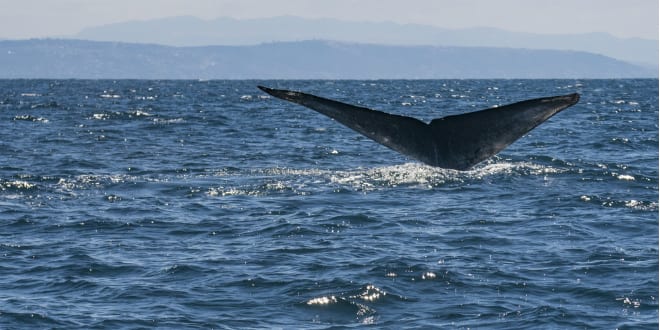
An Iranian missile alert forced a team of Israeli marine researchers to abandon their survey of the Mediterranean last Monday, just as they made one of the rarest sightings in a decade of deep-sea research: two sperm whales off the southern coast of Israel.
Researchers from the Morris Kahn Marine Research Station at the Charney School of Marine Sciences at Haifa University were conducting the 11th survey of the Deep Sea Cetacean Project, funded by the Energy Ministry. Their boat had set out from a sailing club in Ashdod on Sunday as part of a regional effort to gather data on marine life in the Mediterranean and the Black Sea — a six-day mission planned to reach 100 nautical miles (185 kilometers) offshore. The missile alert cut it short.
“Moments before we lifted the hydrophone from the water, around 35 kilometers west of Ashdod, at a depth of 700 meters, we suddenly heard familiar clicks,” said Aviad Scheinin, chief researcher of the project and head of the Apex Predators department at the Morris Kahn Marine Research Station. Following the acoustic signals, the team surfaced to find the two whales resting between deep dives. Yaly Mevorach, who leads the Deep Sea Cetacean Project and is researching sperm whales for her doctorate, described the animals as “healthy and beautiful” specimens that were actively hunting.
It was only the second visual sighting since the surveys began, and just the fifth time the whales had been detected at all, including by acoustic equipment. A Haifa University spokesman said the survey could yet be completed if the ceasefire between Iran and Israel, announced later that Monday, holds.
Sperm whales are among the rarest species in the Mediterranean. Only a few hundred are believed to inhabit those waters, genetically isolated from their Atlantic counterparts. They spend most of their lives at depths of 800 to 1,200 meters, hunting in total darkness, using sonar — emitting clicks and reading the returning echoes to navigate and locate prey. The first confirmed sighting in Israeli territorial waters since the Israel Marine Mammal Research and Assistance Center began its research in 1993 was recorded only in June 2020.
“The Israeli Mediterranean suffers from many human influences, a shortage of food, and a complex climate, so it is not easy for such species to survive in our region,” Mevorach said, adding that the team is mapping sperm whale distribution to provide data-driven recommendations to the Energy Ministry.
Thanks to the station’s ongoing monitoring, evidence is accumulating that sperm whales return to Israel’s deep waters for extended periods each year.
The sighting coincided with International Oceans Day.
For those immersed in prophetic tradition, the appearance of these great creatures in Israeli waters is not simply a marine biology story. The Prophet Ezekiel envisioned a transformed Land of Israel teeming with an extraordinary abundance of sea life:
“And it shall come to pass that fishers shall stand by it from En-gedi even unto En-eglaim; there shall be a place for the spreading of nets; their fish shall be after their kinds as the fish of the Great Sea exceeding many.” (Ezekiel 47:10)
The Tikunei Zohar (Tinyanya Tikkun 43), the esoteric work attributed to Rabbi Shimon bar Yochai in the first century CE, teaches that an increase of fish in these waters signals a specific stage of the Geulah — the redemptive process — in which Mashiach ben Yosef, the practical builder of the land, and Mashiach ben David, who ushers in the miraculous era including the building of the Temple, merge into a single unified unfolding. The period marked by the fish is described as one of hamtakat hadinim — a sweetening of divine judgments — symbolized by the fish’s mystical capacity to make seawater potable.
The Leviathan — referenced in Job 3:8, Psalm 74:13, Psalm 104:26, and Isaiah 27:1 — occupies a central place in this prophetic framework. While the modern Hebrew word livyatan simply means whale, the original Leviathan of Jewish tradition was a creature of fearsome mythological power. The Talmud (Baba Batra 75a) records that God originally created both a male and a female Leviathan, but fearing the destruction the species would bring if it multiplied, He slew the female and preserved her flesh for the banquet that will be given to the righteous at the arrival of the Mashiach — the feast to be held inside a great tent fashioned from the Leviathan’s skin.
This midrash (homiletic teaching) is the source of a blessing recited on the holiday of Sukkot (Feast of Tabernacles) upon leaving the sukkah (tabernacle): “May it be Your will, Lord our God and God of our forefathers, that just as I have fulfilled and dwelt in this sukkah, so may I merit in the coming year to dwell in the sukkah of the skin of Leviathan. Next year in Jerusalem.”
Two enormous mammals surfacing off Ashdod — in the middle of an Iranian missile alert, on International Oceans Day, during a period of escalating conflict and apocalyptic tension — may be exactly the sign the Tikunei Zohar described: the deep waters of Israel are coming alive, and the great banquet may be closer than anyone imagined.
