




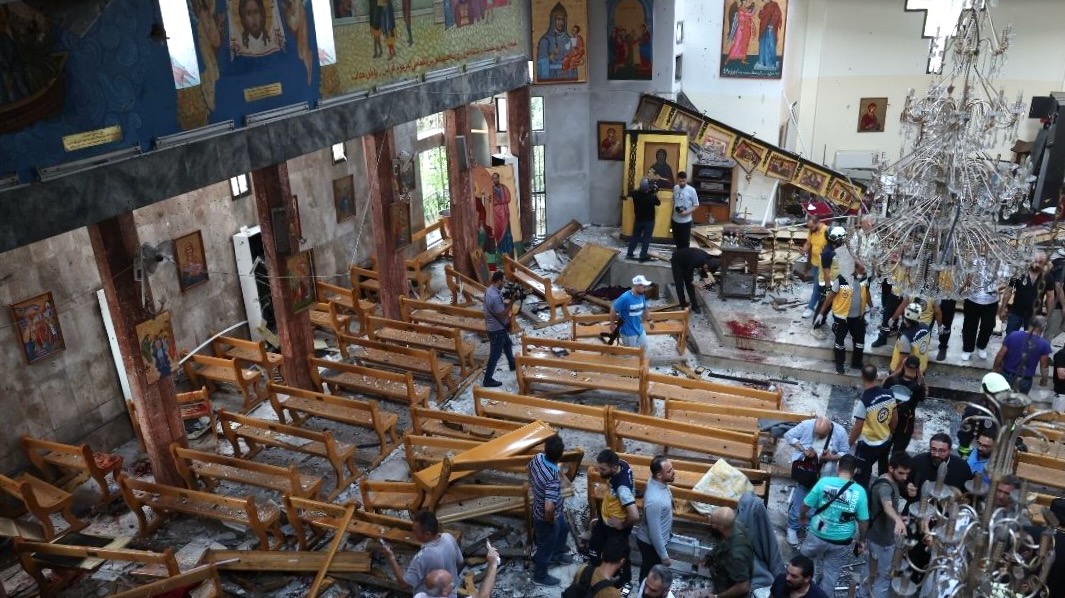
A “two-state solution” would endanger Israel, but it would also mark the end of Christianity in this part of the world, the region where Jesus was born.
When Iran launched ballistic missiles at Israel this week to punish Jerusalem for striking a Hezbollah command center in Beirut, most of the world’s media treated it as a story about missiles and military escalation. It is actually a story about something far larger: the systematic Islamist takeover of a region that was once home to flourishing Christian, Jewish, and pluralist civilizations and Israel’s role as the last line standing against that tide.
The nations now arrayed against Israel were not always what they are today. Within living memory, they were something else entirely.
Lebanon: The Paris on the Mediterranean
Until the 1970s, Beirut was rightly called the “Paris of the Middle East,” with Swiss banks, American and French universities, beaches at Jounieh, and wines competing with Bordeaux. After World War II, Lebanon was a wealthy country, a peaceful, multiethnic, multireligious nation under a Christian majority.
Lebanon was a majority-Christian country from the first century CE through the mid-20th century. When Lebanon gained independence from French rule in 1943, the Maronite Christian community held major political and social power, making Lebanon the only Christian-majority nation in the Middle East. The confessional power-sharing system enshrined this reality: a Maronite Christian as president, a Sunni prime minister, a Shia speaker of parliament.
Then came the demographic and military assault. Throughout the 20th century, Lebanon was deliberately used as a destination for refugees by neighboring Muslim-majority countries seeking to shift the religious balance. After the creation of Israel in 1948, the Palestinian exodus brought a large influx of predominantly Muslim refugees into Lebanon, a migration supported by regional powers with the intent of weakening Lebanon’s Christian majority. During the 1970s, both Jordan and Syria played roles in this process.
The 1975-1990 civil war was not primarily a religious war. It was a demographic referendum conducted at gunpoint. The Lebanese civil war began with shots fired at a Maronite church on April 13, 1975. Arafat’s Palestinian Arab terrorists turned Beirut into a military stronghold. Christians did not lose militarily because the Phalange held out to the end, but they lost politically and numerically.
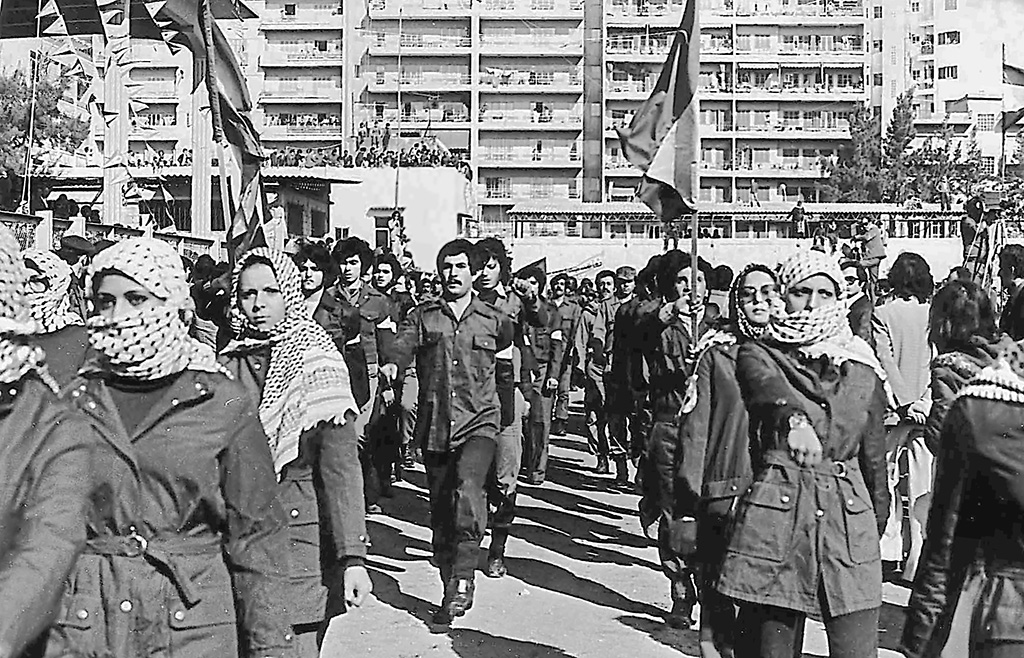
Then Iran moved in. Hezbollah, created and funded by the Islamic Revolutionary Guard Corps, finished what the civil war started. Today, Lebanon is 61.62% Muslim and only 38.22% Christian. Christians who can leave take the first plane to Montreal or Sydney.
Four out of every five Maronite Christians have left Lebanon. The country that was once a model of Christian-Arab pluralism is now a platform for Iranian missiles pointed at the Jewish state. Hezbollah does not govern Lebanon by popular mandate. It governs Lebanon by force, funded by Tehran, and the Lebanese government is powerless to stop it, as Lebanese President Joseph Aoun himself acknowledged this week when he told Iran directly: “It’s not your country, it’s our country.”
Egypt: The Oldest Christian Community in the World, Under Siege
Egypt was Christian before it was anything else. The Coptic Church traces its founding to St. Mark the Evangelist in the first century CE. The word Copt derives from the Greek Aigyptos, Egypt itself. The Copts are not a foreign minority in Egypt. They are the Egyptians, the direct descendants of the pharaonic civilization that predates Islam by more than 3,000 years.
Throughout Arab, Circassian, and Ottoman rule, the Coptic population was persecuted by its Muslim rulers. Churches were destroyed, books burnt, and elders imprisoned. By the time the British took Egypt in 1882, Copts had been reduced to one-tenth of the population, mainly as a result of centuries of forced conversion to Islam.
The 20th century brought no relief. When Arab nationalism rose under Gamal Abdel Nasser, Egypt was declared a Muslim country, and Copts were systematically pushed out of political and economic life. There are approximately 10 million Copts in Egypt — the largest Christian minority in the entire Middle East. While the everyday average Copt is not necessarily subjected to overt persecution, everyday forms of discrimination are common: only Muslims get hired for the best jobs. And attacks on churches, the kind of persecution that occurred centuries ago, are on the rise, unsurprisingly so, considering the overall Islamization of Egypt in recent decades.
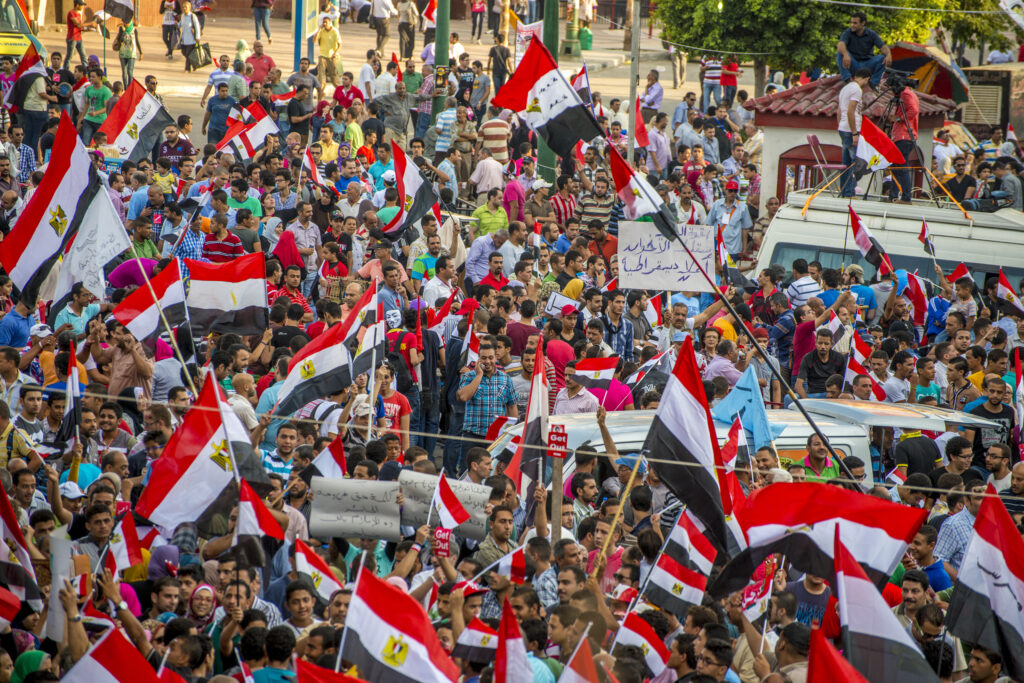
The Arab Spring of 2011 made everything worse. Persecution increased dramatically in 2011 during the Arab Spring, which popularized the long-suppressed Muslim Brotherhood. Many Christians in Egypt subsequently suffered at the hands of ISIS. When the military ousted Muslim Brotherhood President Mohammed Morsi in 2013, retaliation came swiftly against Christian churches and police stations across Egypt. When the smoke cleared, more than 40 churches had been damaged or destroyed, most in fiercely Islamist areas of southern Egypt.
The Muslim Brotherhood, the ideological parent of Hamas, was born in Egypt in 1928. Its explicit goal was and remains the restoration of the Islamic Caliphate and the imposition of Sharia law across the Arab world. Egypt suppressed it for decades, but it never went away. In the 2011 parliamentary elections following the fall of Mubarak, two Islamist parties ran and were the big winners. Three-quarters of the parliament belonged to Islamist movements. The Copts, who had been building civilization in the Nile Valley while the ancestors of the Muslim Brotherhood were still pagans, found themselves politically voiceless in their own ancestral homeland.
Syria: Islamists Inherit the Ruins
Syria was never a Christian-majority country like Lebanon, but it had a substantial and ancient Christian population, with communities going back to the first century CE, the very soil on which Paul of Tarsus was struck blind on the road to Damascus. Before the civil war, Syria was home to approximately 2.5 million Christians. Today, the Christian population has fallen to somewhere between 500,000 and one million, a reduction of up to 80 percent.
The Assad regime was secular and brutal. Christians, as a minority that needed the regime’s protection from Sunni Islamists, largely accommodated themselves to it. During the Syrian Civil War, many Syrian Christians in Damascus, Homs, and Aleppo preferred Assad’s government to rebel administrations because rebel groups were dominated by extremist factions such as al-Qaeda’s affiliate Hayat Tahrir al-Sham, the Islamic State, and the Syrian National Army, all of which committed atrocities against Christians in areas under their control.
When Assad fell in December 2024, those fears proved entirely justified. Syria’s transitional government and its security forces have been dominated by fighters from Hayat Tahrir al-Sham, a jihadist group that attacked Christians throughout the civil war, and whose leader, Ahmad al-Sharaa, was previously on the FBI’s Most Wanted List from 2013 through 2024 for his role in Sunni Islamist regional terror.
The Antiochian Patriarchate reported in September 2025 that “for days now in Syria there has been a systematic and unprecedented massacre of Christians, the killing of monks, the burning of monasteries, the looting and burning of entire Orthodox villages, while the authorities in Syria are doing nothing to prevent it.”
An al-Qaeda-affiliated organization now controls Damascus. This is not speculation; it is the documented reality on the ground, while the world’s diplomats speak politely of “transitional governance.”
Iran: The Most Instructive Collapse of All
Iran is the most instructive case, because the transformation was the sharpest, the fastest, the most deliberately engineered, and Iran is now the engine driving every other front in this war.
Before 1979, Iran under Shah Mohammad Reza Pahlavi was a functioning modern state with deep ties to the West and to Israel. Under the Shah’s rule, Iran’s economy and educational opportunities expanded. He pushed the country to adopt Western-oriented secular modernization, allowing cultural freedom. Women gained the right to vote in the mid-1960s, and the first female representatives were elected to parliament. Iran and Israel maintained quiet but substantive cooperation in intelligence, agriculture, and commerce.
Jews had lived in Iran for 2,700 years, since the Assyrian exile of 722 BCE. The Book of Esther is set in the Persian court. Cyrus the Great, king of Persia, issued the decree that sent the Jewish exiles home from Babylon and funded the rebuilding of the Beit HaMikdash (the Temple) in Jerusalem. The Jewish connection to Persia is written into the Bible itself.
Before the 1979 Islamic Revolution, Iran was home to more than 120,000 Jews. Today, that number has fallen to approximately 9,000, a decline of over 92%. One of the earliest signals of what was coming was the arrest, sham trial, and execution of Habib Elghanian, a prominent Jewish industrialist and community leader. Imprisoned shortly after the revolution, he was accused of “corruption” and ties to Israel. Following a swift, staged one-hour proceeding before a revolutionary court in which no defense was permitted, Elghanian was executed by firing squad in May 1979. He was one of 17 Iranian Jews executed as spies since the revolution.
Following the Twelve-Day War in June 2025 and repeated Iranian failures to strike Jewish targets in Europe, Tehran redirected its hostility toward its own Jewish citizens. More than 30 Iranian Jews were arrested on espionage charges, numerous Jewish leaders were interrogated, and members of the country’s small Jewish community were pressed to express public support for Khamenei and the regime.
Since 1979, the Islamic Republic has imposed a theocratic order subordinating all of Iran’s diverse communities to an extremist interpretation of Shiism. The Baha’i, Iran’s largest non-Muslim minority, have been subjected to mass arrests, property confiscation, and systematic erasure. Christians who proselytize face revolutionary courts. Sunni Muslims are second-class citizens in a Shia state. The Iran that launched missiles at Israel this week is not an ancient civilization defending itself. It is a 46-year-old revolutionary theocracy that has spent those 46 years dismantling everything that came before it.
Israel: The Exception That Proves the Rule
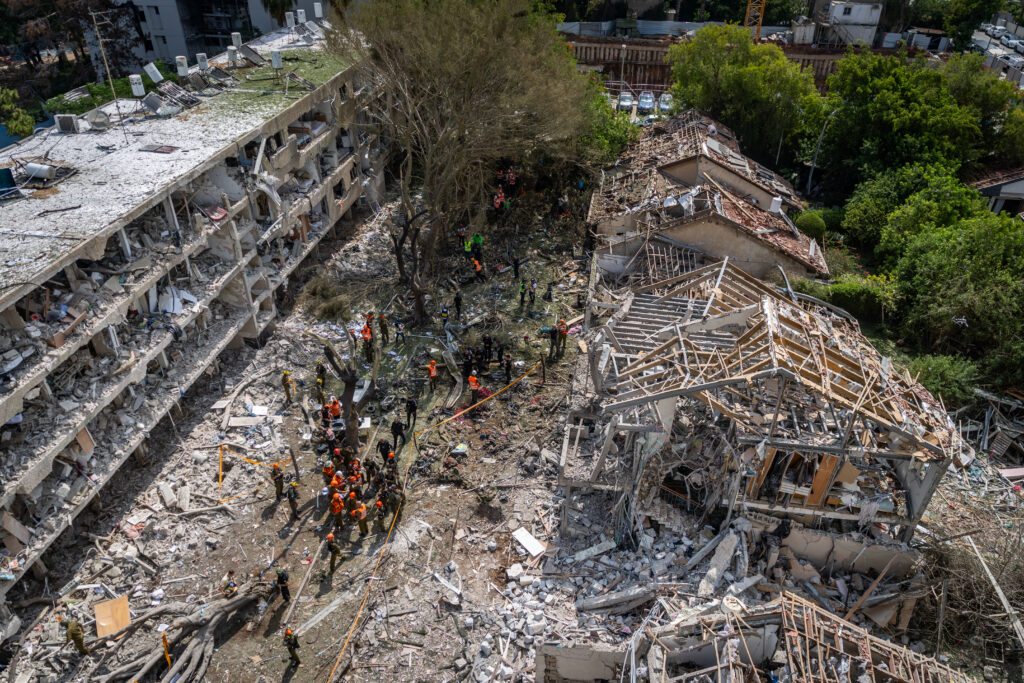
There is one country in the Middle East where the Christian population has not declined. Where Jews have not been expelled. Where the Druze serve in the army, where Bedouin are elected to the Knesset, where an Arab judge sits on the Supreme Court. That country is Israel.
In the last 50 years, Christian populations across the region have dropped significantly in every country except Israel.
This is not a coincidence. Israel is the only country in the Middle East governed by a non-Islamic framework that is indigenous to the region. It is not imported from the West, but rooted in the same land, the same Bible, and the same covenant (brit) that predates Islam by more than a thousand years. Israel does not merely coexist with religious minorities out of liberal tolerance. Israel’s foundational text, the Hebrew Bible, commands the protection of the ger (the stranger who dwells among you) with the same force it commands Shabbat.
The Contrast No One Talks About: Christians in Israel vs. Christians Under Palestinian Rule
The proof of Palestinian intent to eradicate Christianity was graphically illustrated when a Palestinian flag was displayed at a Christian event in Bethlehem in the early 1990s. It carried a message the visiting South African pastor almost certainly never saw coming — written in Arabic across its face was a declaration of murderous intent: “On Saturdays, we will murder the Jews. On Sundays, we will murder the Christians.” Nadia Matar, co-chair of the Sovereignty Movement, brought the flag to the Israel365 offices this week as a visual exhibit in an argument she believes the Western world can no longer afford to ignore.
For Matar, the flag’s inscription is not a relic of the past but a roadmap for the present. “People have to understand that the war here in Israel is not about Gaza,” she said. “It is not about the settlements. It is a war by the Islamo-fascists who have a clear plan — they want to first destroy and kill the ‘Saturday people,’ the Jews, and then go on to kill the ‘Sunday people,’ the Christians in Europe and America.” Her warning was direct: “They will come out and do October 7 to you — in London, in Brussels, in New York, in Florida. So be against a Palestinian state for the sake of Western civilization.”
The most telling evidence of what Israel represents comes from a direct comparison that the mainstream media systematically ignores. In Israel proper, the Christian population is growing. Israel’s Christians account for 1.9% of the country’s population and grew by 0.7% from 2023 to 2024, according to Israel’s Central Bureau of Statistics. Some 6,700 Christian students attended higher education institutions in 2024/25, representing 2.2% of all students, outperforming their share of the population. Church bells ring in Nazareth, Haifa, and Jerusalem. Christian Arabs sit in the Knesset. Arab Christian enlistment in the IDF has increased threefold in the past year alone.
These are the statistics of a community that has found a home.
Cross the line into Palestinian Authority-controlled territory, and the picture inverts completely. Violence and coercion have resulted in up to a 90% decline in the Christian population in areas under Hamas or Palestinian Authority control. In 1922, Christians constituted 11% of the population in those areas. Today, they are just 1%. In 1950, Bethlehem and the surrounding villages were 86% Christian. By 2017, Bethlehem’s Christian population had dwindled to 10%. Bethlehem, the city where, according to Christian tradition, Jesus was born, has been effectively emptied of its Christian population since the Palestinian Authority took control in 1994. The last census showed Bethlehem at 10% Christian families, with many leaving due to systemic discrimination, harassment of Christian clergy by Muslim Palestinians, and policies imposed by the Islam-dominated Palestinian Authority.
How a Palestinian State is a Lie That Threatens to Eradicate Christianity in This Part of the World
Gaza tells the same story in sharper relief. The Christian population in Gaza shrank from 5,000 before Hamas took over the area to only 1,000 by October 2023. Kamal Tarazi, a Christian who fled Gaza in 2007, described what Hamas rule meant in practice: “The moment they took control, they started persecuting us, ruining our churches, and forcing Christians to convert to Islam.” He added, “Do you know what a Hamas prison is? It is pure torture.”
A recent Jerusalem Center for Security and Foreign Affairs report found that Christians in the Palestinian Authority area fear reporting hate incidents against them for fear of arrest or worse. Christians in Bethlehem, the birthplace of Christianity itself, live in fear of their Muslim neighbors and their own governing authority, while Christians in Haifa and Nazareth serve in Israel’s military, study at its universities, and raise their children in safety.
This is not a coincidence of history. It is a direct consequence of governance. Israel, governed by the framework of the Hebrew Bible, which commands forty-six times that the stranger dwelling among the people of Israel must be treated justly, protects its minorities. The Palestinian Authority and Hamas, governed by an Islamist framework that classifies non-Muslims as dhimmis (second-class subjects) at best, drive them out. The numbers are not ambiguous. The only question is why the world refuses to read them.
For over four decades, the Middle East policy of Europe and the US has been based on an anti-Israel “land-for-peace” policy, which has failed. It is based on the Two-State Solution, which would create an unprecedented militarized Arab state inside Israel’s borders, one ethnically cleansed of Jews, with its capital in an exclusively Muslim Jerusalem. This would require a return to the ceasefire lines drawn up after the defensive 1967 Six-Day War that are considered to be indefensible against an Arab threat. The UN resolution violates the Oslo Accords, which require any resolution concerning Judea and Samaria to be the result of bilateral negotiations between Israel and the Palestinians. The two-state solution is based on the disastrous land-for-peace process, which inevitably leads to war.
The two-state argument always rested on the assumption that Palestinians wanted a state alongside Israel, not instead of it. That assumption has never been reliably true. According to an analysis by the Palestinian Center for Policy and Survey Research polling over multiple years, an average of 53% of Palestinians rejected the two-state outcome across the full period under review, with rejection peaking at 71% in March 2023, shortly before October 7. When West Bank Palestinians were asked to choose between territorial alternatives in a September 2025 survey, 28% backed a single Palestinian state from the Jordan River to the Mediterranean Sea, excluding Jews. A separate INSS survey from March 2025 found that 24% of the Israeli public supports a two-state solution, while 24% supports full annexation of the territories without granting Palestinian residents civil rights.
Advocates of the two-state solution in the West spent decades arguing that Palestinian rejection was the product of Israeli occupation, and that a generous offer would unlock a deal. The data does not support that argument. It never did.
Toward this end of the creation of a fictional Palestinian state, the United Nations Relief and Works Agency for Palestine Refugees in the Near East (UNRWA) was established in 1949 solely to “support the relief and human development of Palestinian refugees.” At the time of its establishment, UNRWA defined a Palestinian refugee as “persons whose regular place of residence was Palestine during the period 1 June 1946 to 15 May 1948, and who lost both home and means of livelihood as a result of the 1948 conflict.” This was later amended to include the 1967 refugees. Even later, this was amended to include the descendants of Palestine refugee males, including adopted children.
Palestinians are the only nationality for which refugee status is ancestral. It is important to note that the UNHCR definition states that if a person fleeing persecution has acquired citizenship or the rights of citizenship in a country in which they have sought refuge, they would not be eligible to receive refugee status. Under the UNHCR definition, almost all of the people served by UNRWA would lose their refugee status.
Iran fired missiles at Israel this week to defend Hezbollah. What it was really defending is a vision of the Middle East with no room for anyone who is not a Shia revolutionary, a Sunni jihadist, or a dhimmi, a second-class religious minority living by the sufferance of an Islamist state.
Israel is not just fighting for its own survival. It is the last remaining evidence that the Middle East was once something very different, and could be again.


