




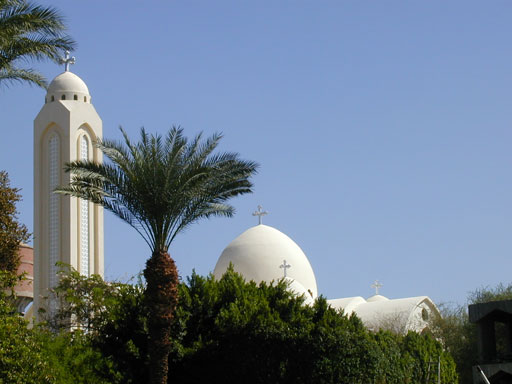
Egypt’s cabinet announced the legalization of 191 additional Christian churches and affiliated buildings following a May 19 cabinet meeting chaired by Prime Minister Mustafa Madbouli. The move brings the total number of church properties granted official legal recognition to 3,804 since the Egyptian government launched a formal review process in 2016 — a milestone that Christian leaders in Egypt have cautiously welcomed. But set against the full sweep of history, the number tells a story that is as sobering as it is encouraging.
Before the modern era’s bureaucratic machinery decided how many churches could legally exist in Egypt, that land was the heartland of a Christian civilization stretching back nearly two thousand years — and its slow, grinding reduction to a beleaguered 10 percent minority is one of the least-told stories of Islamic conquest.
Egypt’s Christian community — centered in the Coptic Church — traces its founding to the first century CE, when the apostle Mark established a congregation in Alexandria, which became one of the great centers of Christian thought in the ancient world. At the time of the Arab conquest in 640 CE, the majority of Egyptians were Christians. What followed was a systematic transformation driven not by persuasion but by legal and economic coercion.
The new Arab rulers classified Christians as dhimmis — a designation indicating a subordinate “protected” status that relegated them to second-class citizenship. Under Arab rule, Christians faced a stark choice: convert to Islam or pay the jizya, a heavy poll tax levied exclusively on non-Muslims. By 727 CE, approximately 24,000 Copts converted to Islam specifically to escape the jizya. It was demographic engineering through taxation.
Throughout the various Arab dynasties, the Coptic population faced discrimination ranging from steep tax increases to outright massacres. Churches were destroyed, books burned, and elders imprisoned. As the native population converted to Islam to escape dhimmi status, the very word “Copt” came to refer specifically to those Egyptians who had not converted.
Under Mamluk rule from the 13th through 15th centuries, the situation reached a deadly combination of state repression and mob violence. Egyptian Christians, who had been an overwhelming majority in the seventh century, now make up only 10 percent of the population. That collapse is not the result of emigration or natural demographic change. It is the measurable consequence of fourteen centuries of sustained pressure.
The modern period has brought its own chapters. Under President Sadat, Salafi groups such as the Muslim Brotherhood were deliberately empowered to dominate public space, enabling them to preach against Christians openly in mosques and on the streets. When the Muslim Brotherhood briefly held power under Mohamed Morsi from 2012 to 2013, over 40 Christian churches across Egypt were gutted by arson and looted — some over a thousand years old and irreplaceable.
Against that backdrop, the current Egyptian government under President Abdel Fattah el-Sisi represents a genuine, if incomplete, departure. The 2016 Church Construction Law (Law No. 80) transferred authority to approve church construction and renovation from security agencies to provincial governors — a structural change that opened the formal legalization process now producing these rolling batches of approvals. The Rev. Khalaf Barakat, president of the General Evangelical Baptist Assembly in Egypt, acknowledged the shift directly. “Baptist churches, like many others, have benefited from these measures, while some churches are still awaiting the completion of the legalization process according to the schedules and mechanisms agreed upon by the state,” he told Christian Daily International. “We appreciate the spirit of cooperation shown by the relevant authorities in dealing with this matter over the past years.”
The Egyptian Parliament is simultaneously considering two historic bills — a Personal Status Law for Muslims and a separate Personal Status Law for Egyptian Christians — that would, for the first time, establish a unified written legal code governing Christian family life, covering marriage, divorce, child custody, and inheritance. Crucially, the draft law for Christians would grant men and women equal inheritance rights. Under the current framework, Islamic inheritance rules apply to Christians, meaning a man receives double the share of a woman.
Yet the structural problems remain. Egyptian blasphemy law — Article 98(f) of the Penal Code — has been applied disproportionately against Christians and those expressing minority religious views. Conversion from Islam to Christianity cannot be officially recognized. There are 211 documented lawsuits from Egyptians who converted from Islam back to Christianity and cannot change the religion listed on their identity cards. Christians remain dramatically underrepresented in government: of Egypt’s 27 appointed provincial governors, only one is Christian. No Christian leads any of the country’s 27 public universities.
Lizzie Francis Brink, legal counsel for Alliance Defending Freedom International, put it plainly: “Among the persecuted are Egypt’s Christians, who live in a land of ancient wonders and rich history — yet face daily discrimination, harsh restrictions, and constant pressure to hide their faith.”
More than 5,400 church legalization applications have been submitted since 2016. With 3,804 now approved, hundreds of congregations are still waiting. And tens of thousands of church buildings across Egypt have not even entered the process.
The legalization of 191 more churches is real progress. But in a country where a majority-Christian civilization was reduced to a persecuted minority through coercion, taxation, and violence across fourteen centuries, progress measured in government committee approvals is a long way from justice.
The move is reason for cautius optimism for the beleaguered population of Jews. Egypt has roughly a dozen synagogues remaining, but most are in severe disrepair — part of the roof of a synagogue in Alexandria caved in — and they function essentially as empty monuments rather than active houses of worship. As of October 2024, only one synagogue in Cairo — Sha’ar Hashamayim — was still actively functioning.
The reason there are almost no worshippers to fill them is equally stark. There were between 80,000 and 120,000 Jews in Egypt up until the mid-20th century, with an impact on trade and culture far exceeding their numbers. But the 1948 Arab-Israeli war began the community’s disintegration, and Nasser’s regime forced out much of what remained. In the late 1950s, Egypt began expelling its Jewish population and sequestering Jewish-owned property. By 2022, only three Jews remained in Cairo.
Cairo’s old Jewish quarter once had 12 thriving synagogues during what historians call the golden age of Cairene Jewry at the turn of the 20th century. Today only two of those remain.
So to put it in direct comparison to the article we just wrote: Egypt is slowly legalizing thousands of Christian churches for a community of roughly 11 million people. For Jews, there is almost no community left to need a synagogue — the expulsion is already complete. The buildings are there. The people are not.

