

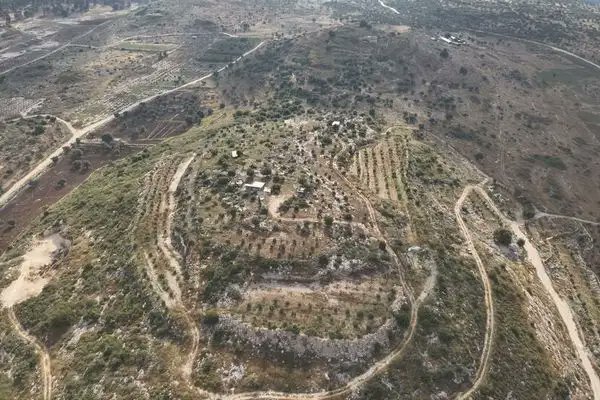
The heavy machinery arrived quietly. No archaeologist supervised. No permits were filed. And now, at Khirbet Farsin — an ancient site in northern Samaria containing a mikveh (ritual bath), burial caves, and underground passages dating to the Second Temple period — four adjacent plots of Jewish heritage have been plowed, fenced, and transformed into Palestinian agricultural land. The Israeli NGO Regavim has sent an urgent letter to enforcement authorities demanding they stop what it calls an accelerating takeover of state lands that also happens to be one of the most historically significant Jewish sites in the region.
The site preserves both the biblical name Peresh — from the descendants of Menashe — and the Talmudic name Kfar Parshai. It sits less than a kilometer from the Jewish community of Hermesh. Aerial photographs compiled by Regavim show land clearing, and road construction began in 2021 but has intensified sharply over the past two years. The question this raises is not merely legal or archaeological. It is existential: A people severed from the physical evidence of their past is a people who can be told they were never there. The Palestinian Authority is not merely building roads. It is erasing Bblical history one bulldozer at a time.
🚨 INSANITY: A 2,000-year-old religious heritage site is being erased before our eyes.
— Regavim (@RegavimEng) June 2, 2026
At Khirbet Farsin, an ancient Second Temple/Talmudic-era village in northern Samaria, illegal PA-backed agricultural takeover is destroying antiquities, flattening state land, and burying… pic.twitter.com/QkmY7bqhXo
Yossi Dagan, Chairman of the Samaria Regional Council, described Khirbet Farsin as “a site of extraordinary historical and archaeological importance,” adding: “An open history book is being erased. The authorities must overturn the table.”
Regavim’s data identifies approximately 6,000 sites of historical and archaeological importance in Judea and Samaria recognized by the scientific community, of which roughly 2,300 have been officially declared protected. That leaves about 3,700 sites without legal protection. A comprehensive survey found that 80% of the important archaeological sites in Judea and Samaria had been damaged, with half in immediate danger of total eradication. A separate survey by Palestinian archaeologists in 2024 found evidence of looting at 309 of 440 sites examined. Of all the destruction, 90% is being carried out by the Palestinian Authority for development purposes.
Roi Drucker, Regavim’s Judea and Samaria District Manager, said the Khirbet Farsin case is not an isolated incident: “We are witnessing a widespread and destructive phenomenon of wild trampling over historical heritage sites in Judea and Samaria. Enforcement authorities must act immediately.”
The pattern is documented. At Sebastia — the ancient city of Shomron, capital of the biblical northern Kingdom of Israel — Palestinian Authority workers brought in heavy machinery and paved a road through the archaeological site, destroying a Herodian-period wall and exposing Second Temple burial caves. Someone subsequently threw pig carcasses into the tombs, apparently to defile them and drive out Israeli archaeologists. At Mount Ebal, where Joshua built an altar to God upon entering the land (Yehoshua 8:30), Palestinian road construction destroyed sections of a 3,200-year-old defensive wall — the same site where archaeologist Scott Stripling recently uncovered what researchers believe is the oldest Hebrew inscription ever found in the Land of Israel. At Beit Fajar, in 2022, a Palestinian Authority quarrying operation dug a 1,500-dunam pit directly through a section of Solomon’s Pools aqueduct, destroying approximately 2,000 meters of the ancient water system. The government of Israel did nothing to stop it.
The Knesset is now racing to respond. On May 12, the Knesset passed in its first reading the Judea and Samaria Heritage Authority Bill, sponsored by Likud MK Amit Halevi, which would replace the Defense Ministry’s Archaeology Unit under COGAT with a new civilian Israeli body reporting directly to the Heritage Ministry. With Knesset dissolution proceedings expected imminently, the Education, Culture and Sports Committee convened three consecutive days last week to push the bill through its second and third readings before the window closes.
Critics call the bill de facto annexation — the first time the Knesset would exercise direct civilian authority, including land expropriation powers, in areas where Israel currently functions under military administration. Halevi makes no effort to conceal the ideological stakes: “The fact that we approach this as if Israel was occupying its own land — and the whole application of international treaties, as if they are relevant to the Jewish people in Sebastia or the Cave of the Patriarchs — is unacceptable.”
At Khirbet Farsin, a mikveh carved by Jewish hands two thousand years ago sits beneath plowed earth, surrounded by new fencing, waiting for someone to enforce the law. Whether Israel’s government responds — or once again does nothing — will say everything about whether this generation understands what is actually at stake.