



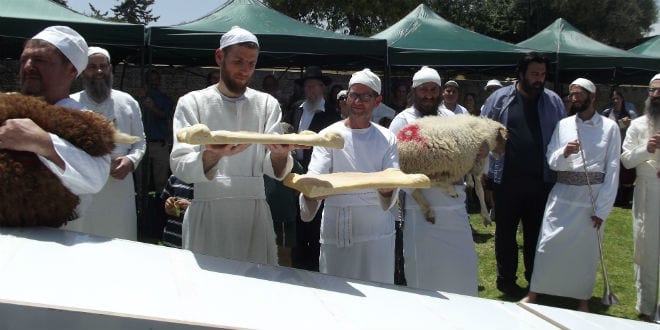
Israeli police arrested 13 people Friday after they broke through security barriers and forced their way onto the Temple Mount in Jerusalem’s Old City, attempting to perform the Biblically mandated grain offering to mark the festival of Shavuot. The arrests came hours before the holiday began at sundown, and initial reports misidentified the ritual items as preparation for an animal sacrifice. What the group actually carried onto the holy site were two loaves of bread.
The suspects breached security and ran into the compound in an attempt to perform the ritual before being stopped by authorities, police said. No animals were present. According to the Ynet news site, the group brought loaves of chametz — leavened bread — made from freshly harvested wheat, the centerpiece of the Shavuot grain offering.
13 נאמני הר הבית הצליחו לפרוץ לתוך מתחם הר הבית, מתוך מחסום משטרתי. זו לא פעם הראשונה בשבועות האחרונים שהם מצליחים להיכנס להר הבית בניסיון לבצע קורבן. אבל זה בהחלט פעמים ראשונות בתקופת מפקד המחוז הנוכחי שזה קורה פעמיים ובטח ובטח בתקופה מתירנית של השר הנוכחי. pic.twitter.com/A2dgXJwpuK
— Yossi Eli (@Yossi_eli) May 22, 2026
The Two Loaves of Shavuot
Shavuot, meaning “Weeks,” marks the culmination of the 49-day Sefirat HaOmer — the counting of the Omer — that begins on the second night of Passover. It is both an agricultural festival celebrating the wheat harvest and the commemoration of the giving of the Torah at Mount Sinai. At the heart of the Temple service for this day is the Shtei HaLechem — the Two Loaves — a unique offering of two loaves of leavened bread baked from the newly harvested wheat and waved before God by the Kohanim (priests). It is the only occasion in the Temple service when leavened bread was offered on the altar.
The Bible commands explicitly: “You shall bring from your dwelling places two loaves of bread to be waved, made of two tenths of an ephah; they shall be of fine flour, they shall be baked leavened, as first fruits to the Lord.” (Leviticus 23:17)
Jews are required to perform the Temple service as described in the Torah; it may only be performed on the Temple Mount in Jerusalem, even in the absence of an actual Temple structure.
Shavuot is also referred to as Chag Habikurim (holiday of first fruits) in Numbers since it was the beginning of the period in which the bikurim (first fruits) were brought to Jerusalem.
The large loaves were specially shaped, rectangular, with four mini towers at each corner of the loaf.
All of the other grain offerings brought in the Temple were flat, pan bread, usually fried in oil. Even the Show Bread that was always present in the Temple, despite being quite large, was essentially matzah, unleavened bread.
A Law That Exists on Paper
Israel’s Protection of Holy Sites Law, enacted in 1967 following the reunification of Jerusalem, mandates freedom of access and religious practice at holy sites for all religious communities. On paper, it applies equally to Jews, Christians, Muslims, and all others.
In practice, the reality on the Temple Mount tells a different story. Under the status quo arrangement — a set of unwritten rules governing the site that successive Israeli governments have upheld under Jordanian Waqf administration — non-Muslims, including Christians, face strict limitations. Jewish and Christian visitors are permitted entry only during limited daytime hours. They are prohibited from praying audibly, bowing, or making any visible act of worship. They may not bring prayer books, a tallit (prayer shawl), tefillin (phylacteries), Torah scrolls, or shofarot (ram’s horns) onto the mount. Anyone who appears to be praying can be immediately removed by Israeli police, who enforce Waqf rules on Judaism’s holiest site.
National Security Minister Itamar Ben Gvir, who has made repeated visits to the Temple Mount, has publicly called for lifting the ban on Jewish prayer there. His visits have triggered strong reactions from Jordan, the Palestinian Authority, and Muslim governments across the region. Prime Minister Benjamin Netanyahu has repeatedly denied that the status quo has changed.
What the Sages Said
The Sages taught that the Temple Mount is the Even HaShetiyah — the Foundation Stone — the point from which, according to Jewish tradition, the world was created. The longing to restore the Temple service is written into the three-times-daily Jewish prayer, the Passover Seder, and every major Jewish holiday — including Shavuot. This is emphasized by Jews facing the Temple Mount when they pray. The 13 people arrested Friday were Jews trying to fulfill a biblical commandment at the place the Bible designates for it — and they were stopped by the government of the Jewish state.
The Temple Mount is Judaism’s holiest site, and it is in Israel’s capital city. Jewish rituals at the site are explicitly described in the Bible, and the Jews carried them out in the two temples for a total of more than 800 years. But for some inexplicable reason, after Israel conquered Judaism’s holiest site in the 1967 Six-Day War, control of the site was turned over to the Jordanian Muslim Waqf, and despite the law requiring Jews to have freedom of worship, the Israeli police remove any Jew who tries to exercise that right. That is the status quo that Israeli governments across the political spectrum have maintained for 58 years.
The two loaves of bread never made it to the altar. The men who carried them are in police custody. And the Mount stands as it has stood — without a Temple, without a service, and without the Shtei HaLechem ascending before God on Shavuot.
